Home › Volumes › American Animals › Wolves and Foxes
Red Fox
Also called: Cross Fox, Silver Fox, Black Fox.
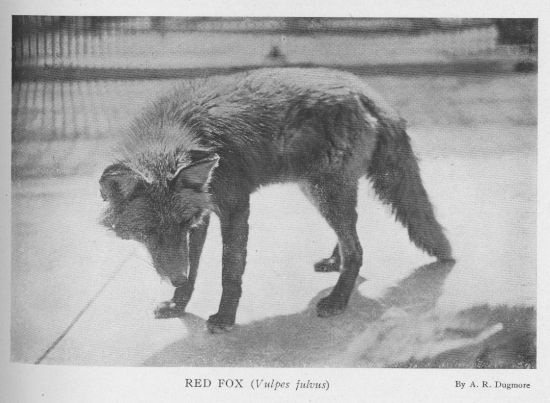
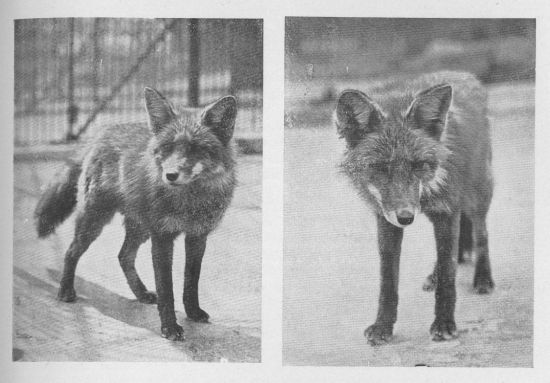
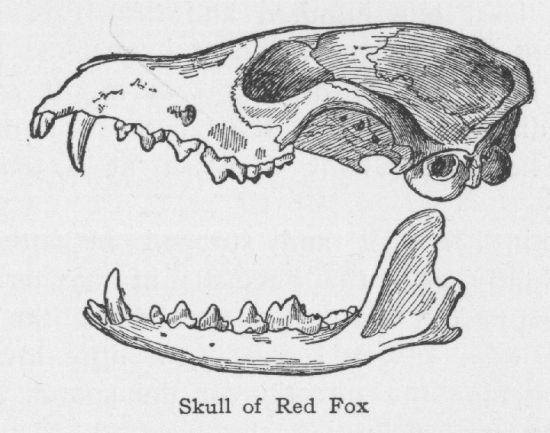
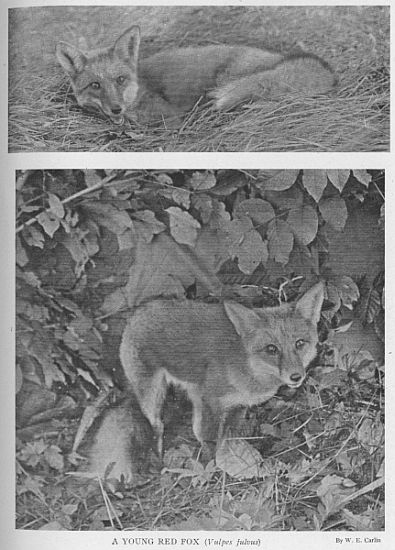
Length.—40 inches.
Description.—Fulvous or rusty red, grayish on the rump and flanks; hairs of the tail black toward the end, tip of tail whitish; legs black, partly white on the inside; throat white; ears largely tipped with black. Considerable variation occurs in the colouration of the red fox, especially in the northern part of his range. One phase similar to the above, but with a black band across the shoulders and another along the back, is known as the "cross fox," while the "silver fox" is a gray phase and the "black fox" a black phase of the same animal.
Range.—Northern North America south to Georgia. Replaced in Nova Scotia and Newfoundland by slightly different varieties.
Range.—Nova Scotia.
Range.—Newfoundland.
The reputation for shrewdness and cunning which the fox has always borne is well-earned and indisputable. One of the most characteristic traits of the whole fox tribe is the quickness with which they gather experience and learn to avoid new dangers. The early settlers found little difficulty in trapping and shooting the foxes which skulked about their clearings, and even now those found in wild, unsettled country are comparatively easy to outwit. But the red fox of cultivated districts has learned a great deal from watching the ways of men, and has already very nearly caught up with Reynard of the Old World in the matter of a highly developed intellect.
He now holds his own against man, as much by boldness and audacity as by caution; few of our wild animals look on man with so little awe.
Only last winter I saw two sturdy fox-hunters hurrying through the snow, eager to head off a fox, which, judging from their remarks which I overheard, they imagined would cross the stream at a point a mile ahead.
And all the time there was the fox they were after coolly following in their footsteps at a safe distance, while the hounds, baffled and outwitted, bayed dolefully in the woods somewhere on the other side of the stream.
This trick of following the hunter is not in the least uncommon. I have frequently, when returning in my own tracks from a tramp on snow-shoes, found the fresh trail of a fox who had been following me.
But you will seldom catch him at it; the instant you stop he slips behind a tree, and if you turn back, vanishes in the shadow of the forests.
I once saw my father driving home the cows on a summer evening with an old fox, of whose presence he was totally unaware, trotting along the sunlit sheep-path scarcely one hundred steps behind him.
The fox's boldness in robbing hen-roosts is well known; and as most foxes know too much to visit the same place twice, it is only rarely that they get caught at it.
I know of one instance when an enthusiastic fox hunter, arriving at daybreak in order to have an early start with the hounds, heard a disturbance in his hen-pen, and looking in to see what was the trouble, met a fox just coming out.
The fox slipped by him and dashed away for the woods; and the hunter, thinking that this certainly was a good beginning for a day's sport, put his dogs on the trail, confident of getting at least one new pelt that day. But all day the fox eluded them, and when at nightfall they came home unsuccessful, beneath darkening skys, they were undoubtedly every bit as weary as the fox they had been chasing. One bright windy Sunday in February, a few years ago, a farmer of my acquaintance happening to look out of the window saw a fox stretching himself to his full height on two legs in order to look through a crack into the hen-house. The farmer seized his gun, and running to the door let fly both barrels, but before the shot could reach him, the fox had dodged behind a corner of the building, and keeping it between himself and the aiming, was quickly out of range.
But the fox likes best to catch chickens in summer, when the corn-fields, orchards and hedgerows furnish him safe ambush and effectually cover his retreat. One hot morning last summer a fox chased some hens up across the new-mown grass land to within one hundred feet of the open door where we were standing, and catching the hindermost one, threw her across his shoulders and started for the woods. I caught up a rifle with one hand and shot-gun with the other, and thus thoroughly equipped hurried to the rescue.
I was too late to save the unfortunate hen, however; the fox stopped when he reached the lower end of the field, and stretching himself in the warm grass, held her down with his paws, biting her tentatively to make sure she was dead. I made a slight detour and crawled cautiously to the top of the nearest knoll, but even then the fox was much too far away for the shot-gun to reach him; so, resting on my elbow, I attempted to get his range with the rifle, but only succeeded in throwing some dust in his eyes, and away he went like an arrow.