Home › Volumes › American Animals › Weasels, Otters, Etc.
Otter
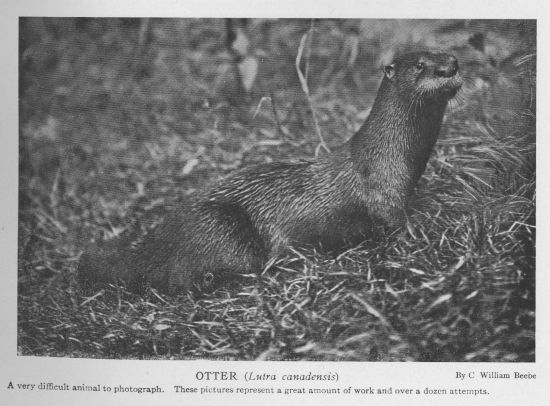
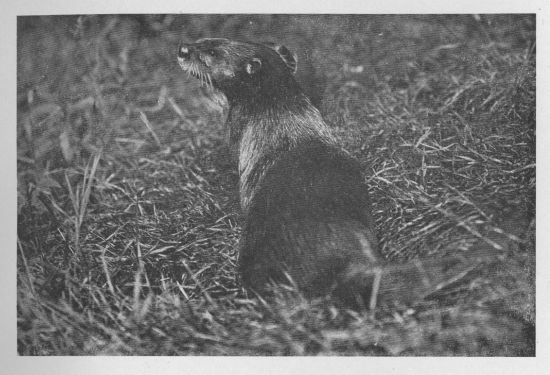
Length.—3 feet 6 inches to 4 feet.
Description.—Body long and somewhat flattened, feet short, toes webbed, tail very broad and flat at the base, not abruptly constricted where it joins the body. Colour uniform seal-brown, brighter beneath, size variable, males generally larger.
Range.—Northern North America, south to Central New York and Pennsylvania, replaced southward and in Newfoundland by closely allied varieties.
The otter has followed a fisherman’s life so persistently that he has grown to look very much like a seal. I never see one swimming under water, or with just its head above the surface, without being struck by the resemblance.
The head and neck in particular, whether seen in profile or as the animal faces you, are remarkably seal-like. Even when the otter is splashing about in the shallow ripples, or climbs out on the bank or some half-sunken log, his shape is still seen to be more like that of a seal than a land animal. His short legs are hardly to be distinguished at a little distance, while his heavy short-haired tail is almost as thick at its base as the rest of his body and tapers away fish-like to a point. The sea otter of the North Pacific being nearly as much of a marine animal as is the seal itself, shows the transformation to a perfectly fish-like shape still further advanced. Even the common otter of our fresh waters swims out form the river’s mouth into the sea at times, and has more than once been caught in nets sunk deep in the ocean; undoubtedly the transition is still going on and the otters born a few thousand years hence will look even more like seals than do those of the present day.
Yet though their legs are short and their bodies so long and heavy as almost to drag along the ground and leave a deep furrow in the snow whenever the otters go about on land in the winter time, they yet make regular journeys overland from one stream or pond to the next. They even essay to go hunting in the woods and thickets occasionally when fishing proves unproductive.
I have never found much evidence, however, that they are often very successful at such times, though their great strength and suppleness would easily enable them to kill deer or sheep.
When traveling overland otters follow the smoothest course they can find, going round stumps and hummocks and beneath logs in preference to climbing over them.
Following the same course week after week, often in families of four or five together, they soon establish a distinct path clear of obstacles; crooked and tortuous yet keeping to the same general direction, and in most cases leading to some rapid or springhole beneath the bank where the water seldom freezes.
Otters are beautiful swimmers; they glide and shoot along through the water, twisting and turning like the fish they so delight in chasing. I have seen one pursuing a muskrat, as a pickerel pursues a shiner, splashing through the shallow water where the steam had overflowed its banks. At times both would be invisible beneath the surface for several minutes, to appear again perhaps out in the current at a distance, the muskrat always diving and dodging for its life.
Otters will also catch wild ducks on the water, raising and seizing them from beneath. They catch their fish by fairly swimming them down in spite of all their twisting and darting. Where fish are reasonably abundant an otter can in this manner easily catch ten times as many as he can eat, and at such times is apt to satisfy himself with just tasting a mouthful from each, preferring the flaky meat just back of the head. Otters are also excellent judges of the different kinds of fish, agreeing with us in choosing trout, salmon and eels from among those that live in the rivers. Like seals, they are affectionate and genial, fond of each other, and, when trained, exhibiting a dog-like devotion to their masters. The old ones take the most solicitous care of the offspring and defend them against all comers; a dog that discovers an otter’s den and imprudently attempts to dig it out is more than likely never to return to his master.
When the young otters are large enough, their mothers take them into the water for their first swimming lesson. It is said that at first they are mortally afraid of the water and have to be carried into it by force.
I have never had any opportunities of observing them at that age, but as late as September, when the young ones were as big as cats, I have seen one climb on its mother’s shoulders, as if tired, and ride there as she swam against the current. They were hardly a dozen yards away, and when she saw me the old one dived, taking the youngster down with her. A few moments later they came up again side by side, with their heads close together, and a very attractive picture they made, bobbing up and down among the pickerel weed, watching me intently; from time to time the old one would lift her head nearly a foot out of the water, as if to see me more distinctly.