Home › Volumes › American Animals › Rats, Mice and Lemmings
Norway Rat
Also called: Common Rat, Brown Rat.
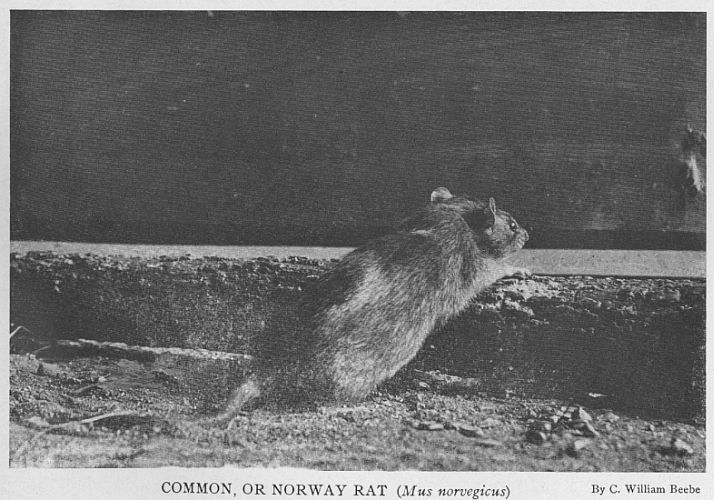
- Length
- 18 inches.
- Description
- Heavily built with thick head and moderate ears, tail medium, always shorter than the head and body.
- Range
- Cosmopolitan. Introduced into America from Europe.
Colour yellowish-brown thickly interspersed with long black hairs, grayer on the sides and grayish-white below, feet whitish. Tail very sparsely haired with the scales very conspicuous, ears dull brown. Young dull gray with no brown tints.
In many ways mice are our benefactors in a degree not often suspected, perhaps even enough to offset much of the trouble they cause by stealing.
With rats it seems to be different. These troublesome brutes may be useful in a way as scavengers, but the good that they do in this way or in any other, is constantly overshadowed by the damage wrought by them in hundred ways, and they are probably as little beloved by man as any beast that lives.
They appear to be on an entirely different scale from mice. It is not altogether a matter of size, a brown rat reduced to a mouse's dimensions would still be coarse and rough and unattractive.
They copy in a general way the colour and proportions of a mouse, because the lives of the two are really very much alike; living as they do in the character of humble dependents on man's production, in obscure out-of-the-way corners, where a dust-coloured coat has proved most useful.
But the fur of a full-grown rat is at all seasons harsh and lifeless; the expression of its eyes is apt to be dull and hateful, in fact, there is hardly an attractive feature that rats may be said to possess.
It would be useless to deny that rats are extremely intelligent, and careful witnesses have always given them credit for looking after any helpless member of their family, old or young.
For my part I have seen but little to like or admire about them, though I am not sensible of any personal antipathy toward them, such as many feel for both rats and mice.
The black and white rats which make such amusing pets belong to a different species than the common brown rat.
I believe that they are varieties of the old black rat, a gentler and much more likable race that is said to have been partly driven out of its native land by the other, and at present only to be found in numbers in such scattered corners of the world as the brown rats have not yet found. I have never come across any undoubted specimens of the black rat living in a wild state; they are said to have been fairly common here before the brown rats followed them across the Atlantic.
Young brown rats until they are nearly grown have rather soft slate-coloured fur, sometimes quite dark, and this together with their slighter build causes them to be sometimes mistaken for the black rat.