Home › Volumes › American Animals › Weasels, Otters, Etc.
New York Weasel
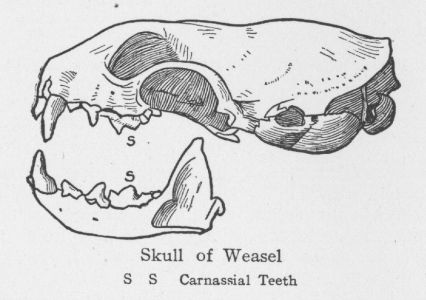
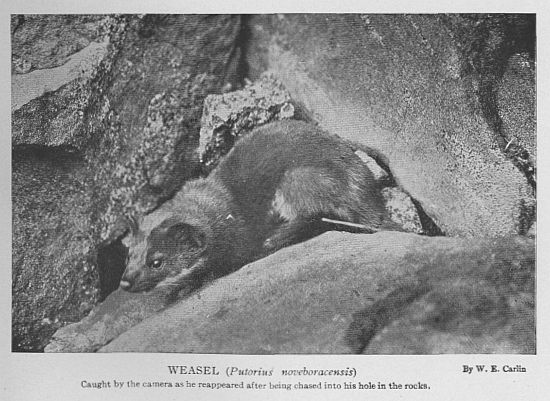
Length.—16 inches. Female 13 inches.
Description.—Tail always more than one-third the total length.
Range.—Eastern United States, New Hampshire to Virginia, and westward to Illinois. To the north and west and in higher parts of North Carolina it is replaced by very closely allied varieties.
Range.—North Carolina.
Range.—Maine, probably to Ontario.
Range.—Eastern Minnesota.
Dark chocolate-brown above, white on under parts, terminal third of the tail black. In winter pure white except the black of the tail. This change in colour is complete only in the northern part of its range. The difference in size of the male and female is remarkable, and the latter is sometimes confused with Bonaparte's weasel, which has a much shorter tail.
The various kinds of weasels in this country are much alike in their habits, and there is probably as much difference to be observed between the ways of individuals of each species as between the different species. There are certain family characteristics, however, which apply to all of them. First of all, they are hunters; if they ever follow the example of the majority of the flesh-eaters and partake of beechnuts, berries, mushrooms, or herbs on occasions, they have evidently never been caught at it and reported by the student of nature.
They hunt tirelessly, following their prey by scent, and kill for the mere joy of killing, often leaving their victims uneaten and hurrying on for more; when game is abundant they content themselves with sucking the warm blood. In cold weather they frequently hide the game they are unable to eat as a provision against period of hunger.
They like best to follow old tumble-down stone walls overgrown with weeds, squeezing into every crevice that may harbour a mouse or chipmunk; white-footed mice in particular furnish them no end of sport, for they are scarcely inferior to the weasels themselves in leaping powers, and are very abundant everywhere in the woods. In eating a mouse, the weasel first sucks the blood through the large veins of the neck, then bites through the skull and eats the brains, and after that, if still hungry, he eats the flesh, turning back the skin as he does so, leaving it turned inside out with the feet and tail attached.
Meadow-mice, moles, shrews, and the common mice and rats of barns and corn ricks, are also hunted by the weasel, but where white-footed mice are abundant they are pretty certain to receive his first attention.
In winter the larger weasels kill large numbers of gray rabbits, and are often to be found in thick growths of young pine and birch that have sprung up, together with blackberry vines and briers, on land cleared of old-growths of pine forests.
I have known the rabbits when chased by weasels to leave the woods and rush frantically out into the open, as if aware that their enemy was even better suited for rapid progress through briers and brambles than themselves, though they usually seek safety from their foes in just such places. And it certainly seems as if they knew what they were about at such times, for the weasels seldom leave the woods to follow them.
In summer they catch grasshoppers, crickets, and beetles of various sorts, and rob every bird's nest they find. Ground-feeding birds are especially liable to be caught by them, and they have even been seen to spring into the air and catch birds on the wing.
Owing to their slimness and elastic muscles they have a decided advantage over most of the other wood-dwellers, and have little difficulty in killing birds and animals several times as large as themselves.
I cannot learn of any other creature that is more thoroughly possessed of the lust for blood than are these slim-bodied little hunters.
The larger kinds, including the ermine or long-tailed weasel and Bonaparte's weasel, appear to be the most savage and bloodthirsty; the New York and the least weasel, from what I can learn, are somewhat more civilized in their ways. A New York weasel which I kept in captivity for a few days was gentle and docile from the very first, and perfectly fearless.
Within less than an hour from the time she was first removed from the trap to her cage, she would take meat from my hand without the slightest hesitation, and never offered to bite my fingers even when touching them with her nose. This tameness could not have been brought about by hunger, for when I found her in the box-trap she had not wholly eaten the rabbit's head which I had used for bait.
The weasels of the Northern States and Canada turn white at the approach of winter. The end of the tail, however, does not change colour, but remains perfectly black as in the summer.