Home › Volumes › American Animals › Rats, Mice and Lemmings
Muskrat
Also called: Musquash.
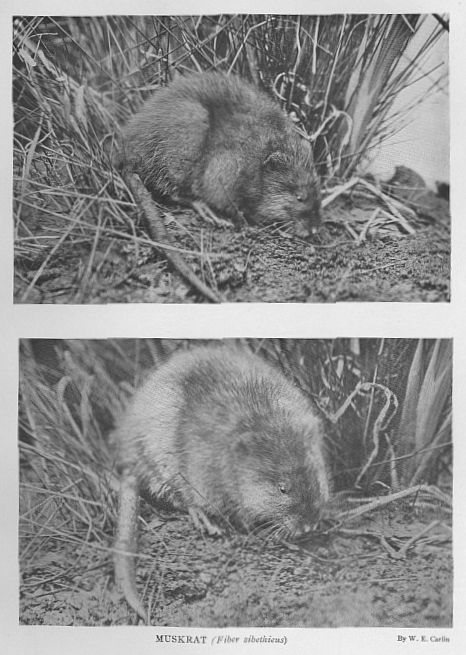
Length.—24 inches.
Description.—Body thick-set like a very large meadow mouse, legs short, tail scaly, nearly naked and flat (compressed laterally). Fur thick, with a woolly underfur, colour dark brown above, somewhat tinged with fulvous especially on the sides; beneath dull white, with scattered fulvous hairs, white on the throat, with white lips, and a brown spot on the chin.
Range.—Eastern North America, southward to Virginia and the middle Mississippi Valley. Replaced in Labrador, Newfoundland, lower Mississippi Valley and Dismal Swamp by closely related varieties.
Range.—Lower Mississippi Valley and Coasts of Alabama and Mississippi.
Range.—Dismal Swamp, Virginia.
Range.—Labrador.
Range.—Newfoundland.
The muskrat, it seems to me, is just a little cousin of the beaver. About the only striking outward difference between the lives of the two is in the attitude each assumes toward man and his works.
The beaver is wild and retiring, hating man in his destructive advance along the quiet forest streams, which the beaver family had held as their own for untold centuries, and refusing to settle contentedly within sound of his works even where most protected and undisturbed.
The muskrat, on the contrary, quickly learned to profit by the settlement of the country and the consequent thinning of his natural enemies, and though hunted and trapped persistently for several months in the year, still refuses to be driven away, and may be found in colonies perfectly undisturbed by the jarring racket of a sawmill or the smoke of a factory chimney, evidently willing to put up with some of the nuisances of civilization, in order to take advantage of the ponds dammed back by man for his own personal use, and which, unlike the beaver, the muskrat has apparently never learned to make for himself.
The adobe cabins of the muskrat are, however, very similar and often practically identical except in dimensions to those of the beaver. When in the late fall the long cold nights and increasing cloudiness foretell the coming snows and ice-locked streams of winter, the muskrats erect these lodges to serve both as living rooms and as air chambers to which they may bring the freshwater clams and lily roots that they dig up from the bottom when working at a distance from their burrows in the bank. If possible, they prefer to begin the work when the water is not very high.
On flat grassy reaches half overflowed they dig up sods, the size of a man's fist, sometimes arranging them in a little circle to hold back the water while they are at work inside, sinking a shallow well down into what will be the bed of the stream when the water gets higher. At a depth of a foot or more they hollow out a sort of chamber and from this make several radiating tunnels or subways, some of which reach well up into the high bank rods away and above high-water mark if possible, where the nest chamber is placed just under the turf or the protecting roots of a tree. Other tunnels extend in an opposite direction to the deepest parts of the channel that never freeze.
The sods and mud removed are piled up about the original opening in a more or less dome-shaped heap, which usually contains two rooms, one at the bottom partly or quite submerged, the other above it and a little to one side, ventilated at the top, and with a short passage leading down to the first.
In this way they are sure of a thoroughfare from their nest in the bank to the bottom of the stream, with a breathing-place midway even in the coldest weather, when everywhere except in midchannel the water is hard frozen to the bottom.
The upper chamber in the cabin is lined with soft grass and moss and here the owners spend much of their time in winter curled up asleep, often three or four together. Some of the smaller cabins have only the upper chamber without any downward passage whatever; others are large enough to contain four or five apartments at least. Many of them are built in low willow trees or on rough frameworks of sticks which the muskrats arrange among the alders; and here they exhibit much of the constructive ability of the beavers, cutting their wood on shore in a similar manner and often towing it long distances to their building sites where they wattle it firmly between the alder stems for a foundation.