Home › Volumes › American Animals › The Cattle
Musk Ox
- Length
- 6 feet. Height at shoulder, 3 feet 6 inches.
- Description
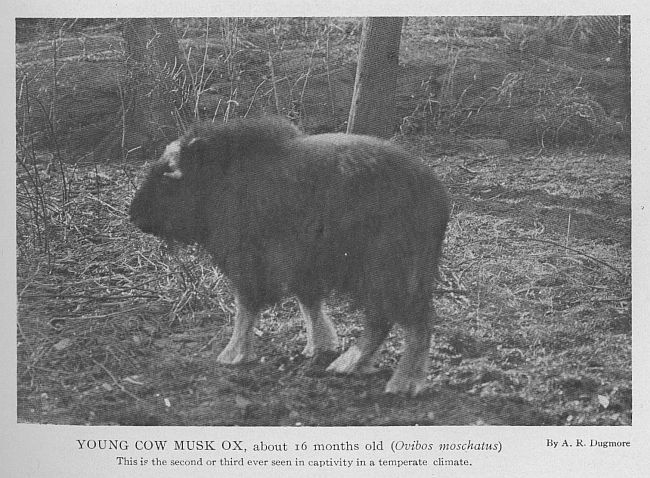
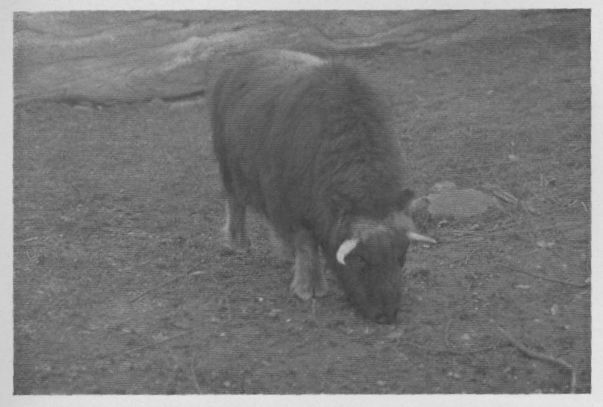
- Heavily built with rather short legs and horns of the male very heavy, their bases meeting on top of the head and curving downward and up again at the tip. Entire head and body covered with a dense mane, matted and curly on the shoulders, but hanging straight on the rest of the body nearly to the ground. Colour very dark brown or blackish on the head and sides; a saddle-shaped patch on the back as well as short hair between the horns, muzzle and limbs below the knees and hocks yellowish white.
- Range
- Arctic barrens of North America, east of the Mackenzie River. In Greenland occurs the closely allied Peary's musk ox (O. wardi Lyddeker).
The herds of musk oxen, now confined to the Arctic regions of North America, would seem to be the last lingering representatives of a diminishing race. Related species formerly inhabited most of Siberia and parts of northern Europe, as well as Germany, England and France; their fossil remains having been found in all those countries.
Musk oxen are curious long-haired shaggy beasts, in appearance half way between bison and sheep, and combining both in structure and habits the characters of each. The old males are rank of musk, especially in the rutting season, when their flesh is practically uneatable. The females, as a general thing, are almost free from the musky odour to which the species owes its name.
It has been observed by the musk ox hunters that when the animals are fat the odour of musk is much less noticeable. The long woolly coat of the musk ox is highly valued by the Esquimaux who use it for various purposes.
Musk oxen associate in herds numbering from about twenty or thirty to as many as eighty or a hundred head. The herds appear to be largest in winter, the big bulls during the summer being for the most part solitary, and the herds consisting of cows and calves which go about in small bands of from ten to twenty. The movements of the herds are described by Colonel Feilden as very sheep-like, the old bulls, when present, taking the lead, and the whole assemblage crowding together when alarmed, much after the manner of a flock of sheep. The single calf is produced in May or June and the cows are reported by the natives to breed only once in two years, so that the rate of increase is slow. In summer, according to Mr. Pike, their food consists almost exclusively of the leaves of the small willows scattered here and there over the Barren Grounds, but grass, moss and lichens are also largely consumed, and in winter these two last, with perhaps bark, must form their sole nutriment. In spite of their comparatively short and massive limbs, musk oxen can run with considerable speed; and when thoroughly alarmed they are stated to take to hilly ground, where they display marvellous agility in climbing precipitous cliffs. In spite of stories to the opposite effect, Mr. Pike is of opinion that even old bulls are by no means dangerous animals." (Lydekker's "Wild Oxen, Sheep and Goats.")