Home › Volumes › American Animals › The Cattle
Mountain Goat
Also called: White Goat.
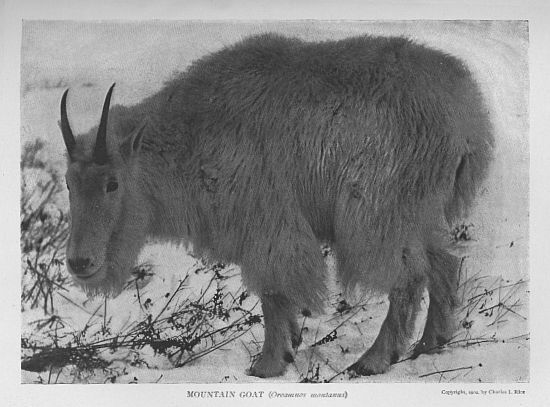
Length.—4 feet. Height at shoulder, 3 feet.
Description.—Body covered with long hanging white hair and a short woolly under-fur, entirely yellowish white. Shoulders rather humped and head carried below their level, nose hairy, a short beard on the chin. Horns slender in both sexes and curving slightly backward, black, as are also the hoofs.
Range.—Higher Rocky and Cascade Mountains to Alaska.
The higher, almost inaccessible slopes of the British Columbian Mountains are the stronghold of the mountain goats. There usually above the timber-line, amid the wildest scenery, and surrounded by glaciers and precipices they live practically unmolested except by the insatiable hunters. Living in such isolation they are in little need of speed or agility and are said to be rather slow and stupid beasts, easily secured if the surroundings admit of an approach.
The mountain goat presents many points of interest. In the first place it is not a goat but rather an outlying member of the great antelope tribe--to which by the way our American "antelope" does not belong. The nearest relatives of the goat are the serow of the Himalayas and the chamois of the Alps, though the long fleecy coat and goat-like beard give it a very different aspect.
In colour too it is peculiar, being the only pure white ruminant animal known; this is an excellent protection, rendering it practically invisible during the snows of winter, though at other seasons it would seem to render it equally conspicuous.
In describing his experience in pursuit of this animal Frederic Irland writes: "The most charming innocent creatures that I met in the Cascade Mountains were the white goats. What do you think of a wild animal which, after he knows you are on his track, will stop and turn back, to peer around the corner and see what you are? These stately animals, with their long white aprons, coal black eyes, and sharp little horns, really seem to me too unsophisticated to shoot. At Ashcroft and Lillooet people had told me to get my hand in by shooting a goat and then perhaps I could improve by getting a sheep. As usual we were seeking what we might destroy, though as a fact we let many chances go. We had nearly burst our hearts by climbing for an hour or two up the mansard roof of North America and high above the deer pasture. The winter on the mountain tops had driven the game down and sent the bears to their winter dens. We had found sheep tracks and were following along to see where they led, when suddenly we saw four white animals on the edge of an abyss of the kind which Dore has portrayed in illustrating Dante. The goats were not very far from us in a straight line, but it was a long way around. They saw us and started on a rheumatic gallop, but only went a little way, and as they reached a turn, huddled up and looked back. We picked our way over toward their last place of abode, reaching the opposite side of the canyon by means wholly unsuited to nervous people. There was just snow enough to show their tracks, which led along scandalous precipices. The fever of pursuit was on my guide, and he walked uprightly in places where I became a quadruped. This was trying to his patience, for he caught glimpses of the goats which I by reason of slower progress, was denied. In about half an hour we came to a great chimney of rock in the path, and clinging with fingers and moccasins, he went around the face of it. . . . When I came out above him I saw he had the goats in a sort of a natural trap, and they were all bunched up against a rock which I thought could not be passed. The biggest billy stood faced about, his long white beard and petticoats making him look like the high priest of some heathen temple. `Don't shoot; he fall down' yelled my guide. At the sound of the voice the goat made a desperate attempt at the face of the rock, scrambling up at an obtuse angle, then standing on his hind legs and throwing his fore feet over, from right to left. I thought he surely would fall back but he did not. The smaller goats followed and in a moment they were gone. . . . We made a flank movement and perhaps a quarter of a mile from the first round-up we saw those four fool goats again, the big one and a small one looking back around the corner to see if we were really coming. Then we did shoot and curiosity broke up that family."