Home › Volumes › American Animals › Rats, Mice and Lemmings
Meadow Mouse
Also called: Field Mouse, Meadow Vole.
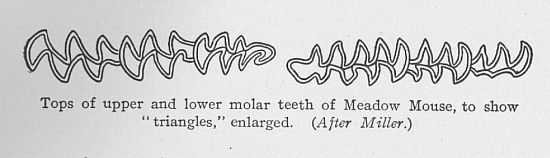
Length.—6.50 inches.
Description.—Body thick and compact, legs short, ears very short. Dark brown above with a general admixture of black hairs, shading gradually into gray on the under surface. The colour of the upper parts varies considerably, some individuals being decidedly blackish, others tinged with tawny and occasional specimens quite chestnut with very few black hairs. The under surface also varies to dull buff.
Range.—Southern Canada to North Carolina westward to the edge of the Plains. Replaced to the northward by four closely related varieties, and one to the southward, while there is also an island race.
Range.—Coast of Virginia and North Carolina.
Range.—Nova Scotia.
Range.—Labrador.
Range.—Ungava, Northern Labrador.
Range.—Quebec and Ontario, in deep forests.
Range.—Little Gull Island N. Y.
With us the meadow mouse occupies much the same position that the field mouse does in England; in fact it is oftener called field mouse than meadow mouse by the farmers, who, it seems to me, are not so very wide of the mark in so classifying it.
It is perfectly true that it prefers meadows to dry fields, but so too does the field mouse of the old country according to many writers, and the greater dryness of our summers might well account for any difference in that direction.
Except in the severest drouths, in New England at least, even the driest and most sandy fields are populated by meadow mice at all times of the year, and in times of abundant rainfall they are, I am confident, as numerous in fields as in meadows.
In summer they regularly resort to the grain lands like genuine field mice, and beyond a doubt if grain were stacked in ricks here as it is in England these would harbour as many mice and suffer an equal amount of damage.
In the fields of Indian corn they do harm enough, making their round nests of stripped up husks in the heart of a shock and fattening themselves at the expense of the farmer until they are routed out at harvesting.
Perhaps the most striking difference is that our species has not yet contracted the habit of spending the winter in barns; even this characteristic does not hold good farther North, as in Canada it is said to be a regular custom with it to do so.
Although many of them have their homes in dry upland fields and pastures, as a rule meadow mice show a decided fondness for water and wet places. Those living on the banks of streams become almost aquatic, and when pursued are as likely as not to take to the water for safety; I have often seen them swimming about beneath the ice in shallow water, and in summer paddling along between the pickerel weed and rushes. I have also seen them dive and swim for short distances under water, and when they emerge, their fur after a few shakes proves its fitness for that sort of thing by coming out as fluffy as ever.
Yet it frequently happens that on taking to the water for safety they only find another enemy, for pickerel often seize them from beneath at such times.
Meadow mice are even abundant on the salt marshes by the sea, not only along the border where the marshes and forest meet, and by the skirts of the sand-dunes, but well out on the flat grassy stretches and by the margins of salt ponds that with each recurring moon are daily inundated by the ocean.
How they manage to escape the floods at these times I know not; it would appear that they are not much in the way of taking refuge in haystacks, even when the marsh is thickly dotted with them, as it is from August until the winter is well spent.
Perhaps they have learned to watch the subtle movement of the tide and are able to foretell each high run in time to remove themselves and their families to higher ground. This would certainly call for an astonishing amount of intelligence on their part, for the treacherous thing will ebb and flow harmlessly day after day and week after week, hardly wetting the roots of the thatch along the creeks; and then suddenly without warning and perhaps just because a coast storm is harassing the sea somewhere out at the edge of the gulf stream so far away that hardly a cloud shows above the sky-lines, it lifts itself and spreads out across the grass, flooding the paths of the mice and all their haunts in the space of a few hours.
But the meadow mice are a wise folk and I firmly believe that they do manage to foretell the floods in most instances and camp along the borders of the marsh until the danger is over. What if some of them do occasionally get overtaken by the tide? as I have said already they are practical swimmers and there is pretty certain to be an abundance of eel grass in bunches and driftwood and rubbish of all sorts floating about to serve as rafts until the waters recede to their accustomed channels. But it is my belief that the mice very rarely allow themselves to be taken unawares in any such manner.