Home › Volumes › American Animals › Jumping Mice
Meadow Jumping Mouse
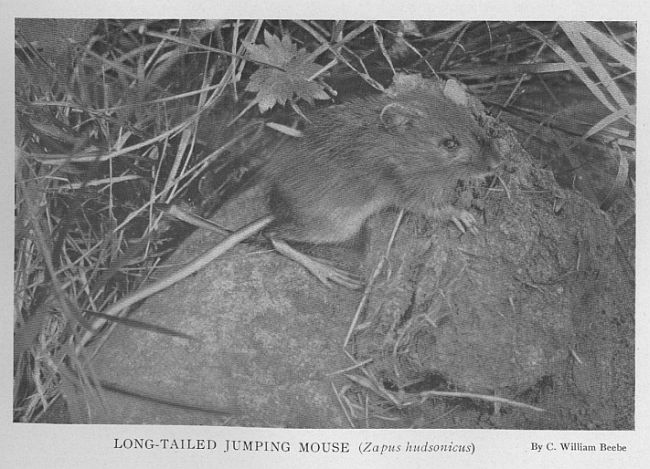
- Length
- 8.80 inches.
- Description
- General colour yellowish fawn to rather dark ochraceous mixed with black-tipped hairs which predominate on the back making it much darker than the sides, belly white, some-what suffused with buff, feet white, tail white beneath brownish above, 130 mm. long. In autumn the fur is yellower with less dusky above.
- Range
- From Hudson's Bay to North Carolina, although those from the Southern States and from Labrador are slightly different. (See beyond.)
This is a mouse of uncertain and varying abundance; as a general thing decidedly rare, then there will come a summer when any one with an eye at all for seeing things, may have half a dozen or even a dozen specimens brought to his notice; the most harmless, inoffensive, kangaroo-like little things with astonishingly long tails, they go bounding off over the grass before you or cower trembling in the stubble, sometimes allowing themselves to be stroked or even taken in the hand without offering resistance or attempting to escape. They seem to be decidedly less intelligent than other mice, trusting mainly to good luck and their gift at jumping to carry them through whatever dangers threaten. Apparently they never look before they leap, so that that which should be their safety often proves their ruin, as they are about as likely to spring directly into the clutches of a cat or other enemy as in an opposite direction; in this manner they are frequently drowned in milk-pans and tubs of water which a little ordinary caution would have avoided.
The last one I saw was on the bank of a stream in the woods where the wild grape-vines and smilax trailed along the edge of the water.
At first it attempted to escape by crouching among the grass and dead leaves, but when I stooped down to examine it it began leaping in the characteristic aimless and erratic manner of the species. Finally when I made an attempt to capture it with a landing net it leaped well out from the bank and descended in the water where the current was pretty strong; the mouse, however, proved equal to the occasion and swam swiftly enough against the stream for several yards to a floating branch along which it ran to the other end, where it again entered the water to swim ashore and hide among the driftwood and rubbish under the overhanging bank.
Jumping mice are oftenest seen just after the meadows and hay fields are cleared in August, evidently driven from their accustomed haunts and wandering lost and bewildered looking for new homes, or it may be that the summer drouth has compelled them to start out in search of water.
Their food appears to consist, like that of the other outdoor mice, largely of grass seeds, undoubtedly varied at times by the addition of berries and mushrooms and probably insects.
Ordinarily they creep about in the grass and leaves in a manner calculated to escape all notice, and it is only when threatened that they bring into use their powers of leaping, the value of which probably depends a good deal on its unexpectedness and the sudden effect of surprise it produces on the enemy.
These mice are dormant through a much longer season than are most hibernating animals, passing six months or more of every year in this condition curled up in their nests underground.
I have seen a family of them turned up by the plough in May and they exhibited not the slightest symptom of life on being handled and breathed upon; their bodies were soft and limp and warm and had every appearance of an animal in a perfectly dormant condition.
Varieties of the Meadow Jumping Mouse
Though the jumping mice bear a close resemblance to one another they exhibit slight variations in different parts of their range so that the following have been distinguished.
1. Meadow Jumping Mouse. Zapus hudsonius (Zimmerman). Described above, ranges South to the mountains of New Jersey, Pennsylvania and North Carolina and in the West to Iowa.
2. Labrador Jumping Mouse. Zapus hudsonius ladas Bangs. Larger and darker, with longer legs and tail. Replaces the preceding in Labrador.
3. Carolinian Jumping Mouse. Zapus hudsonius americanus (Barton). Replaces the above in the lowlands from North Carolina to the Hudson and Connecticut Valleys.