Home › Volumes › American Animals › Squirrels and Marmots
Flying Squirrel
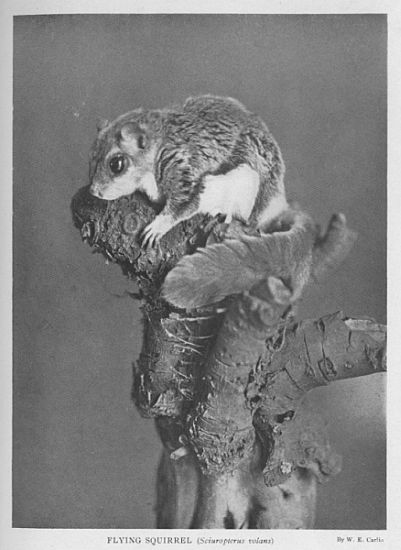
Length.—9.40 inches.
Description.—Fur soft, dense and mole-like; skin of the sides produced and susceptible of being spread out when the legs are extended, so as to form a sort of parachute. Drab above, irregularly tinged with russet, slightly brighter in summer; under parts pure white to the roots of the hair.
Range.—Northern New York and Southern New England to Georgia and west to the plains. A slightly different variety replaces this in Florida, while in the Northern part of its range there occurs a much larger, quite different species. (See below.)
Range.—Replaces the last in southern Georgia and Florida.
Range.—Maine, southern Canada, and the mountains of New York (probably also tin the Alleghanies).
Range.—Arctic America to northern Canada.
Flying squirrels are so persistently nocturnal that it is extremely difficult to learn much about their habits. Yet they are such beautiful, gentle, dreamy-eyed little forest folk, that one cannot help wishing to know more about them. What do they do with themselves in the quiet woods all night long, pattering about among the leaves?
If you watch with exceeding patience, you may see them in the dim light sailing from one tree to the next, but life is hardly long enough to learn much about them in this manner.
When you have found a flying-squirrel tree it is easy enough to rap on the bark with a stick and rout them out into daylight, and make them show off their power of flying to your satisfaction; but that will be about all you will get out of them at such times.
I have made them come out on dark cloudy days and watched them patiently, but their patience far exceeded mine; in fact, I am not quite sure that they did not even go to sleep clinging there against the bark, like lichens which they so much resembled as to suggest that their clouded cream buff colouring might serve them well at imitating the fungus growth or the bark of a dead tree. Such protective copying is to be seen all through the woods. On the same trees I noticed small, dull-white, half-moon-shaped patches of fungus, and on closer inspection found that fully two-thirds of them were moths flattened against the under sides of the branches to avoid the drip of the rain.
Unless disturbed, Flying Squirrels pass the day asleep in their warm nests, generally in some deserted Woodpecker's hole or natural cavity in a decayed tree-trunk, though they are quite ready when opportunity offers to establish themselves in holes about the eaves or in the garret of the farm-house. The cold winter months seem also to be passed in the same way, if, indeed, the little animals are not entirely torpid at this season.
During the milder parts of the year they come forth about dusk, and, so far as we know, their activity continues throughout the night. From tree to tree they go in pursuit of food or chasing one another about in pure enjoyment of life and motion. Alighting upon a tree-trunk they always go upward, scrambling and jumping until they reach the topmost branches, when they launch forth in their parachute-like descent, their legs stretched out to the utmost, so as to extend the folds of skin on either side, to which they owe their power of sailing. Flight it cannot properly be called, since they can only glide downward until just about to come to rest, when by a deflection of the body they are enabled through their momentum to shoot up diagonally a few inches and grasp the tree-trunk, ready for another climb. They sometimes cover long distances when they start from a considerable altitude, and Doctor Bachman states that he has seen them sail from the top of one tree to the base of another fifty yards away.
The young are reared in the nests and vary in number from two to four. Doctor Merriam has found them in the Adirondacks half-grown by the end of April.
In their food Flying Squirrels are not very particular. They subsist mainly upon nuts, and, from Doctor Merriam's experience, seem to prefer acorns, hazel and beech nuts. Insects, he states, particularly beetles, do not go amiss, and they are also known to eat portions of dead birds. Some of these little animals regularly find their way into our cabin in the pine woods of New Jersey, and here they vary their diet to a considerable degree, sharing with the White-footed Mice any scraps of victuals that may be left exposed.
As pets Flying Squirrels are exceedingly gentle and affectionate. When raised from the nest they become perfectly accustomed to the presence of human beings, and seem to delight in clinging to one's clothing and taking refuge in any convenient pocket.