Home › Volumes › American Animals › The Manatees
Florida Manatee
Also called: Sea Cow.
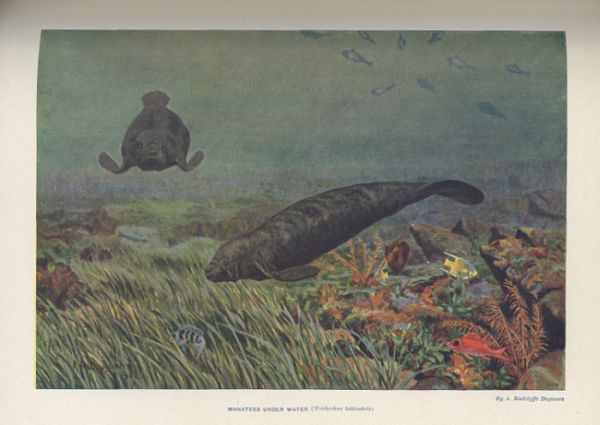
- Length
- 9 feet.
- Description
- General shape cylindrical, neck short, not much contracted, forehead oblique, nose, as seen from the front, triangular, lips thick, upper one clothed with bristles and capable of much expansion. Tail flat and widened, then tapering to a point, flipper rather long (1 foot), eyes small, skin with a few scattered hairs. Colour bluish black, somewhat paler below and gray on the muzzle.
- Range
- Formerly the Gulf and South Atlantic coasts of the United States, now restricted to rivers and lagoons of south-eastern Florida and becoming very scarce.
The exact number of species of manatee which occur on the coasts of the New World is a matter of some doubt, but it is pretty certain that the Florida manatee is different from the Trichechus americanus of South America.
Unlike the whales, manatees are not lovers of the open ocean, but remain close along shore, feeding in the bays and lagoons on the various water plants and grasses. From the meagre accounts that we have of these animals in their native haunts they seem to spend their time lazily floating or wallowing about with the upper part of the head generally exposed. Those kept in captivity usually rest on the bottom of their tanks and rise to the surface for air at periods of from two to six minutes. They accomplish this "with the least perceptible movement of the tail and flapping motion of the paddles, raising the upper part of the body until the head reaches the surface, when the air is admitted through the nostril flap valves which are closely shut after the operation."(Crane. “Proc. Zool. Soc.,” London, 1880, p. 456) They seemed ill at ease when the water was drawn off and were apparently unable to progress on land. When feeding they seemed to fan the strands of grass and sea weed into the mouth by means of the copious bristles which surround it.
It is sad to contemplate the extinction of these curious beasts which present so many interesting peculiarities to the naturalist, and problems in evolution which he has yet to solve. Their harmlessness would seem to warrant their preservation, but it seems on the other hand to aid in their destruction. As fast as the settlement of the country makes their haunts more accessible their numbers lessen and, being tropical in their nature, the frosts and cold spells which have of recent years prevailed in Florida with such ruin to the orange groves have also played sad havoc with the remaining small band of manatees.