Home › Volumes › American Animals › Rabbits and Hares
Cottontail
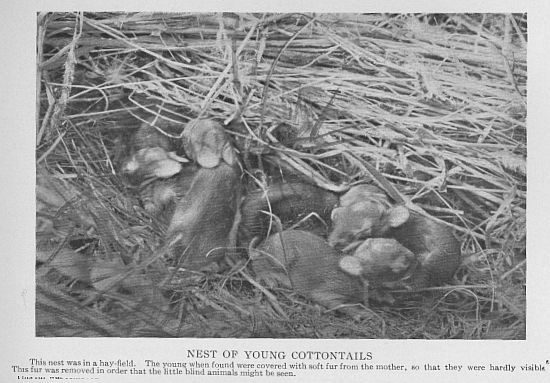
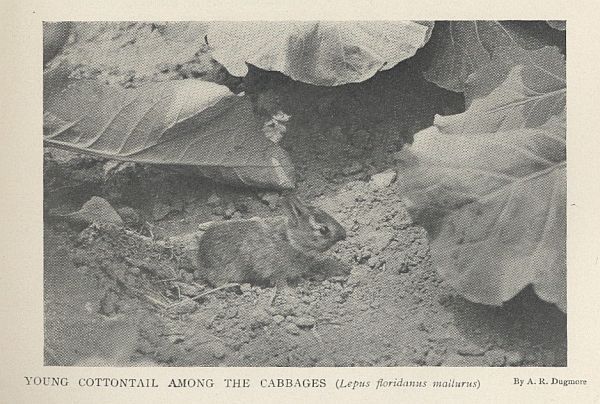
Length.—17 inches
Description.—Above, a fine mixture of brown, cinnamon and russet, grayer on the rump, dusky edgings to the ears and an indistinct dusky spot between them; below, white with a brown band across the breast; lower surface of the tail pure white.
Range.—Lowlands of the southern and middle States from northern Florida to the Hudson Valley in the East, and to West Virginia and Tennessee, west of the Alleghanies. Other closely related varieties replace this form to the north and south, and many allied species occur in the West.
Range.—Southern Florida north to Micco.
Range.—Alleghany Mountains and northward east of the Hudson to southern Vermont and New Hampshire. To the southward it merges gradually into the southern cottontail and westward into the following.
Range.—Upper Mississippi Valley south to Indiana and east to Central New York and Ontario.
Also known as Rabbit, Gray Rabbit.
For the last week I have been watching a rabbit that was caught in a box trap. It quickly became tame enough to allow itself to be stroked and patted without exhibiting much alarm, and when it escaped from its cage, which it did several times, offered but little resistance on being caught and replaced in bondage, at last even allowing itself to be taken up without a struggle.
It ate readily whatever was offered it--apples, raw cabbage, and even the dry hay of which its bed was composed, besides gnawing all the bark from the twigs of apple tree which I placed in its cage, but never while I was watching and, I think, only at night, apparently hardly changing its position while the day-light lasted.
Yesterday morning I found that it had not only escaped from its cage, a frequent enough occurrence, but that it had also managed to make its way to the outside world, and the snow on the lawn has since been thickly marked with its tracks leading off across the orchard finally, and I trust that by this time the little cotton-tailed chap is once more at home in the woods.
Like the white rabbit the cottontail has well-beaten paths, which it follows winter and summer alike, but these are usually not so extended and regular as those of its larger cousin.
In winter the goshawk has a habit of following these paths on foot in a most unhawk-like manner, especially where they are arched over by bushes that might prevent the hawks from pouncing down from above, and I believe that it is done with the intention of driving the rabbits out into the open woods where, perchance, the hawk's mate is waiting to seize them, for goshawks usually hunt in pairs throughout the winter. Even the common crow, unless I am very much mistaken, not infrequently manages to kill rabbits when the new snow is sufficiently deep and light to prevent them from making full use of their power of running.
The rabbit's custom of resorting to burrows perhaps as frequently proves a menace to its safety as otherwise, particularly where, as is often the case, there is only one place of exit, for the mink, the skunk and the weasel can all easily enter any opening that will admit a rabbit and undoubtedly often get their dinner in that manner.
Last winter I saw what looked like a rabbit crouching among the stems of a cluster of wild rose bushes, but on approaching more closely I discovered that the animal had been dead for several days, having evidently been killed by a weasel, and in the struggle became so wedged between the briars that its captor was unable to move it and must needs satisfy itself with sucking its blood and leaving it in that position.
Later some white-footed mice and a blue jay had also been at work nibbling and pecking here and there, but by the time they had discovered it it had evidently become frozen so hard as to prevent their making much impression on it, so that at a distance of a few yards it looked as if still alive.
The gray rabbit prefers above all things briar-grown berry patches with a sprinkling of young pines and birches and numerous rotting stumps of a former generation of trees, but readily establishes itself in any kind of woods, high or low, while any isolated clump of bushes a few rods in extent, whether it be by the road-side or on the edge of a meadow is likely to harbour a family of them.
Their food seems to be of much the same general character as that of the white rabbit though perhaps a little more varied, including fruit and all kinds of garden vegetables when convenient, though the damage done in this way is hardly worth considering, in which respect it sets an example which the Old World rabbit might profit by.