Home › Volumes › American Animals › Cats
Canada Lynx
Also called: "Loup Cervier."
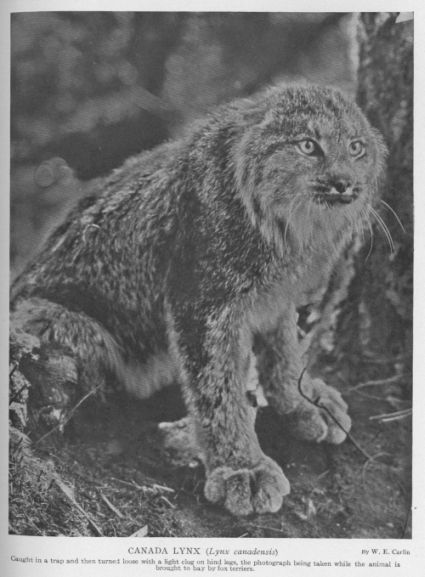
- Length
- 40 inches.
- Description
- Feet much larger than in the wild cat, tail shorter, fur much longer and looser. Colour light gray mottled with brownish, caused partly by the dark bases to the hairs, tips of ears with tufts of long black hairs. Under parts white, tail tipped with black, face-ruff long, white bordered with black.
- Range
- Boreal North America, south formerly to the mountains of Pennsylvania. Replaced in Newfoundland by the allied Newfoundland Lynx L. subsolanus Bangs, darker and more richly coloured; and in Alaska by a paler from L. canadensis mollipilosus Stone.
The Canada lynx is the real lynx of all the north, that mysterious creature which the ancients believed possessed the power of seeing through all substances, whether opaque or not to other eyes.
The distinction between this species and the lynx of Northern Asia and Europe appears to be no more than may with safety be ascribed to local environment. Those branches of the family which have strayed southward into the forests of a more temperate climate have invariably decreased in size, showing that the true home of their race is in the north.
The Canada lynx is a savage, flat-faced beast, with enormous muscular legs and paws out of all proportion to the size of its lean body and absurd retrousse tail. Its soft fur of clouded gray is so blended with various shades of pale buff and tawny as to be extremely difficult to distinguish in any light or against almost any background; even in the cruel publicity of a barred cage it is still indistinct, and one might well fancy the cage empty at a little distance.
In the northern woods the lynx travels with silent leaps, his broad paws supporting him on the snow, or alighting without a sound among brittle twigs or dry leaves of a past summer, enabling him to pounce on grouse or hare before they have time to take alarm. He can also climb trees with ease, to rob the nests of birds and squirrels, or stretch himself along a lower branch from which he can launch himself on whatever may pass beneath. Yet since every creature that he hunts is equally well fitted for the contest, and even more earnest and watchful in its endeavours to avoid him and so enjoy its own wild life in the woods a little longer, the lynx must necessarily go without food often for days together in the winter, glad enough perhaps to pull some frozen scrap of flesh or skin out of the snow, dropped there by more fortunate hunters weeks before. The lack of insect scavengers is not felt in the woods in winter; every scrap of flesh that is scattered is wanted by one warm-blooded creature or another before warm weather comes again. The lynx appears to have its summer home in tangled thickets and snarls of young growth, where the interlocking branches of fallen trees afford protection. Here the ill-natured kittens are raised and taught to hunt, so that when the bitter struggle of winter is forced upon them they may, if possible, hold their own and prolong their lives at the expense of others, in order that their race may live. They hold on to life grimly through long, cold nights in the dark Northern forests, believing somehow that at last spring will be in the woods again, bringing flight birds from the South, and awakening the small creatures that sleep all winter down deep in the frozen earth where the most desperate lynx can never reach them. Until then the lynxes must hunt as best they can, tireless and in splendid health, and quite unconscious of the cold, but oh, so hungry!
One of the most astonishing facts in nature is the length of time that most flesh-eating animals can go without food, on long hunts through deep snow, night after night, breathing frozen air that drives a man hungry soon after the heartiest meal, they maintain their strength ready for a desperate struggle when at last the long pursuit draws to successful end.