Home › The Fairy May Flies › The Fairy May Flies (Larv of our fairy May flies)
The Fairy May Flies (Larv of our fairy May flies)
are the larvæ of our fairy May flies? They have a mouth! see what big jaws for such little creatures. - And what do you suppose they eat?
No doubt they, too, live on animal food.
No doubt they move about in the mud and catch what they can.
You see, John had to dig them up; they like to burrow in the weeds and mud, and some of them even make tunnels of mud in which to protect their soft bodies. Their short, stout legs enable them to dig well.
Their bodies are soft, but their jaws are not. O dear, no!
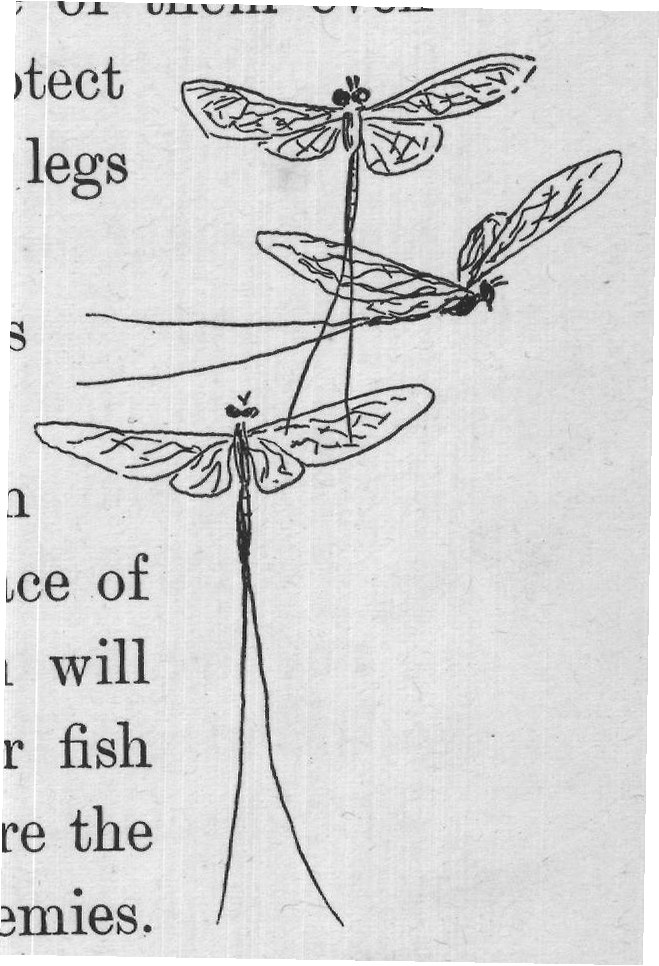
The grown-up May flies mate, and then the female drops her eggs on the surface of the water. When she does this a fish will very often jump up and seize her, for fish are very fond of May flies, and lucky are the May flies to escape these ravenous enemies.
The eggs are heavy and sink to the bottom, where they hatch into these queer-looking larvæ that eat and grow and shed their skin just like the dragon fly larvæ.
Those brushes along their sides are the gills they breathe with.
See the gills moving swiftly back and forth; they look as though the larva wished to swim with them, but this is not why it moves them so constantly.
The continual motion of the gills stirs up the water and keeps our larva supplied with fresh air.
Nellie is asking what gills are.
Well, gills in fishes and in such insects as have gills, and in crabs and lobsters and other creatures that live in the water, are parts that often look like fringes or flat plates.
The gills of fishes have a great many blood vessels running through them. The walls of these blood vessels are very thin, and the oxygen from the air that is in the water passes into the blood that is in the gills, and then this blood, all full of oxygen, circulates through the fish's body. You see in fishes the blood vessels come into the gills and get the oxygen.
In insects it is different. There are air tubes running like tiny pipes all through the gills and into the body of the insect. The oxygen of the air that is in the water passes out through the walls of these tubes into the blood of the insect.
Yes, John, in fishes the blood comes to the air, in insects the air goes to the blood. The air passes into the air tubes of the insects, and thus is carried all through their bodies.
The blood takes the oxygen out of the air.
Without oxygen in the blood no animal could live.
Now let us go back to our May flies. They remain in the larval state a year, and some species remain two years. Think of living in the mud for two long years! In the mud they creep about, eating, eating, eating. Then some summer day they leave the mud and swim to the surface of the water.
Pop! they are gone.
They were so quick about it we could not see what happened.
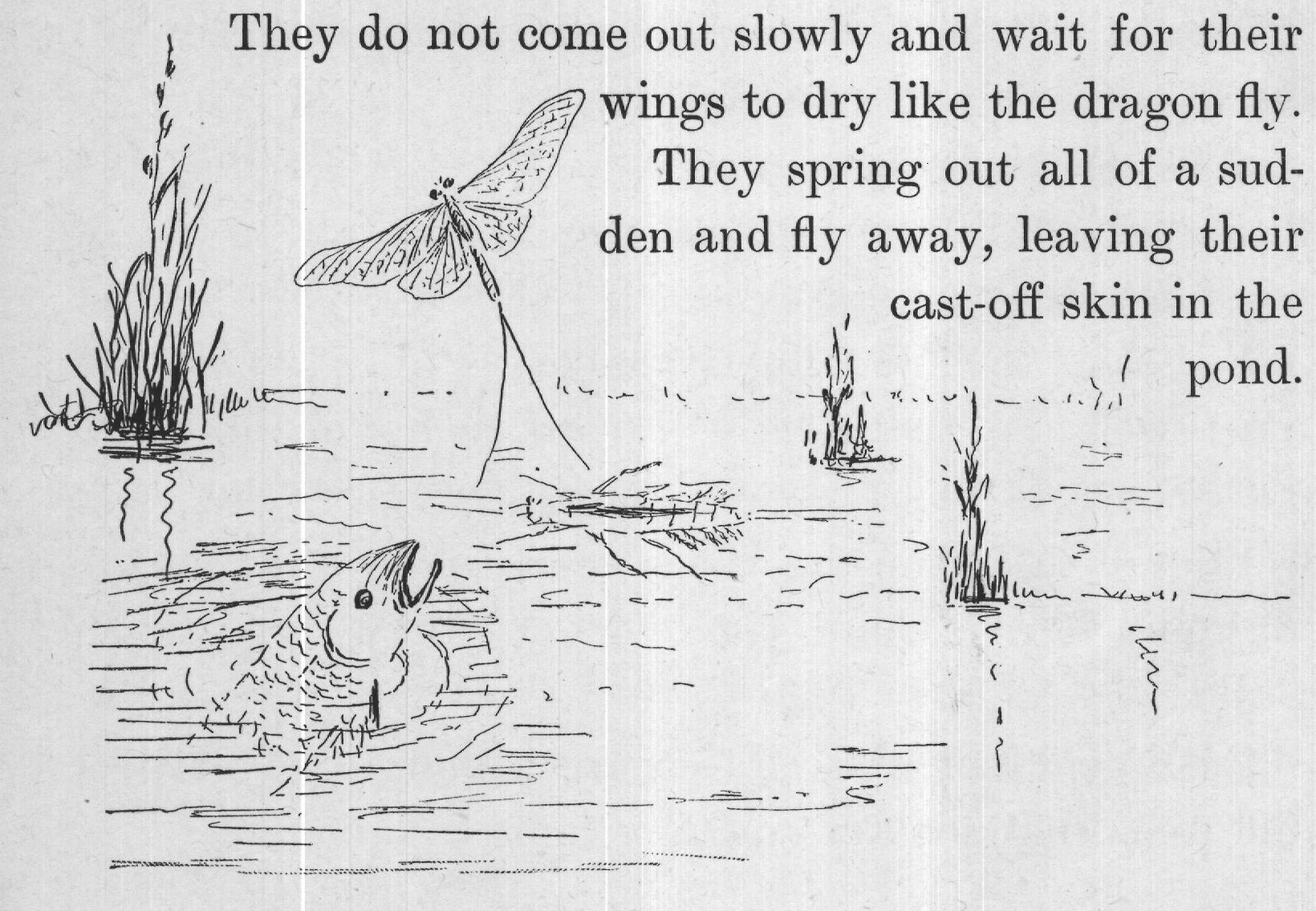
The larval skin burst open and forth leaped the May fly, like a winged fairy from a prison cell.
They do not come out slowly and wait for their wings to dry like the dragon fly.
They spring out all of a sudden and fly away, leaving their cast-off skin in the ( 1 pond. 내~~ Unless their motions were quick they might be snapped up by the fish that are so fond of them.
But though they seem to emerge thus quickly into perfect winged May flies, they are not quite done with infancy. They are still wrapped about by a very delicate skin that they have to get rid of. So they fly to a bush near the water and stay a little while until this skin splits and comes off, and they are free. In spite of their quick motions when they spring from the water, many of back into it and are the May flies fall caught by the fish. become fat and goodflies emerge, they eat so what the fish do not Swallows and other in- It is said that the trout flavored when the May many of them. And catch the birds try to. sect-loving birds have a glorious feast when the May flies come out. For a season they live in the midst of more delicacies than they can possibly use.
Fish like the May fly larvæ, too, which is probably the reason the larvæ have learned to live in the mud, out of reach.
Fishermen dig up the larvæ for bait, so you see the May flies have a hard time to get safely through the world.
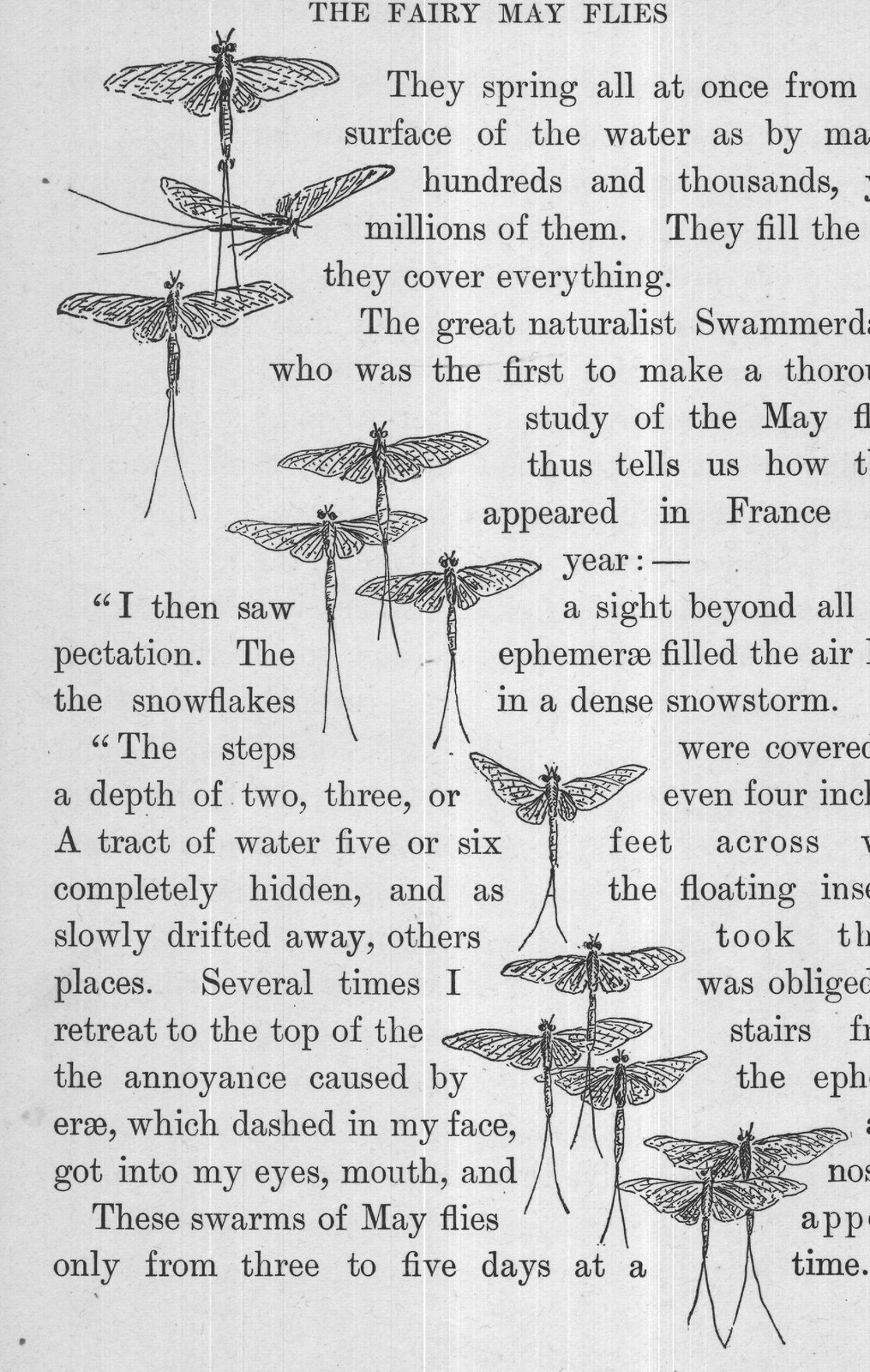
But in spite of difficulties a great many of them live, and some summer day out they come trooping. - They spring all at once from the surface of the water as by magic, hundreds and thousands, yes, millions of them. They fill the air, they cover everything.
The great naturalist Swammerdam, who was the first to make a thorough study of the May flies, thus tells us how they appeared in France one year: "I then saw pectation. The the snowflakes "The steps a sight beyond all exephemeræ filled the air like in a dense snowstorm. a depth of two, three, or A tract of water five or six completely hidden, and as slowly drifted away, others places. Several times I retreat to the top of the the annoyance caused by eræ, which dashed in my face, got into my eyes, mouth, and feet were covered to even four inches. across was the floating insects took their was obliged to stairs from These swarms of May flies only from three to five days at a the ephemand nose." appear time.
Wherever there are streams there are May flies, and the canals of Holland make good breeding places for them; no wonder, then, the Dutch, who you know live. in Holland, have a saying, "As thick as May flies."
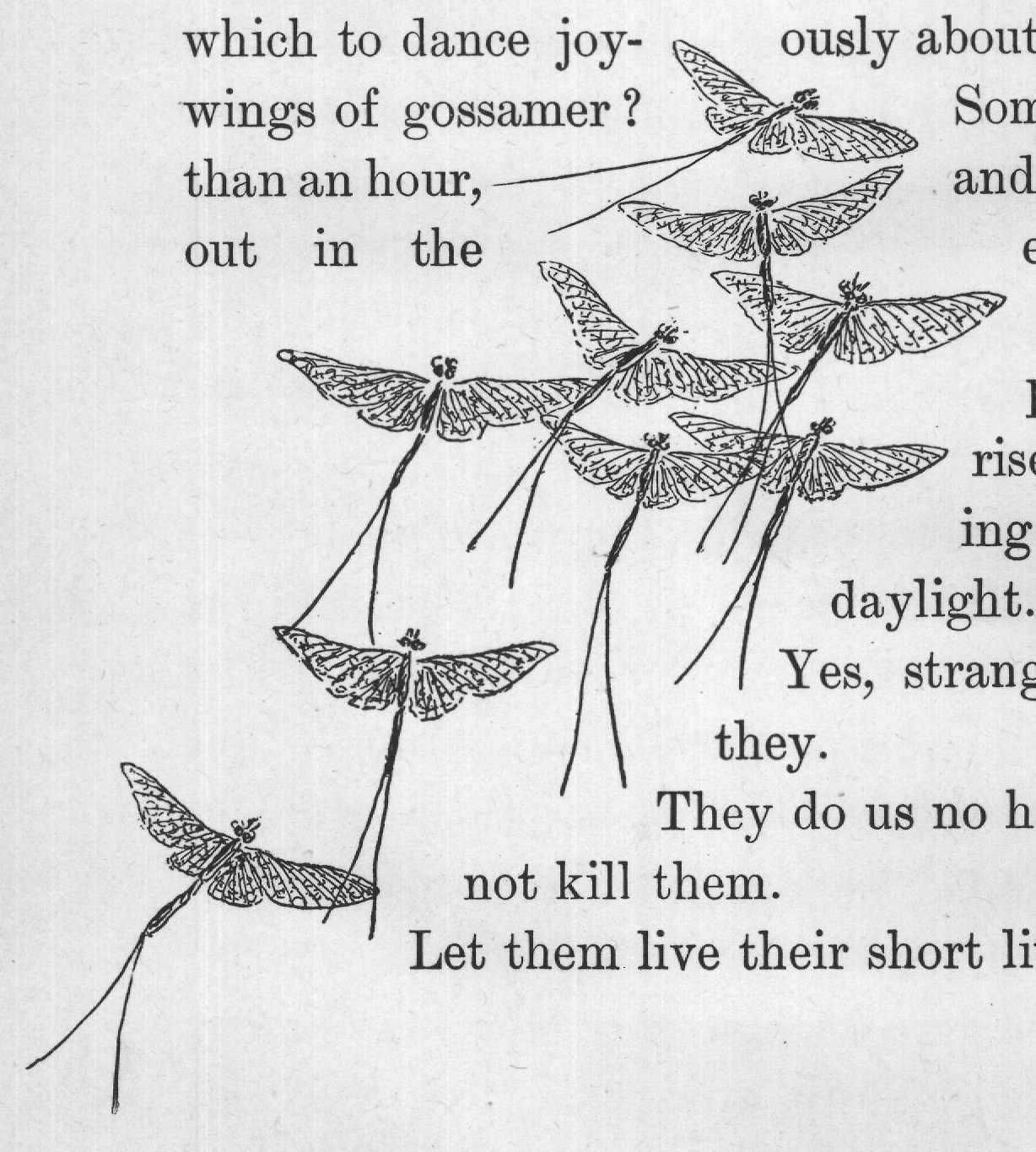
Although so many of the May flies perish at once, multitudes of them drop their eggs into the water to renew the race of May flies. which to dance joywings of gossamer? than an hour, Is it not wonderful that after so long a period of creeping about in the mud as larvæ, these graceful and beautiful little creatures have but a few hours in ously about in the upper air on Some, indeed, live less and some, that come evening, finish their dance of life and perish before sunrise, without ever having seen the beautiful out in the daylight.
Yes, strange little beings are they.
They do us no harm and we should not kill them.
Let them live their short lives and be happy.