Home › Our Pretty Dragon Flies › Our Pretty Dragon Flies
Our Pretty Dragon Flies
COME, children; come with me.
Come to a pond I know of.
See how the water shines in the sun.
Over there is an old log lying on the edge of the pond.
It is covered with green moss, and a green frog is sitting on one end of it.
Let us go and sit on the other end.
Goop! he says, and - plump! he has jumped into the water.
That is too bad, frog; we did not mean to disturb you. How pretty it is here!
See the pickerel weed growing out in the water with its arrow-shaped leaves, and its spikes of purple flowers. See, down in the water are little fish, and very likely pollywogs are there too, and lots of queer little things. But who is this darting over the pond?
Ah, we know you.
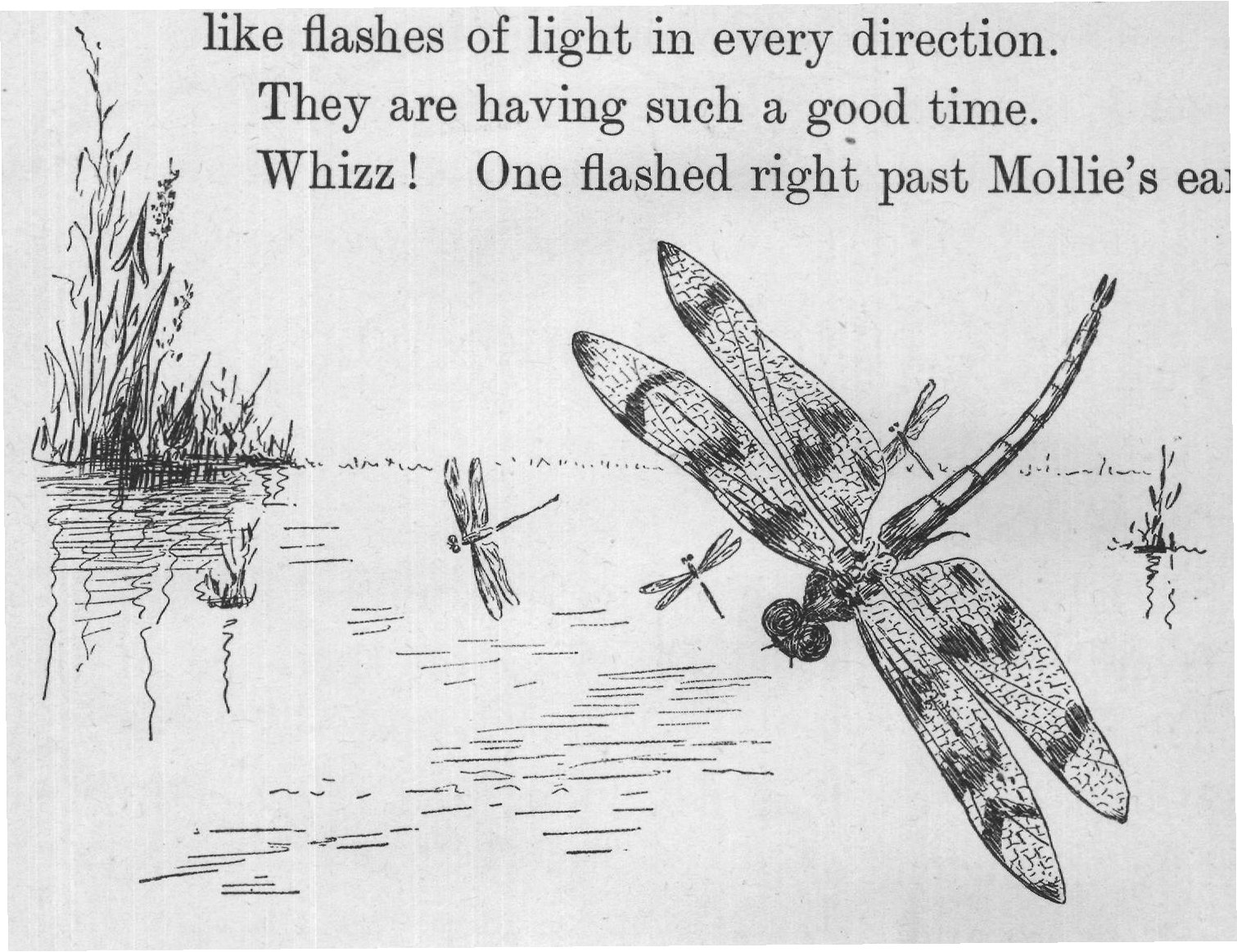
You are our queer little, dear little old dragon fly. Look, children; see the dragon flies darting about like flashes of light in every direction.
They are having such a good time.
Whizz! One flashed right past Mollie's ear.
Pretty people, I wish one of you would come and sit by us a little while, so we could get a good look at you. What is that, Ned? You have found a large one lying on the ground?
Sure enough; it is a beauty too, with a green body and silver wings.
Something seems to be wrong with it; it does not fly nor try to get away.
What a big one it is!
My! my! what eyes!
Don't crowd, Amy; let little Nell see too.
What is that you say, Richard? "It catches mosquitoes and gnats and flies and other insects while flying."
We Yes, and that is why it has such big eyes. should need big eyes ourselves if we were to spend our time chasing mosquitoes.
Two eyes you have, little dragon fly, like the rest of us, but your eyes are not like ours.
No, in-deed!
Each of your big eyes is made up of a great many small eyes packed close together.
Do you know, children, that some of the largest of the dragon flies have as many as twenty thousand facets, or small eyes, in each large eye?
Think of it! Forty thousand eyes in one little dragon fly head. It ought to see well.
These facets are six-sided, excepting those along the edge, which are rounded on the outside. You cannot see their real shape without a microscope, they are so small. But here is a picture of some facets as they look under the microscope.
Eyes like these, made up of many facets, we call compound eyes.
All grown-up insects have compound eyes, though not many have as large ones as the dragon fly.
Only insects that chase other insects or that need to see in the dark have very large eyes.
See what a big mouth the dragon fly has. Its jaws do not show unless it opens its lower lip, which fits over its mouth like a mask.
I should not care to have it bite my finger.
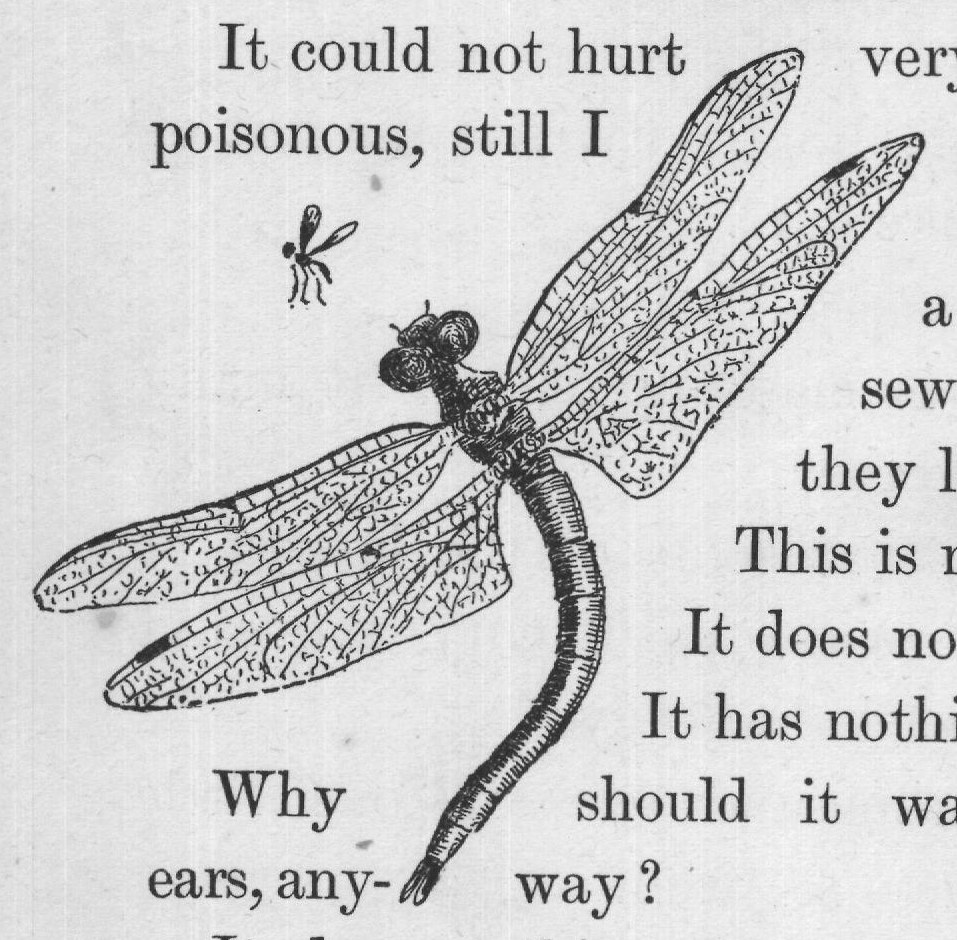
It could not hurt poisonous, still I Why ears, anyvery much, and its bite is not shall handle it carefully.
Some call the dragon fly a darning needle, and say it sews up people's ears when they lie on the grass.
This is not true.
It does not sew up anything.
It has nothing to sew with. should it want to sew up people's way?
It does nothing unpleasant but bite fingers, and it never goes out of its way to do that.
If we let it alone, it always lets us alone.
It is our good friend because it catches mosquitoes. For this reason it is sometimes called mosquito hawk.
We should never kill a dragon fly.
Sometimes it is called a spindle, I suppose because it is long and slender like a spindle.
Down South the colored people believe the dragon fly brings dead snakes to life, and they call it snake doctor. In some places it is called snake feeder.
But it has nothing to do with snakes, dead or alive. The French have given it a pretty name, demoiselle, or damsel fly, and that is quite deserved, for the dragon fly is a graceful little creature, as pretty as pretty can be. See, sticking out of the front of its head are two little feelers, or antennæ, as we must call them.
They are very short, but it does not need long ones. Insects smell with their feelers, you know, but our dragon flies see so well they do not need to smell very well, I suppose.
See how it can turn its head around. That is because it has a little short neck between its head and its body.
Its eyes, its mouth, and its antennæ belong to its head.
Of course our demoiselle can fly well; one need only look at those wings to know that.
To fly well is quite as necessary to one of its habits as to see well.
What would be the use of seeing an insect if it could not fly fast enough to catch it?
We all like your pretty wings, little dragon fly; they look like glass and they shine so in the sun.
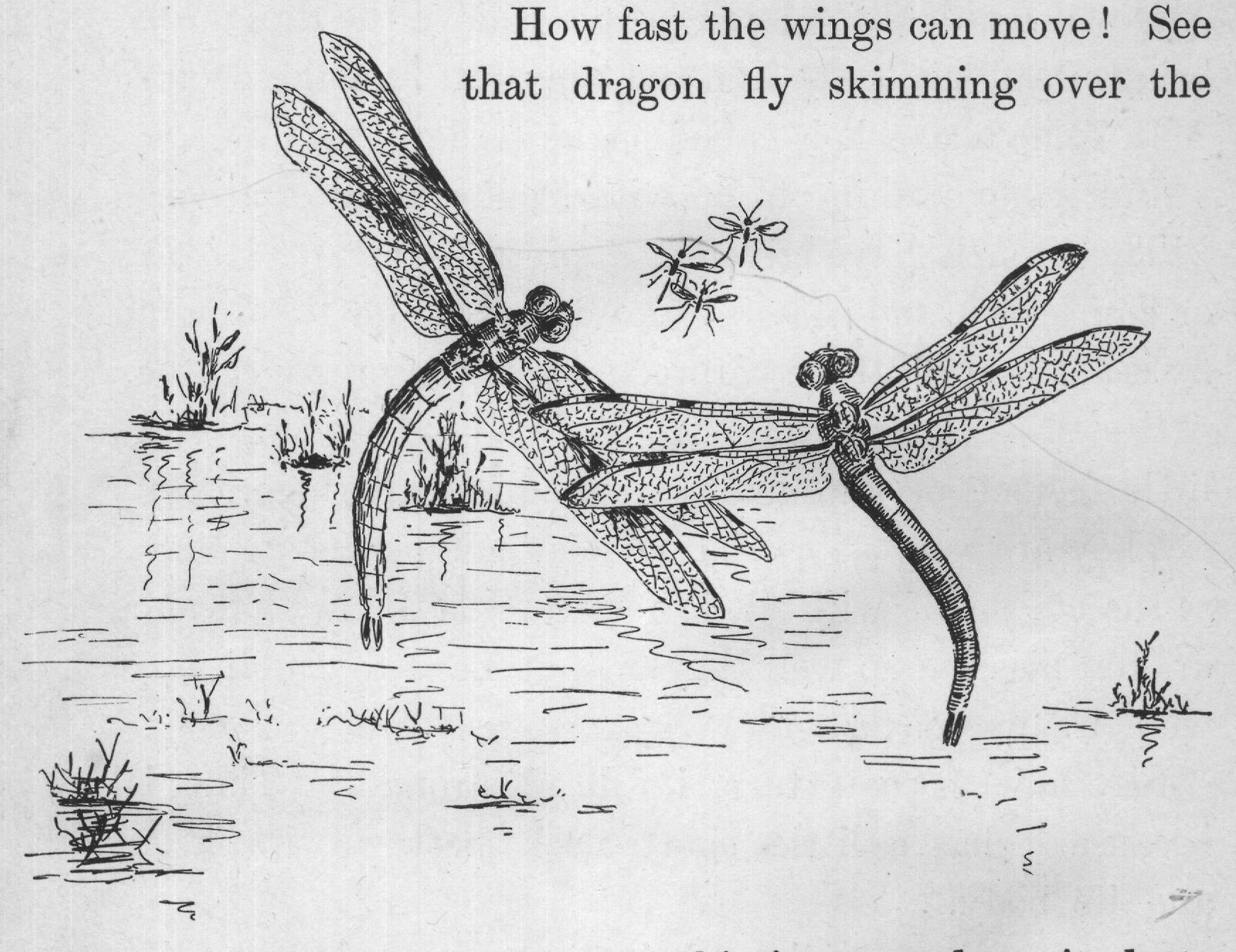
How fast the wings can move! See that dragon fly skimming over the MW pond; its wings make a whizzing sound as it darts about.
Why does it zigzag so?
Why doesn't it fly in a straight line?
Yes, Mollie, you are right, it goes zigzagging along after insects.
It sees one it wants off at one side - whizz! around it turns after it.
Shouldn't you like to fly like that, children?
And yet we would not be willing to exchange our arms and hands for wings.
We could not whittle a stick nor write a letter if we had only wings. do.
In fact we could not do most of the things we now I am glad I have my hands.
We are glad, too, that the dragon flies have their. pretty, swift wings.
They have four wings, all nearly the same size and shape, you see, and they are all stiff and shining.
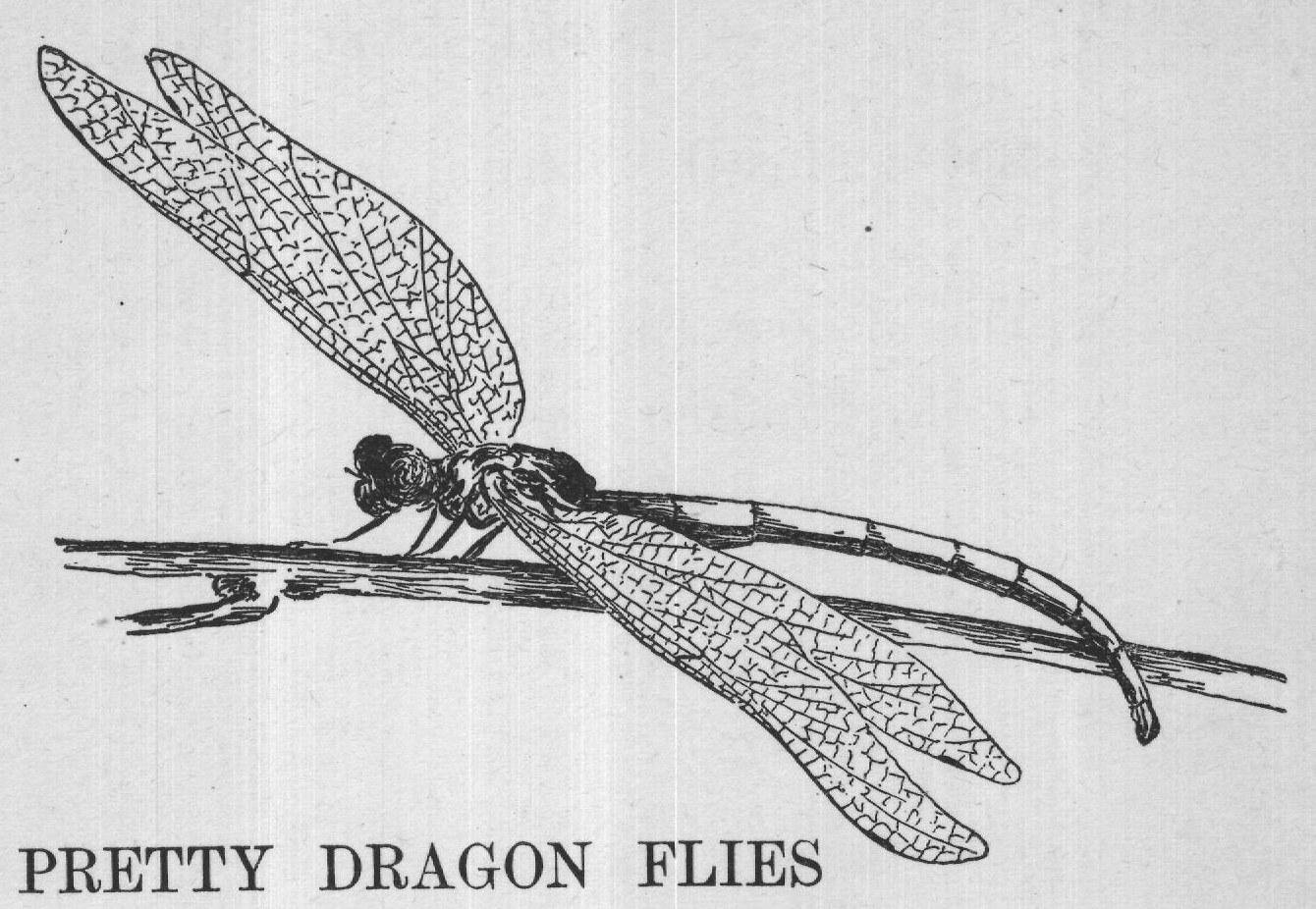
Some dragon flies, like this one we have picked up, always keep their wings spread out.
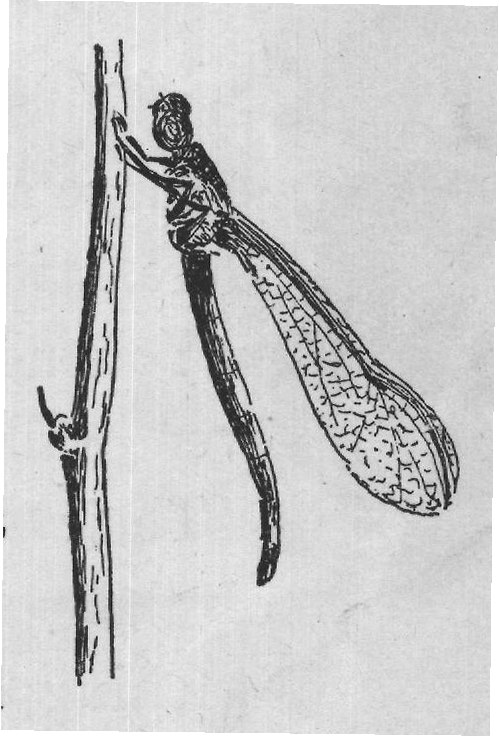
But over there, standing on the end of that stick, is another kind.
When it rests its wings are folded together.
What a pretty one it is! Do you see it?
It is small, but so pretty.
It is bright blue and shines as though it had been polished.
Sometimes birds catch these smaller dragon flies, though birds, as a rule, are not fond of any of them. They are so hard and their wings are so stiff I should think a bird might almost as well swallow nails.
I am sure no bird could swallow one of the big ones, wings and all!
But frogs can.
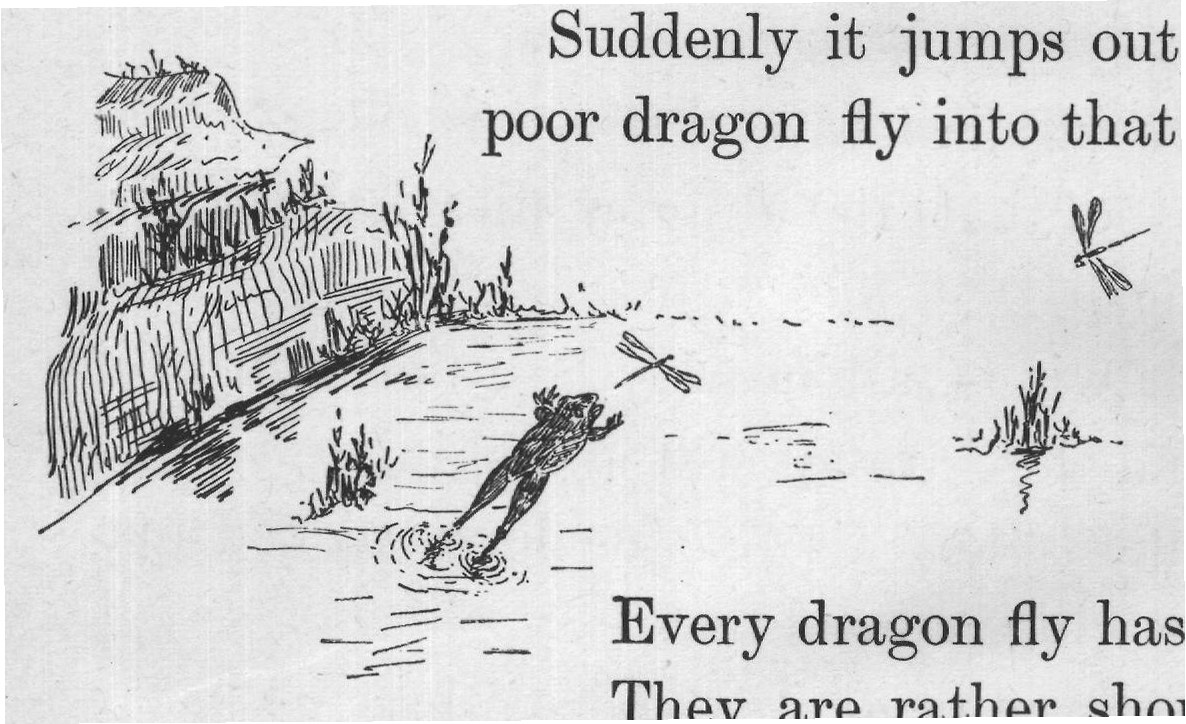
A frog will try to swallow almost anything it can catch, and it watches for the dragon flies when they come to lay their eggs in the water.
Suddenly it jumps out, and away goes poor dragon fly into that great wide frogmouth.
Now look at the legs of the dragon fly. It has six.
Every dragon fly has six legs.
They are rather short and small for so large an insect, but that is because it does not need large, strong legs.
You never saw a dragon fly dig a hole, or run, or even walk, did you?
Their legs are not arranged for walking. All six of them are directed forwards as though they were reaching out after something. And so they arereaching out after insects. Dragon fly catches his prey while he is flying, and he grasps the insects with his feet.
He snatches one, and then what?
Does he sit down somewhere and eat it?
Not he, he is far too hungry for that; he continues his swift flight, and as he flies he eats.
As soon as he has finished one fly or gnat, zip! he snatches another.
A He has an insatiable appetite, consuming hundreds of insects in the course of a day. Nor does he confine his attention to flies and gnats and mosquitoes and such small fry. He catches what he can. large dragon fly will even gorge himself on one of the large-sized butterflies, and one has been seen calmly chewing away at an enormous wasp!
No, indeed, Mabel, the dragon fly does not eat the wings of the butterfly, it eats only the soft body.
Probably nothing eats a butterfly, wings and all.
Birds and insects sometimes catch butterflies, and you often see the bright wings lying on the ground. The wings of insects are not worth eating, and are almost always cast aside by the creatures that eat the insects. Besides catching insects with their legs, the dragon flies cling fast to things with them, but when they wish to move they do not walk, they fly.
Yes, indeed, Frank, you are right; their legs are jointed.
That is so they can move them easily and fold them up when they want to.
They would find it as hard to get along without joints to their legs as we should.
Wouldn't we be stiff if we had no joints!
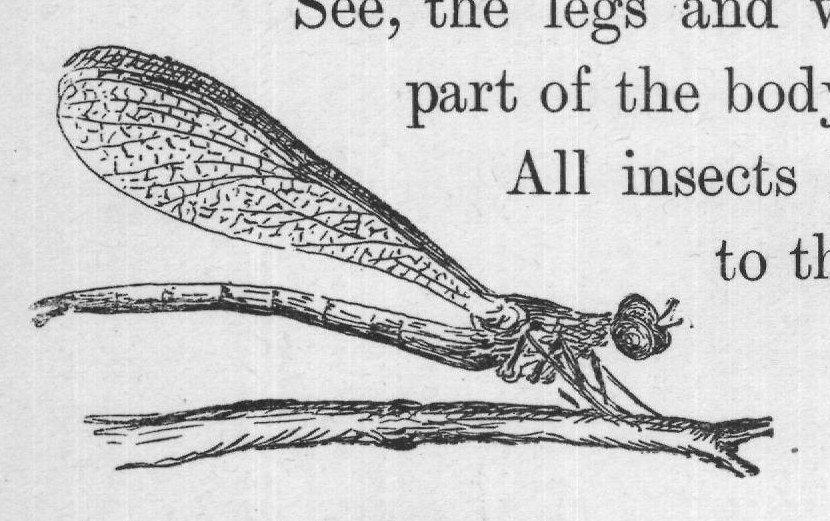
See, the legs and wings are fastened to the middle part of the body, the thorax, we call it.
All insects have the legs and wings attached to the thorax.
The rest of the body is the abdomen. See how long it is.
It is the long abdomen that gives the dragon fly its name of spindle, I suppose. The abdomen is jointed, and it can curl up.
All grown-up insects have a head, a thorax, and a jointed abdomen.
What are you looking at, Charlie?
Something moving in the bottom of the pond?
Let us get it out.
Here, we will dip it out with this cup.
What a lot of stuff!
Sticks and mud-and-what is that?
Something alive, surely.
Let us put some clean water in the cup and examine what we have found.
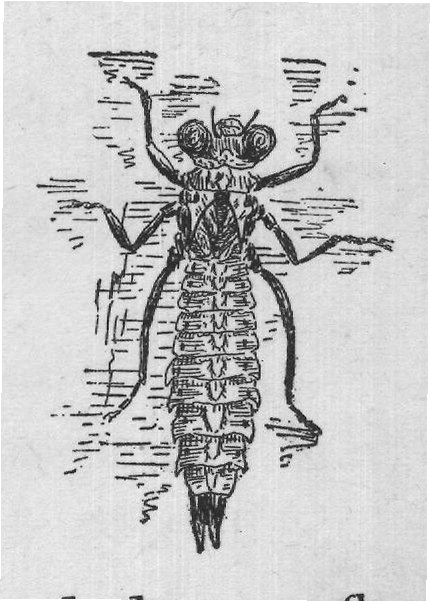
My! my! what a queer little thing!
What do you suppose it is ?
Ah, I know now, but I do not think you could ever, ever guess, not if you tried a week.
It is a young dragon fly!
It does not look much like its shiny-winged parents. It looks like I don't know what, with a face likewell, when you look right in front of it, like a pug dog.
Queer! Well, I should think so!
What is that, Amy? Am I sure it is a dragon fly?
Yes, there is no mistake; a dragon fly one day dropped an egg in the pond, and out of it hatched - this.
It will some day become a shiny-winged dragon fly and catch mosquitoes.
We will call it larva, and we will watch it a little while.