Home › The Sting › The Sting: Park
The Sting: Park
During his travels in Africa Mungo Park in May, 1805, came near being wholly undone by the bees which the people of his guide Isaaco had infuriated.
Park says: "On the 26th, when the party had come up to a place called Bee Creek, a curious accident befell them. Some of Isaaco's people, being in search of honey, disturbed à large swarm of bees, which attacked the men and beasts of the company with such violence as to send them flying in every direction for safety. The severity of this assault may be conceived from the fact, that six asses and one horse were lost - two, if not three, of the asses being literally stung to death, and the other animals being never recovered after their dispersion. Many of the people were seriously stung about the face and hands."
Sometimes bees war with each other, two swarms taking a fancy to the same hive, or one swarm attacking another in order to steal its honey. These battles are at times ter rific, lasting several hours or even days, the slain strewing the field of battle in great numbers.
In itself the sting of a bee is a small enough object, and does mischief out of all proportion to its size or appearance. It would seem as though the anger of the bee was somehow conveyed to that organ and not only was the offender pierced by a pointed instrument but also by the bursting rage, rancor and hatred that at the moment possesses the little termagant. And this in a sense is true, for in a sac oblong, white in appearance, and not much larger than a pin head is stored up a vile fluid composed largely of formic acid, and an organic poisonous principle. This sac communicates with the hollow sting, and into the wound made by that weapon the acrid poison is viciously pumped. The sting is located at the extremity of the abdomen, and the bee's abdomen, like that of other insects, is, as we know, composed of horny rings, each ring made of several parts. These rings are joined to each other by flexible membranes, and fit together so that they may be drawn out and retracted something like the parts of a telescope. The Sting It is this many-jointed abdomen with its flexibility, allowing movement in every direction, that makes the sting such an exceedingly effective weapon, the bee being able to twist its abdomen about and plunge its convenient dagger where it pleases.
Hidden within the hindermost rings of the abdomen is the sting, which is not at all what it seems, for it appears to the naked eye as a smooth, slightly curved needle point, while in reality it is a complex and cruel weapon armed with lances and conveying a virulent poison.
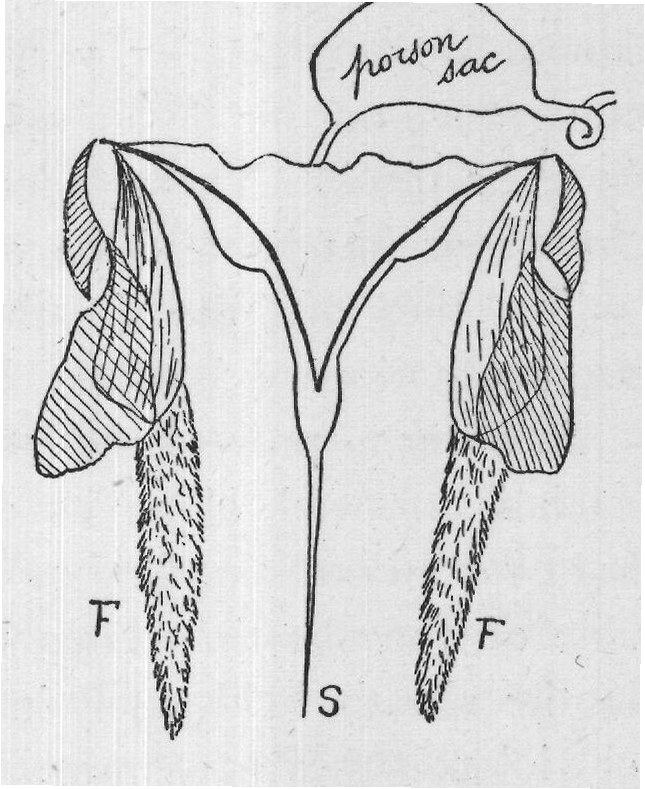
F porsonac F S When the bee desires to inflict a sting the spot is first investigated by a pair of delicate feelers (F) placed just behind the sting and pretty enough, one would think, to poison sac M F L A L F be put to a pleasanter use.
These little feelers work with lightning-like rapidity, and when a spot has been selected the sting (S) is thrust home, all in the twinkling of an eye.
The sting, like the bee's tongue, is not a simple tube, but is composed of several With a good deal of parts. care these parts can be separated and there is found to be an inner sheath bearing a groove along its under side, and into this groove are accurately fitted two lances. The sheath is large at the top where it widens into an oblong hollow pouch A, and it has two rows of microscopic backward-pointing teeth at its tip, although but one row can be seen at a time. The two lances are very slender, very sharp, and lie side by side in the groove on the under side of the sheath, fitting closely in their place. These lances can be pulled out of the groove as has been done at L, L. As they are hollow within, they and the sheath together form a tube. They are not stationary, however, but play up and down.
In order to prevent the lances from slipping out of place each is grooved along its outer edge, the grooves sliding over a corresponding projection that runs along either side of the sheath. Thus the lances ride up and down in the sheath, held safely in place no matter how quickly or violently they may move.
Each lance is viciously barbed at its point with ten stout hook-like projections that point backwards like the barbs on a fish-hook.
The poison-sac opens into the pouch A and on each lance where it lies in this pouch is a curiously constructed valve (X) which acts like the piston in a pump and pushes the poison through the tube in the sting as the lances are thrust down.
The poison is supplied by a long, slender white gland which at length branches into two and lies coiled up like a white thread in the abdomen, ending near the stomach in flattened knobs and opening below into the poison-sac. When the bee stings, the end of the sheath is first driven into the skin and held fast by the barbs at the end. It now acts as a guiding rail as one after the other the lances are forced down, at each thrust going deeper into the victim. The poison escapes from the interior tube through openings on the lower barbs of the lances, The Sting The wound inflicted by the sting of the honey-bee is very minute, being not more than one twelfth or one fifteenth of an inch deep and only one five hundredth of an inch in diameter. So far as the mere puncture is concerned it does no more harm than a prick from the finest cambric needle, but when into these little wounds the stinging poison is pumped that is another story. As soon as the sting enters, the poison is pressed out of the poison-sac by muscles provided for the purpose, and ejected into the wound with spirit and precision.
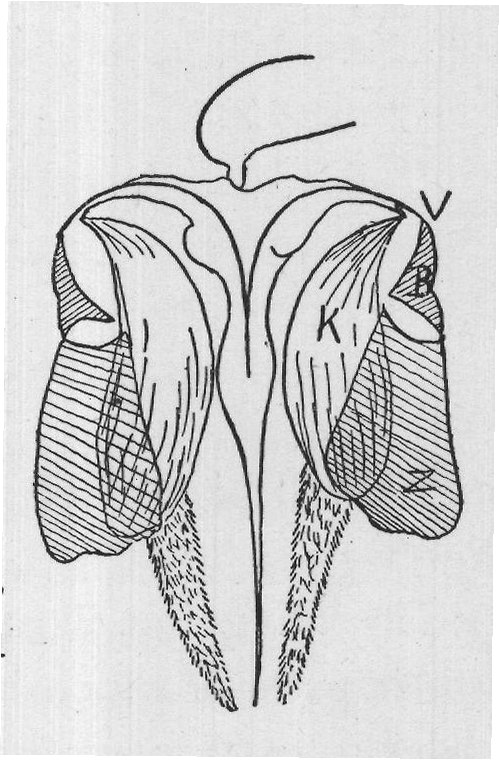
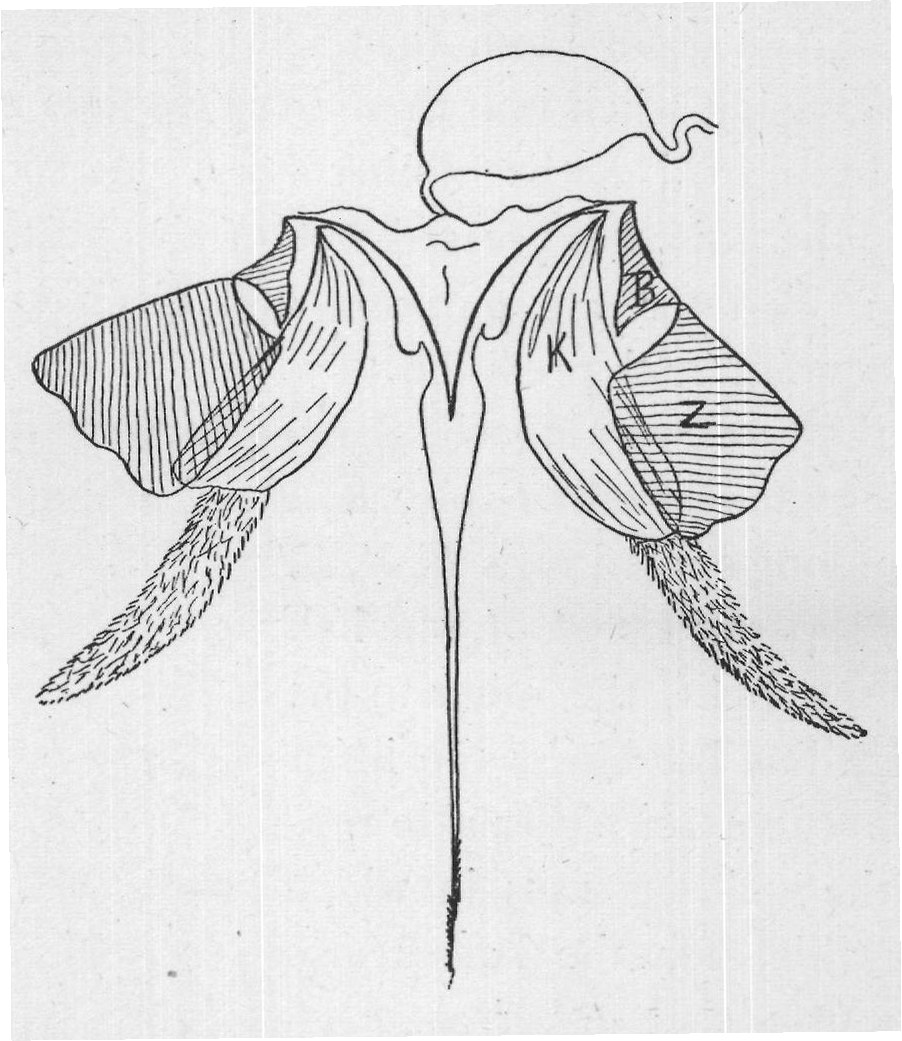
The method of working the lances is very ingenious, three horny plates on either side, K, B, Z, acting as levers to move the long curved rods V, A, S.
The sheath separates at A, A, one half curving to the right, the other to the left, the dark line bordering the inner edge of the curve on either side representing the guiding rails in which the lances ride, for the lances also curve away from each other at A, A, following the divisions of the sheath.
The lances reach beyond the sheath, and at Von either side are articulated to the horny plate B, which in turn is articulated to the plate Z.
These plates act as levers and when they raise the point V the tip of the lance is lowered; when they depress the point the tip is raised.
The plate K attached to the upper termination of the sheath acts in a similar manner, lowering and raising the tip of the sheath.
Muscles attach the plates B, K, Z, to the inner side of the abdominal walls and by contraction move them, when, as has been described, they act as levers upon the long curved rods, moving sting and sheath up and down independently of each other. In the illustration on page 97 the sting is entirely withdrawn; in the following one it is forced out to its full extent, and it will be noticed that the left-hand lance is a little the lower.
The foregoing illustrations are taken from a sting, the upper parts of which have been flattened out somewhat, in order to get an unobstructed view of the working apparatus; in nature the two sides of the sting are folded towards each other so that the plates Z, Z, for instance, are more nearly parallel instead of, as in the picture, standing on the same plane.
A side view of the sting in its natural position in the bee makes the working of the mechanism clearer.