The Legs
ALTHOUGH less airy and poetical than the wings, the legs of the bee have an interest of their own. In fact, when properly understood, they do not fall far short of the wings in poetic value; and if the ancients had known them as we do, the bee's legs, no doubt, would have been immortalized in song and made the subject of innumerable graceful allusions.
As it is, the poets have done scant justice to the legs of my lady the bee, though Milton in "Il Penseroso" thus alludes to her pollen-laden thigh, - "Hide me from the garish eye, While the bee with honeyed thigh, That at her flowery work doth sing, And the waters murmuring, With such concert as they keep, Entice the dewy-feather'd sleep."
And Shakespeare in "Henry IV." - using the bees in a simile - speaks of "thighs packed with wax," a mistake as to the office of thighs, for they never carry wax, but a tribute to the thighs themselves that we cannot afford to let pass unnoticed.
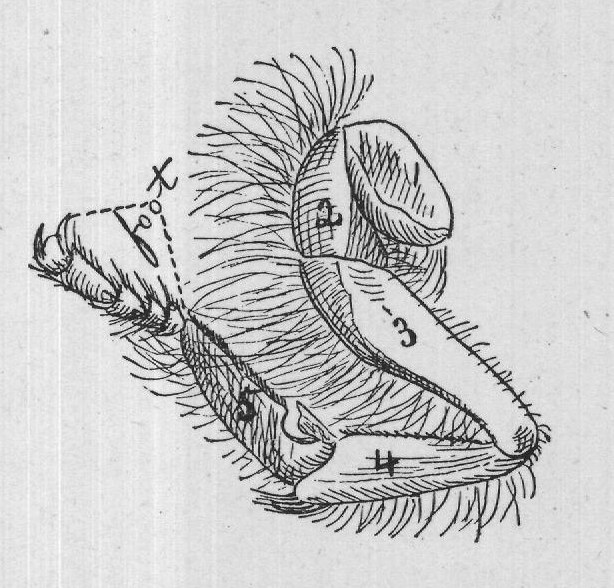
The bee's legs perform the usual offices of legs: running, walking, jumping, climbing, and clinging, and do these things very well; but this is the prose side, for they are furnished with ingenious and beautiful instruments for performing offices not usually accorded to mere legs. But 4 The Legs bees' legs are gifted organs, blessed with a versatility otherwise unknown in the realm of legs. The bee has six of them, as is the habit among insects, three on either side of the thorax and attached to it. Each leg consists of ten joints; a small compact joint (1) next the body, called by naturalists the coxa. This is much alike in all the legs, and serves the useful purpose of attaching the remainder of the leg to the body by a highly movable joint.
Next comes another short joint (2), the trochanter, which serves chiefly to give to the leg freedom of motion. 3 The third joint (3), or femur, is long and rigid; and these three joints are densely clothed with long-branched hairs that have an important office. The fourth joint (4), or tibia, is long and more or less covered with hairs. It is remarkably modified in the different pairs of legs, and is as interesting as anything we have yet seen about this very interesting insect.
The fifth joint (5), or metatarsus, is also long and curious.
The remaining five joints are short and triangular, fitting together so as to give them great flexibility in moving. They are sometimes called the "foot," and the last joint of these consists of the "toes" or "hooks."
The legs gain much freedom of motion from the numerous joints, while the design of the different divisions allows them to be folded up close to the body when not needed.
As organs of walking and running, the legs are efficient enough for the purpose of the bee, who travels only short distances by means of her legs, and who, unlike the spider, the daddy-long-legs, and other long-legged folk, has no necessity for leg speed.
The usual gait of the bee is a rather slow walk, and when she runs she usually evokes the aid of the wings, as the hen does when she attempts to run.
A bee does not jump much excepting when frightened or angry - then she goes along by little hops that make her ladyship appear rather ridiculous - as angry folk are wont to appear. If a captive bee is annoyed by a pencil placed in front of her to cause her to go in a certain direction, instead of travelling as desired, she will often jump at the pencil with open jaws, and give it a good biting for troubling her. She seems to know there is no use in stinging a senseless thing like a pencil, and does not make the slightest attempt to do so. Try to persuade her to change her course against her will with the end of your finger, however, and you will soon discover whether she knows the difference between that and a pencil.
The "foot" of the bee, being extremely flexible, enables its owner to gather flower-petals in her grasp, so to speak, and to curl her foot about the edge of a stalk or a cell of honey-comb. The final joint is particularly movable, and consists of two pairs of curved and pointed hooks, or "toes," a tuft of long, strong hairs between them, and a curious, soft, and flexible disk X, also lying between the pairs of hooks, and enabling the bee to climb upon smooth and upright surfaces.
This little white disk can be seen with the naked eye when the bee is ascending a window-pane, and like the foot of the fly it exudes a liquid that enables the owner to cling to the glass.
By a certain motion of the foot the disk is peeled up and the bee freed.
The Legs When walking on rough surfaces, the disk, or pulvilla, is folded together and turned back out of the way, the toes clinging to the irregularities.
The toes can be turned up so as to form veritable hooks from which the bee can suspend itself. The strength of these hooks is remarkable, they being able to maintain their position hours at a time, and bearing several thousand times the weight of the bee, as in the case of swarming, where the upper bees are hooked fast to the tree branch or other support, and the rest of the swarm suspended from them.
The six feet are all alike; but while the legs share equally in the labors of walking, running, jumping, clinging, and climbing, each pair has its own individual duties, different from all the rest; and to aid in the performance of these duties, each has its own special and peculiar implements with which to accomplish its designs. The foremost pair of legs is the smallest and shortest, being attached to the thorax as close to the head as possible. These legs are indeed the servants of the head, keeping it and its important organs free from disturbing substances.
One prime function of the legs is to keep the bee clean. A cat does not make as elaborate a toilet nor keep itself as neat as a bee, the cleanliness of the little creature having been noticed and commented upon from Aristotle down. Butler says, "For cleanliness and neatness they may be a mirror to the finest dames." * * To watch a bee at its toilet is as edifying as it is amusing. One does not need to arrive at a certain hour nor wait at all for the performance to begin. - It is only necessary to catch your bee - and let it free on the window and it will at once commence upon its elaborate and endless toilet. If it is sulky, or perchance considers itself clean enough for the present company, it can at once be brought to another mind by breathing upon it, when it will fall into a very justifiable rage and after venting its feelings in strong bee language will fall vehemently to work freeing every part of its diminutive person from the obnoxious exhalations. Or, dust it ever so lightly with a bit of fine flour.
No matter how dusty it is, or how badly stuck up from having been cruelly smeared with honey or syrup, it will cause itself to shine like a new bee in a few minutes, unless its spiracles have been smeared over and closed, when it will perish from suffocation.
First of all, its front legs will clean its precious antennæ. Since the antennæ bear the principal sensory organs it is very important that they be kept perfectly clean at all times, and this is accomplished by an almost ceaseless applying of comb and brush to these wonderful organs. It is the duty of the front legs to clean the antennæ and they are always ready - and nearly always doing it. In the midst of honey-gathering after every dip into a pollen-dusted flower the bee stops for a second to clean the dust from its feelers. This can be done very quickly, though a thorough cleaning takes more time, and a bee may often be seen apparently resting from its labor on a clover-head. But it is not resting - it is cleaning its antennæ. Whenever a bee appears to be resting in the midst of its work you may be pretty sure it is doing nothing of the sort but on the contrary is as busy as a bee can be The Legs removing every pollen grain and particle of dust from its ear-holes, smell-hollows, and sensory hairs.
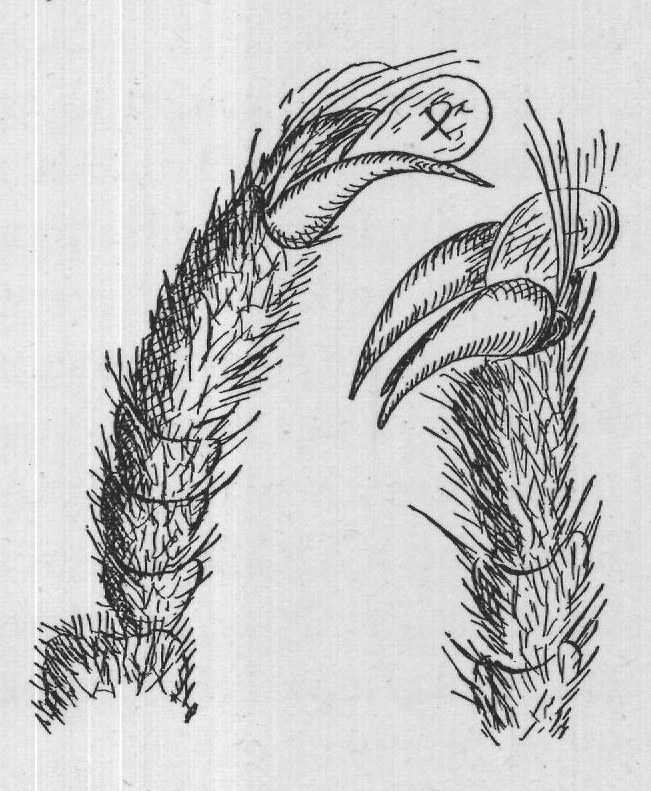
This it does by a very ingenious apparatus in the bend of the foreleg between the tibia and the metatarsus, - that is, between the fourth and fifth joints.
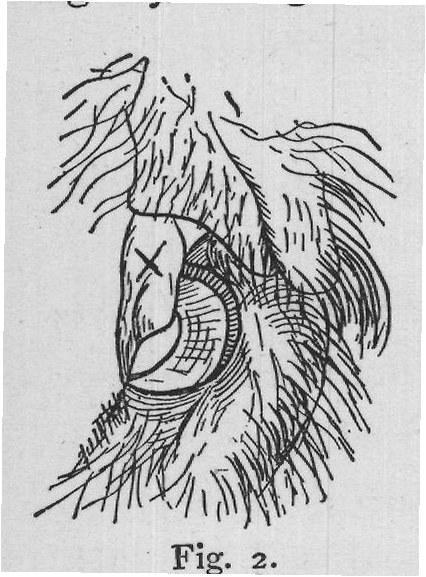
On the upper inner edge of the metatarsus is a semicircular groove just large enough to hold the antenna and surrounded on the outside edge by an outward pointing comb of very fine teeth. Hanging from the lower inside edge of the tibia is a curious valve-like structure X, which, when the leg is flexed (Fig. 2) covers the opening to the semi-circular groove.
Fig. I.
Seen from above this lid or valve somewhat resembles a slightly irregular curved fish scale with a keel running through the centre.
Fig. 2.
The antenna, when the leg is raised above it and then lowered, slips into the groove, the leg joint is then flexed, bringing the valve down so that the antenna is caught as in a trap. The leg being moved outward, the antenna is drawn through, the comb on one side and the thin edge of the valve on the other scraping it clean.
This apparatus is evidently designed specially for cleaning the antenna and is a remarkable illustration of the development of an organ for a special purpose.
It is used very quickly and very frequently, and one watching a bee will surely see it draw its feelers through the cleaners.
The cleaning apparatus can be seen with the naked eye, particularly on a large bumble-bee, and very beautifully seen through an ordinary magnifying lens.
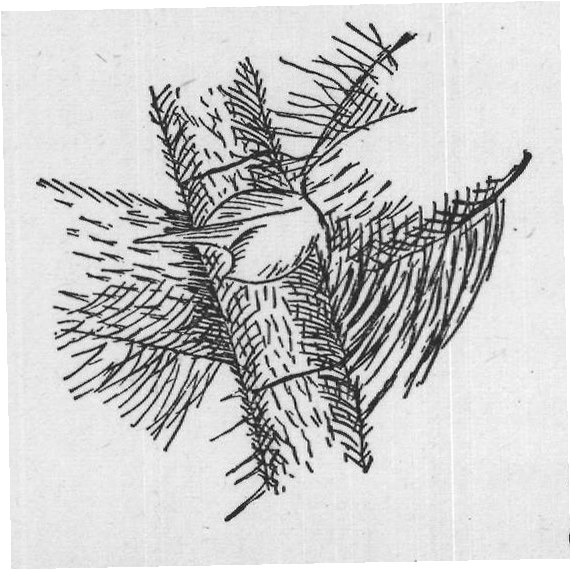
Along the back of the joint containing the groove is a row of stiff strong hairs, as can be seen in the illustration, of stiff strong hairs, as can be seen in the illustration, and these serve the purpose of an ordinary hair-brush, combing or brushing out the dust and pollen from the hairs on the bee's head, and particularly from the eye hairs.
Almost as often as the bee cleans its antennæ it brushes its head and eyes.
There is another important brush on the forelegs, opposite the hanging valve, used to sweep out the teeth of the groove on the opposite leg and to clean off the pollen from the long branched hairs that grow upon the four upper joints of the leg.
The stiff hairs on the short foot joints are also toilet brushes .
Instruments that do so much cleaning for other parts must themselves be kept clean, and this office the forelegs perform for each other. The bee may often be seen standing on its four hindermost legs apparently washing its hands with invisible soap in invisible water. Then it crosses its arms thus bringing the outside of one against the brush of stiff hairs on the outside of the other, and moves the two up and down until both are thoroughly cleaned.
The proboscis does not escape in the general cleaning up but is lowered, grasped by both forelegs at once, and vigorously polished.
It is amusing to watch a bee standing on its four remaining legs and holding fast to its tongue with both hands as it The Legs were, though occasionally when needing its forefoot for support it will have but one with which to rub its tongue.
Butler treats us to the following: - "Her rough and dew-clawed feet, apt to take hold at the first touch, are in number six: that she may stand fast upon four, while she useth the other two to wipe her eyes, her wings, her tongue, or any other part."
Neither are the jaws neglected, but occasionally are opened and polished by their tidy owner.
The top of the bee's head, the thorax above and below and the upper joints of all the legs are clothed with long branched hairs for collecting pollen. These "gathering hairs" are admirably planned to catch and hold the pollen grains that touch them, and are found on all pollengathering bees. The pollen that adheres to the legs and body of the bee is a valuable part of its food, and is by it brushed together and saved.
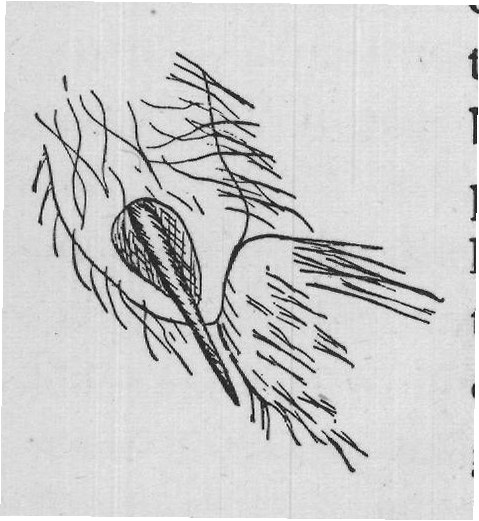
The second pair of legs is larger and longer than the first pair. These legs have no antennæ cleaners, but at nearly the same place on the tibia is a long stout spur used in cleaning the wings and body as well as to push out the contents of the pollen baskets that are located on the third pair of legs. The metatarsus of this leg is covered with a coarse brush and the bee can often be seen with one of its middle legs over its back energetically rubbing the pollen from the branched hairs there and frequently lowering the leg so employed to rub it between the back legs and relieve it of the accumulated load.
The bee is also frequently seen with one of its middle legs doubled under it, in the act of rubbing the pollen from the hairs of the breast.
The last or third pair of legs is perhaps the most curious and interesting of all.
Upon them are the baskets for storing and carrying home the pollen; these are borne by all the workers but not by the queen and drones.
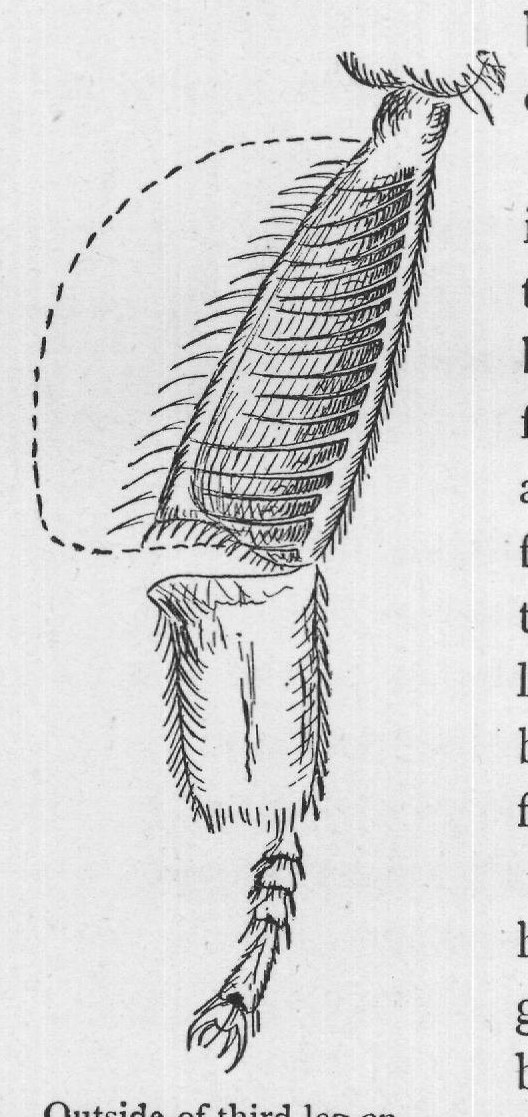
Outside of third leg on right side. Dotted lines represent load of pollen.
The pollen-basket, or corbiculum, is the hollowed outer side of the tibia bordered by stiff hairs. The hairs along the edges curve in, thus forming the sides of the "basket" and preventing the contents from falling out. Every one has noticed the "honeyed thigh" of the bee, as laden with yellow, white, red, or brown pollen it scrambles over the flowers adding to the load.
In order to bring its branched hairs in contact with the pollen grains the bee rushes about over a bed of flowers as if looking for something it had lost, scampering back and forth and turning about in a dazed manner.
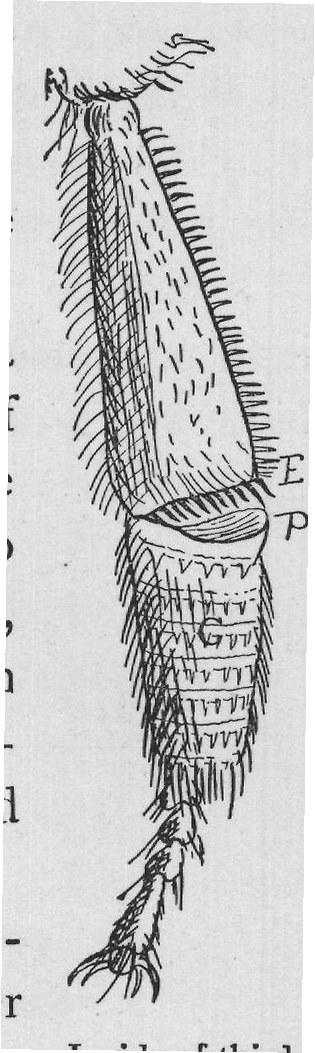
When on a single flower it gathers the pollen from the anthers with the legs, scraping them back and forth against each other to good purpose as the rapidly enlarging ball of pollen on the " thigh proves. The pollen is made sufficiently adhesive by being occasionally moistened with honey. " Sometimes bees gather honey and pollen at the same The Legs time, sometimes nothing but honey as the bare thighs testify, and sometimes nothing but pollen. At the joint between the tibia and metatarsus, and best seen on the inside of the leg, is a curious modification known as the wax-jaws. This in reality is a pair of pincers by which the bee grasps and removes the scales of wax from the abdominal plates. The end of the tibia (E) is curved and fringed with stiff hairs that shut down against a plate (P) on the metatarsus, thus forming the "jaws."
The metatarsus on the inner side bears a beautiful shining golden-brown comb (C) of several rows of stiff bristle-like hairs. These comb pollen from the breast of the bee, comb down the wings, clean the middle pair of legs, clean the abdomen above and below and clean each other. With the exception of the antennæ cleaners they are the most often used of all the implements of the toilet.
The wing is cleaned by being caught between the body and these combs; the upper wing by itself, first one side and then the other, and the lower one in the same way. ارا Inside of third right leg.
E P These combs also make the final gathering of pollen and deliver the load to the basket of the opposite leg.
On all the legs cleaning hairs are mingled with the gathering hairs in order to keep the pollen-dusted little creature free.
Bees will clean each other of honey, though they do not take equal pains to restore to purity a sister distressed by other substances.
When disturbed slightly bees have a curious habit of raising the middle and last legs on one side of the body, as if they meant to strike, or give warning to the intruder to stand back.
Bumble-bees are particularly given to this habit, and it is very amusing to see the warning legs fly up when one comes too close.
The legs are always used in this way when a stranger bee comes too near and the intruder thus repulsed generally takes the hint, unless it happens to be out of temper, when a fight ensues, a fight that always leaves the wounded in the throes of death.
It may be that these elevated legs are useful in catching hold of an enemy, for in this position the body can easily be jerked around and the fatal sting inserted.