Home › The Drone › The Drone: Bees
The Drone: Bees
Moffett uses the time-honored privilege of abusing the drone, to whip, at the same time, his Roman Catholic brethren. "Some have stings (as all true Bees have :) others again are without a sting, as counterfeit and bastardly Bees, which (even like the idle, sluggish, lither, and ravenous cloystered Monks, thrice worse than theeves) you shall see to be more gorbellied, having larger throats, and bigger bodies, yet neither excellent or markable, either for any good behaviour and conditions, or gifts of the minde. Men call them unprofitable cattle, and good for nothing, Fuci, that is, Drones; either because they would seem to be labourers, when indeed they are not: or because that under the colour and pretence of labour (for you shall sometime have them to carry wax, and to be very busie in forming and working Honey-combs,) they may eat up all the Honey."
The ancients sometimes speak of the drone as if it were not a bee at all, but some other insect that made its nest with the bees. Some believed that it laid its own eggs and made its own cells, using the hive only as a convenient resting-place where it could get food at others' expense. - The following is Pliny's opinion of it : "The drones have no sting, and would seem to be a kind of imperfect bee, formed the very last of all; the expiring effort, as it were, of worn-out and exhausted old age, a late and tardy offspring, and doomed, in a measure, to be the slaves of the genuine bees. Hence it is that the bees exercise over them a vigorous authority, compel them to take the foremost rank in their labours, and if The Drone they show any sluggishness, punish them without mercy. If you deprive a drone of its wings, and then replace it in the hive, it will pull off the wings of the other drones." Needless to say, it will not pull off the wings of the other drones if reduced to that unpleasant condition. Neither will it labor, no matter how mercilessly it may be punished.
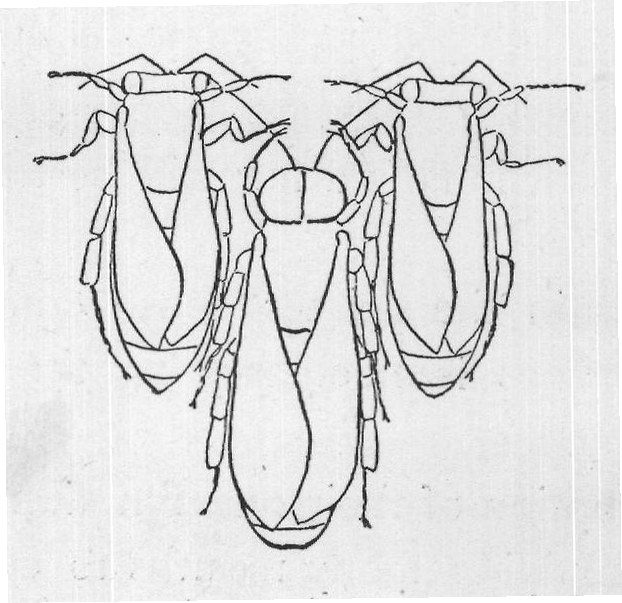
After ages of scorn and contumely, it is time for some one to break a lance in the service of the drone.
It is time for some one to proclaim him for what he is, next to the queen the most important bee in the hive, and to demand that he be recognized as such by the old and the young, by the wise and by the foolish.
His destiny is a hard one, but he is not ignoble. He merits the crown of martyrdom, though he is the most cheerful martyr imaginable. He is the male bee; and if in other creatures his sex is pre-eminent, in him the tables are indeed turned, and he finds himself wholly at the mercy of the worker-bee, who has no mercy.
He is carefully nurtured in infancy, being, like the queen, fed on royal jelly.
He comes forth an innocent and happy bee, capable of enjoying life, but unfitted to share in the labor of the hive.
By no fault of his own he has a very short tongue, too short to gather honey from the flowers; he has also small weak jaws quite incapable of working in wax or performing any other difficult task. He has no wax glands, no honeysac in which to convey sweets to the hive; no pollen baskets on his legs, and no well-developed gathering hairs on his body. So far as work is concerned, he is by destiny an aristocrat and suffers the fate of the aristocrat born into a communistic society.
He is large, being more bulky than the queen, though not so long in the abdomen. His wings are large and powerful, though he does not use them often.
He has a large round head with particularly fine eyes, his great compound orbs covering the sides of his head and meeting on top, thus crowding the three simple eyes out of their places to a lower position between the compound eyes. Each eye contains the enormous number of more than thirteen thousand facets, the worker having only half that many.
The Drone.
He has thirteen joints to his antennæ instead of twelve, and these remarkable organs each contain nearly thirty-eight thousand smell-hollows.
Thus magnificently equipped with sense organs, he forms a striking contrast to his mother, the queen.
He is a handsome creature with his sheeny wings drooping about his bright form, making what Butler calls his "side gown." His back is covered by a soft golden-brown down as though he were clad in a jacket of fine velvet, and his legs are long, strong, and beautiful. He is less hairy than his sisters, the workers, though the end of his abdomen is fringed with rows of bright brown hairs. He is also less intelligent, for although his head is large, his brain is small.
On the whole, with his big eyes, velvety body, and gossamer wings, he is as pretty a bee as any in the hive, when regarded without prejudice, and he is certainly pleasanter to handle, as he never under any circumstances stings, one of his masculine peculiarities being the total absence of a sting.
If teased, he will sometimes go through all the motions of stinging, perhaps as an inherited remembrance of his mother's original power in that direction. And he will also threaten with his tiny jaws, showing plenty of mascu- .
The Drone line courage, even though he lacks weapons to make it effective.
He will thrust his short tongue into a drop of honey given him, though he much prefers running to one of his sisters and getting her to feed him, which she is usually perfectly willing to do.
Like the queen, he is devoid of pollen-digesting glands, and thus all his life he is partly dependent upon his sisters for food.
He appears just before the swarming season as a rule, and there may be hundreds, or even thousands, raised in one hive.
Since each queen mates but once, and consequently only one drone is necessary to every swarm, the question arises as to why so many are produced.
Doubtless for two reasons, that no time may be lost when a queen flies abroad, and that cross-fertilization may at least occasionally be insured.
The meeting between the queen and the drone takes place high in the air, and it is essential that the queen remain abroad as short a time as possible. Being large and conspicuous, she is in danger of falling a prey to insecteating birds, or she may be blown into streams, or carried away by the wind and lost.
For these reasons it is also desirable that she be not obliged to fly forth more than once, as she assuredly will, if not successful in finding a mate the first time. On sunny days the drones fly abroad in the middle of the day, the time when the young queens go forth.
As soon as a queen takes flight, any drones that chance to be near follow. And now is explained the cause of the drone's splendid sense endowment and of his large strong wings. All of his superior equipment is needed to help him in the race. The victory is to the best, and thus are transmitted to posterity the qualities of the best.
But even here the strange Nemesis of the drone's life follows him. The victor puts forth his splendid powers to the utmost, succeeds, provides for the life of countless descendants, and as a result dies.
Nor is this the end of the tragic tale. As the season advances and the drones are no longer needed, they are slaughtered in the most ruthless manner by the workers. Huber gives a graphic account of this act of anticipative economy, he having constructed a glass support for his hives, beneath which one could lie and observe what took place within. He placed six hives upon the glass table, and this is what he says: - "On the 4th of July, we saw the workers actually massacre the males in the whole six swarms, at the same hour, and with the same peculiarities. The glass table was covered with bees full of animation, rushing upon the drones as they came from the bottom of the hive; they seized them by the antennæ, the limbs, and the wings, and, after having dragged them about, or, so to speak, after quartering them, they killed them by repeated stings directed between the rings of the belly. The moment that this formidable weapon reached them was the last of their existence: they stretched their wings and expired. At the same time, as if the workers did not consider them as dead as they appeared to us, they still darted it so deep that it could hardly be withdrawn, and they were obliged to turn round upon themselves before the stings could be disengaged. "Next day, having resumed our former position, we witnessed new scenes of carnage. During three hours, the bees furiously destroyed the males. They had massacred all their own on the preceding evening, but now they attacked those which, driven from the neighboring hives, had taken refuge amongst them. We saw them also tear The Drone some remaining nymphs of this species from the combs; they greedily sucked all the fluid from the abdomen, and then carried them away. The following day no drones remained in the hives."
Often the bee-keeper anticipates the onslaught by the workers; and when the drones go forth for an hour in the sunshine he narrows the entrance to the hive so that the workers can pass, but the drones, being larger, cannot return. When the banished ones have collected disconsolately on the outside of the hive, they are swept into a vessel of water, and to put the crown upon their misfortunes - ignominiously fed to the chickens!
The ancients also excluded the drones by narrowing the entrance to the hive, as we learn was done as far back as the time of Aristotle.
The edict of banishment by the bees themselves goes forth early or late in the season according to the condition of the storehouse. In a successful season the drones are tolerated longer than in a poor one. If the colony is weak or the honey flow slight, the drones may be cast out early in the summer, but under better circumstances they may be allowed to remain even as late as November. In a prosperous colony, however, they are sooner or later destroyed, excepting that occasionally a few will be tolerated through the winter.
The bee-life is in the strictest sense communal, and the death of the drones is necessary to the welfare of the community.
With the exception of their one function, they are worse than useless, supplying many mouths to consume the precious stores. Idle members are a menace to the safety of the community, hence even such workers as become incapacitated are said to be ejected, and even the queen grown old or useless is sometimes sacrificed by her whilom attentive subjects. As Pliny says, they know of nothing but what is for the common benefit of all.
The drones are the least tenacious of life of all the bees. When sent in a mailing box with queen and workers, several of them will generally arrive dead, and the others soon die, every drone having disappeared as a rule before a single worker succumbs. The drone is as easy to kill as the queen is difficult, a very short application of chloroform being sufficient to end his term of existence. He is more delicate than any of the bees, sipping daintily of prepared sweets, flying only for pleasure in the warm sunshine, disappearing with a breath or a rude touch. Since he dies so easily it may be that death is not painful to him; he struggles not, but passes on.
His wing music is more sonorous than that of the other bees, giving a droning sound, from which he gets his name and by which he is easily recognized by a practised listener.