Home › Eyes, Antenne, and Brain › Eyes, Antenne, and Brain: Huber
Eyes, Antenne, and Brain: Huber
No doubt bees recognize their queen by touching her with the antennæ, as Huber performed a number of careful experiments to prove. He separated the queen from the bees by a wire partition, through which they could see, hear, and smell her, but could not touch her; and they soon betrayed all the symptoms of a queenless colony, and began to build cells in which to raise a new queen. But when the queen was so confined that they could touch her with their antennæ, they showed no inclination to build queen cells. They knew she was there, and they were comforted.
Doubtless, too, the information that the queen is missing is conveyed from bee to bee by crossing the antennæ, as Huber also demonstrated.
With its antennæ alone, our bee would be better endowed with sense power than seems to be the case with many a being having a merely human complement of eyes, ears, nose, and tongue.
One can but wonder if the bee's joy in living is acute in proportion to the amazing sensitiveness of these wonderful organs. We should very much like to know that.
Inside the head is the motor that runs the tongue, eyes, and antennæ, and gives the bee its consciousness of the outer world.
The small size of the bee's brain makes its power seem to us the more wonderful. From it emanates such wisdom that from all time the bee has been held as a model before mankind.
Concerning it Moffett says, voicing the beliefs that had come down through the ages, "Whereas the Almighty hath created all things for the use and service of Man, so especially among the rest hath he made Bees, not only that they should be unto us patterns and presidents of political and oeconomical vertues, but even Teachers and School masters instructing us in certain divine knowledge, and like extraordinary Prophets, premonstrating the success and event of things to come." And again, - "Xenophon likewise in his Oeconomicks, termeth Honey-making the Shop of vertues, and to it sendeth mothers of Housholds to be instructed. Poets gladly compare themselves with Bees, who following Nature only as a School-mistress, use Art."
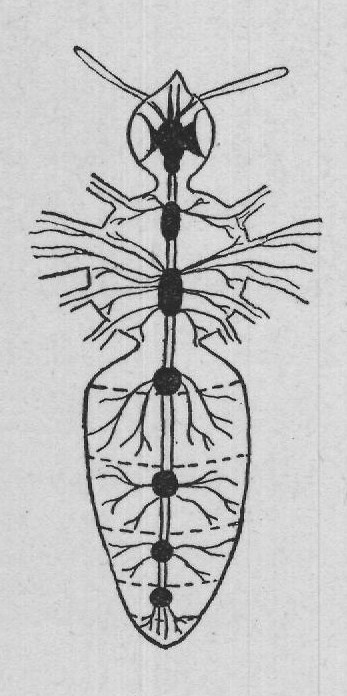
Although the bee's brain is so small an object, it is complex, and can better be understood by a brief glance at the general nervous system.
In the larva, which is the undeveloped bee, there is very little differentiation of the nervous system.
The business of the larva is to eat and assimilate food Eyes, Antennæ, and Brain through all parts of the body. Hence the nervous system is very much alike from end to end, the ganglia being but little larger and more complex at the head end.
In the adult bee the conditions of life are very different. Instead of devoting its life to eating, it now devotes it to providing food for others, and in performing many complex actions requiring a high form of intellect. Consequently in our adult bee we have the nervous system centred more toward the head, and culminating in a comparatively large and well-developed brain.
So far as the nervous material of bees is concerned, there is no great difference between them and ourselves. Their form demands a different location for nerve-trunks, but the nerves themselves, like those of the higher animals, are composed of bundles of sensory and motor fibres, and distributed along the course of some of the nerves are found ganglia. The brain is composed of gray and white matter, as in the higher animals, and is without doubt the organ of consciousness and intelligence.
Besides containing the brain, the bee's head holds also three sets of glands, the smaller one opening within the mandible on either side, while a larger set opens at the base of the tongue.
The secretion of these two sets of glands is probably saliva, and with it must mingle any nectar entering the bee's mouth, and thus probably is the nectar at once partly changed before it reaches the stomach.
The third set of glands within the head opens into the mouth, and is credited with very remarkable func- 56 The Honey-Makers tions, first secreting the silk of which the larva spins its cocoon, and later supplying a liquid food for the young bees.
Numerous muscles, as we know, also find a resting-place and points of attachment within the head.