Home › The Throne of England › The Throne of England: Scottish
The Throne of England: Scottish
They are supposed to have brought with them Jacob's stone, and it is described as being "in fashion like a seate or chayre, having a fatall destinie, as the Scottes say, following it, that wheresoever, it shoulde be founde, there shoulde the Scottish men raigne and haue the supreme gouernance. Hereof it came to passe that first in Spaine, after in Irelande, and then in Scotlande, the kings which ruled ouer the Scottish men receyued the crowne sitting upon that stone, untill the time of Robert the First, king of Scotlande." It is said to have been taken to Ireland about 700 b.c. by Simon Brech, king of Scots. Thence it was taken to Scotland by King Fergus, about 330 b.c., and in 850 A.D. it was placed in the Abbey of Scone by King Kenneth. He found it at Dunstaffnage, a royal Scottish castle, the sandstone of which has a very near resemblance to the stone itself; in fact, it is undoubtedly, geologically speaking, the same dull reddish sandstone. It must not be forgotten that the Mohammedans say that Jacob's stone is now preserved at Jerusalem, and that consequently our story is not the true one. King Kenneth had the stone enclosed in a wooden chair, of which the present one is a copy made for Edward I. (Fig. 45), and particulars concerning it are to be found in his Wardrobe Accounts. It was originally gilded, painted, and inlaid in places with glass mosaics, traces of which can still be seen on a careful examination, especially on the back of the chair. It was dedicated by Edward I. to St. Edward the Confessor in 1297, and the part of the Abbey in which it is kept is still known as St. Edward's Chapel. Edward had an engraved plate inserted in the stone, and on it the legend- "Ni fallat fatum, Scoti hunc quoqunque locatum Inveniunt lapidem regnare tenentur ibidem"; which may be translated- "Except old saws do fail, and wizards' wits be blind, The Scots in place must reign where they this stone shall find." This plate is now gone, but a space remains to mark the place to which it was formerly attached. A cross is cut upon the stone, and it has old handles at the ends. Another superstition concerning it was that it would groan or speak whenever any of the monarchs of the Scythian race seated themselves upon it. This must have been known to Hector Boece, who gives a fuller version of the old Scoto-Irish prophecy which, being translated, says- "Unless the fixed decrees of fate give way The Scots shall govern and the sceptre sway, Where'er this stone they find, and its dread sound obey." During the Great War 1914-19, the stone was removed to the vaults for safety against the German air attacks. The four lions upon which the chair rests are gilded, and one of them had a new face given him for the coronation of George IV. During the coronation ceremony itself the chair is carefully covered with cloth of gold. Its appearance when thus prepared shows admirably in Sir George Hayter's beautiful picture of the coronation of Queen Victoria, in which the Queen is seen just after she has been crowned, holding in her right hand the royal sceptre with the cross, and in her left the sceptre with the dove, and wearing the colobium sindonis, stole, dalmatic, and mantle. She also has a high footstool, and the Plate XVI QUEEN ELIZABETH'S SALT-CELLAR THE THRONE OF ENGLAND Gothic pinnacles at the top of the chair were apparently restored for the occasion (Fig. 46).
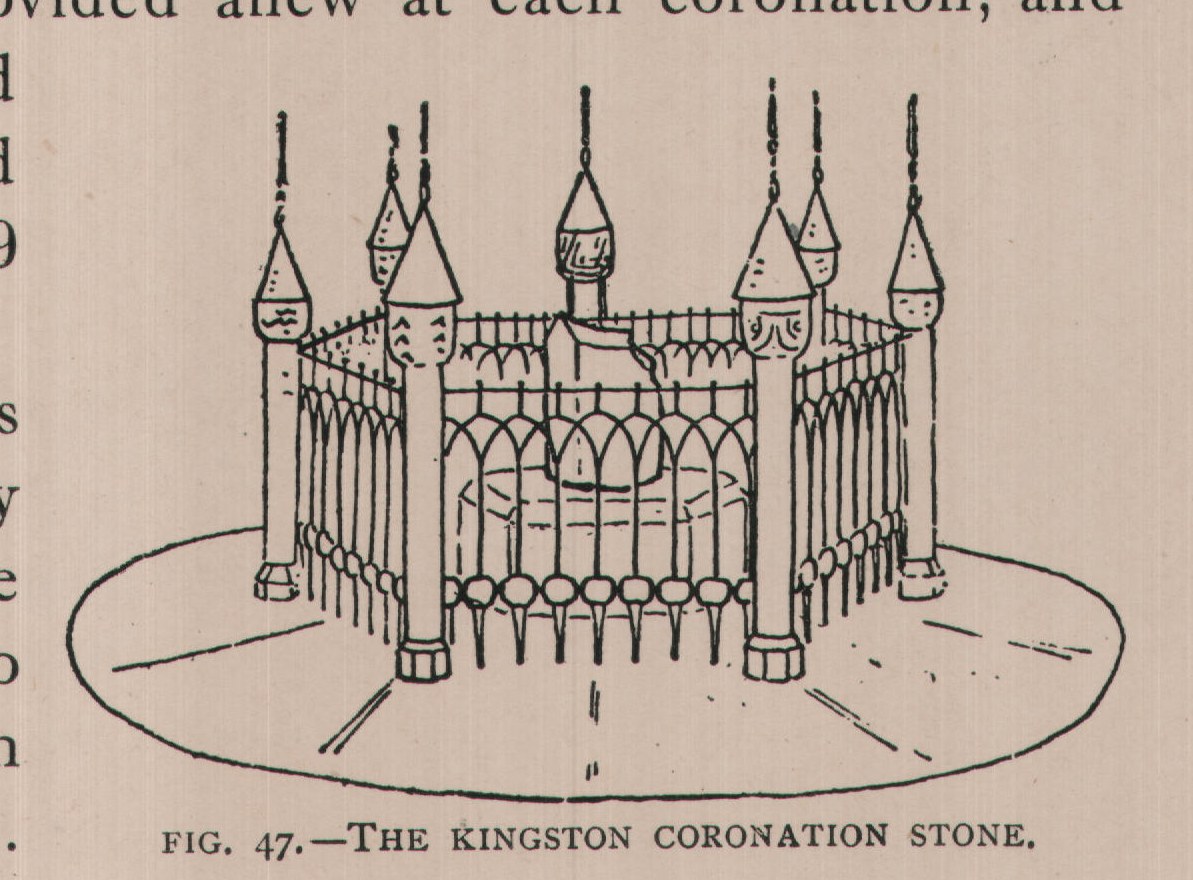
Sacred stones have been used in many countries and at many times as seats for the coronation ceremonies of kings; and although the stone which has been used in England since the time of Edward I. for this purpose came, as we have seen, from Scotland, we possess at Kingston an old piece of what was most likely a holy Druidical stone of purely English origin. This stone was used for the coronations of some of our Saxon kings certainly, and, probably enough, for more of them than is recorded. As early as the reign of Edred, in 946, in a charter, mention is made of Kingston as the royal town in which the coronation was usually performed, and the fact of the stone being there gives the place its name.
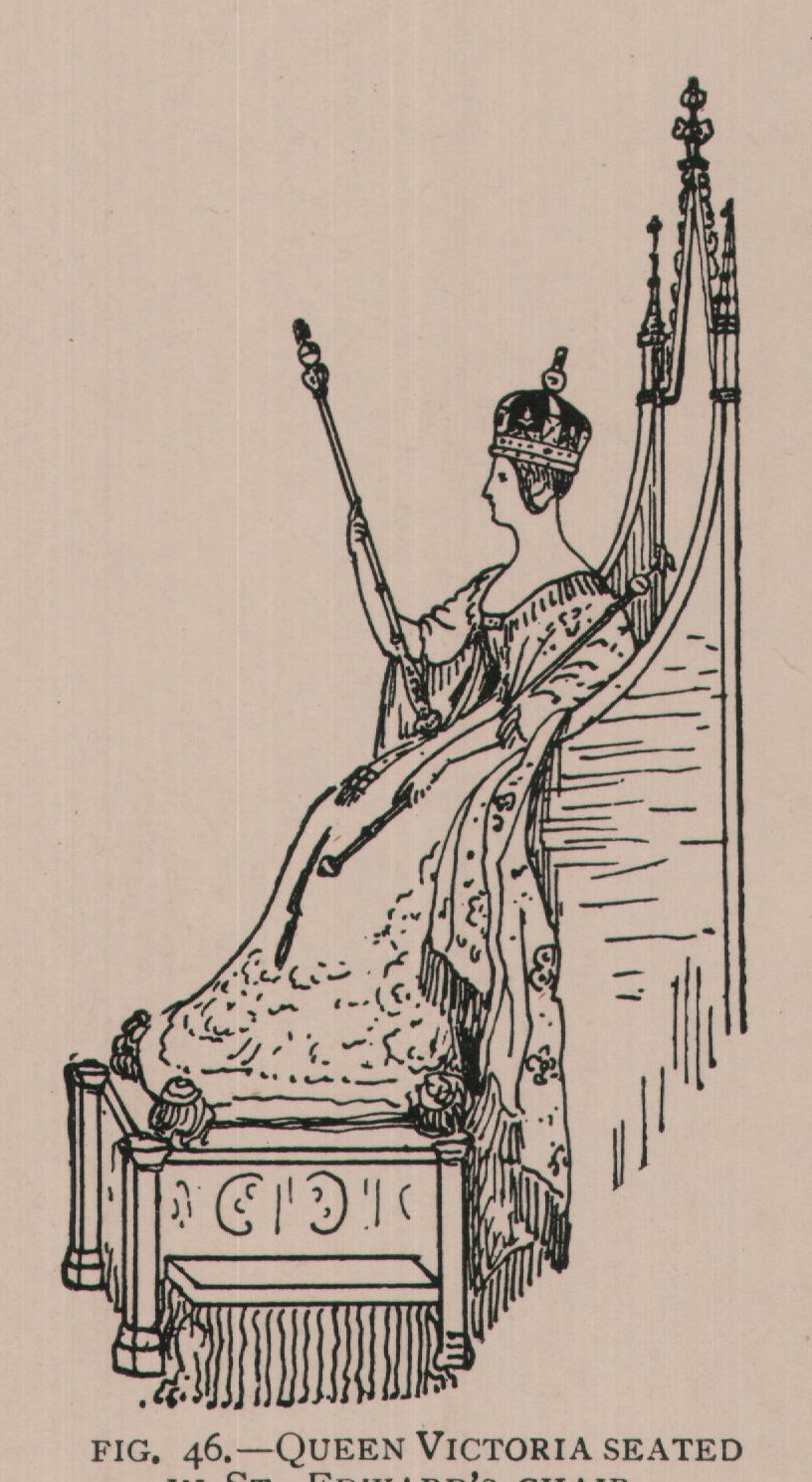
IN ST. EDWARD'S CHAIR.
During the tenth and eleventh centuries seven of our kings are known to have been crowned at Kingston, the Saxon monarchs having a palace, as nearly as can be ascertained, on the spot where the stone now is. The stone itself resembles the stones of the Druids at Stonehenge, and it is extremely likely to have had some especially sacred character (Fig. 47).
It is now resting on a septangular block of stone enclosed within an iron railing, with a pilaster of stone at each of the seven corners. The arrangement and design of the railing and pillars is excellent, and under each of the columns is a penny of one of the kings that were certainly crowned there.
THE CORONATION BOOK It seems rather curious that, considering the importance of the coronation oath, we have no official Bible on which it is to be taken. The Book has, at all events since the time of Henry VIII., been provided anew at each coronation, and indeed it is probable that if we had possessed a fine book-possibly covered with gold and gems-it would have been destroyed in 1649 with the rest of the regalia.
The coronation oath is very old, and is traced back a long way. Lingard, in his history of the Anglo-Saxon Church, says it is referable to Anthenius, Patriarch of Constantinople, who refused to crown Anastasius until he had sworn to make no change in the established religion. ار This was in the fifth century; but it is most probable that, long before, there was some form of oath administered to rulers, by virtue of which their protection of the religion of their subjects was secured.
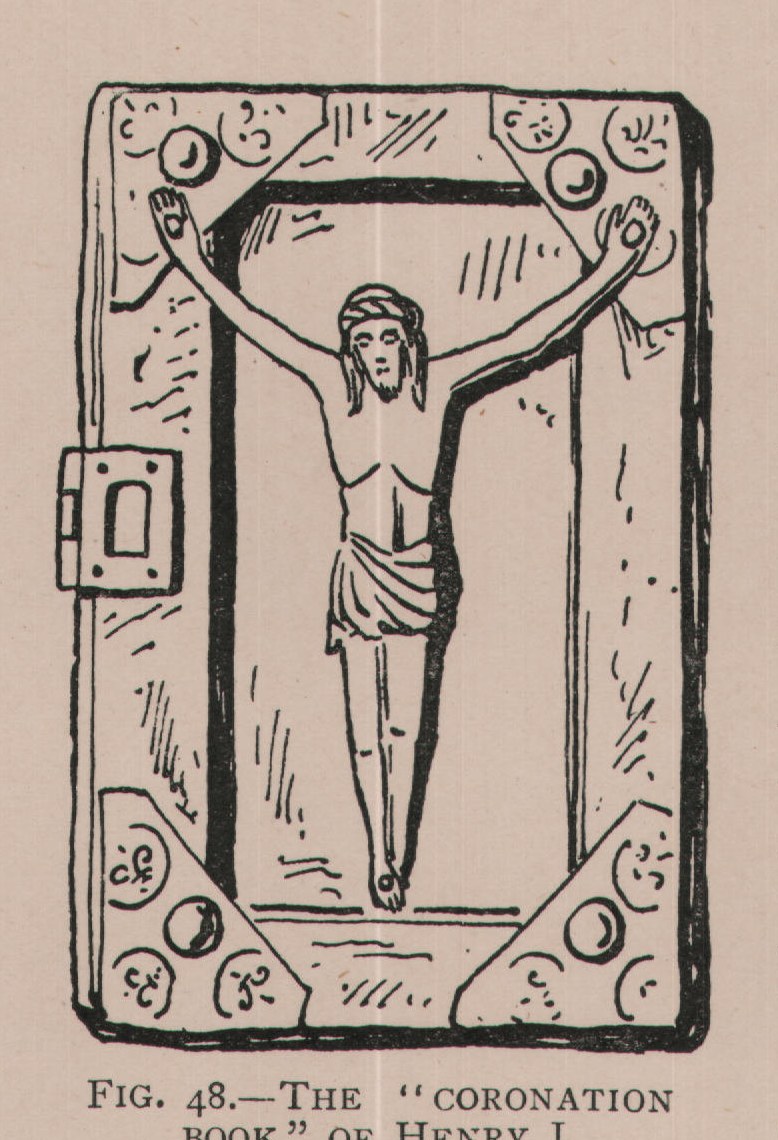
In the library of the Society of Antiquaries at Burlington House, in one of the scrap-books, is a drawing by Vertue of a curious old book said to have been that on which our kings from Henry I. to Henry VIII. took their coronation oath. This same book is now in the manuscript department of the British Museum, and, apart from its historical interest, it has the distinction of being one of the very few decorative bindings of English workmanship of the twelfth century now existing. It is a vellum manuscript of extracts from the Gospels in Latin, with interlinear Saxon version, and it also contains all the Gospel of St. John except some missing pages, and a few other extracts. Inside the book are several notes concerning its history; one signed by John Ives at "Yarmouth, St. Luke's Day, 1772," says it "appears to be the original book on which our Kings and Queens took their coronation oath before the Reformation." Powell, in the Repertory of Records, 1631, at page 123 mentions "a little booke with a crucifix," and says it is preserved in the chest of the King's Remembrancer at the Exchequer. Mr. Thomas Madox, author of the History of the Exchequer, considered that it was the book formerly belonging to the Exchequer, which was mentioned by Powell. It was shown to Mr. Madox by "Mr. Thomas Palgrave," who owned it C 10 BOOK" OF HENRY I. in the eighteenth century; but how it left the "chest of the King's Remembrancer at the Exchequer" there is nothing to show. Early in the present century it belonged to Mr. Thomas Astle, Keeper of the Records in the Tower, and on his death, with the rest of his library, it became the property by purchase of the Marquis of Buckingham. Although a beautiful Gothic room had been built at Stowe in which to keep this library, it was all sold in 1849 to Lord Ashburnham. From Lord Ashburnham the "Stowe" library was purchased by the Trustees of the British Museum in 1883, and so this little book became once more national property, and is not likely to leave its present guardianship. of It is covered with thick wooden boards three-quarters an inch thick, covered with deerskin. On the lower cover is a sunk panel, and in this is a figure of our Lord, finely modelled and chased. The figure shows remains of old gilding, and the workmanship is excellent. The corners are protected by corner-pieces of gilt metal, each with a boss and a design of a fleur-de-lys within a circle stamped upon them, and there is an old clasp (Fig. 48).
The figure of our Saviour and the clasp are probably contemporary with the rest of the binding and the manuscript itself, but the corner-pieces are apparently a subsequent addition.
THE THRONE OF ENGLAND As far as can be ascertained from pictures of recent coronations, the Bible upon which the oath has been taken was covered in dark blue velvet with gilt clasp, centre-pieces, and corners. That used by Queen Victoria was in 1883 the property of the Rev. J. H. Sumner, Rector of Buriton, Hants. It came to him from his father, the Bishop of Winchester, to whom it was given after the coronation.