Home › The Royal Sceptres › The Royal Sceptres: Sir Edward Walker
The Royal Sceptres: Sir Edward Walker
The orb at the top is not specially described by Sir Edward Walker, but Sandford describes it as an amethyst, and in George IV.'s coronation book it is shown blue, which doubtless indicates the same stone. The fleur-de-lys which originally supported this orb was in course of time developed into an elaborate piece of goldsmith's work (Fig. 32), thickly jewelled with coloured gems and diamonds, with supplementary curves and sprays of enamel work. a In the sceptre as it is now some of the lower parts of the ancient top are still retained in modified form. From the centre of this ornamental groundwork spring four large and two small enamelled curves, the larger ones jewelled on their outer surfaces, which clasp the great dropshaped Star of Africa* diamond firmly (Fig.33). The curves can be opened and the stone removed whenever it is required to be worn as a pendant.
Above the diamond the enamelled scrolls and jewels of the old head are still retained with some minor additions.
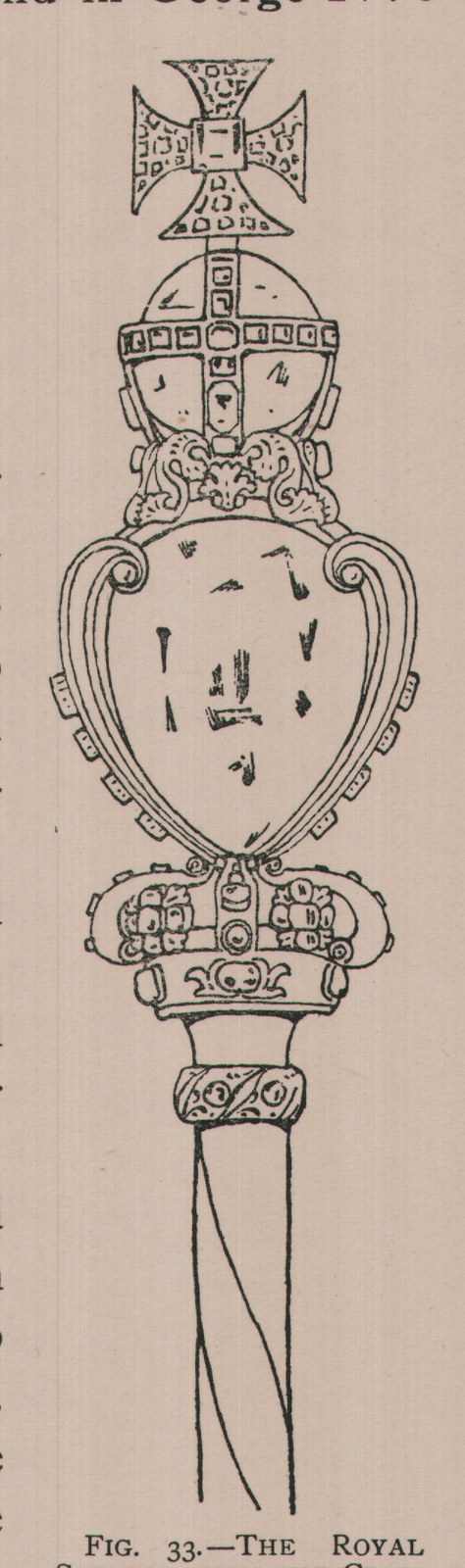
On this glittering foot rests the great amethyst orb, faceted all over, and having round the centre a jewelled band with an arch of gold, rubies and diamonds. The cross-patée at the top is thickly set with diamonds, a large emerald being in the centre. The entire length of the sceptre is about three feet, the upper part is wreathed, collars of gems and enamels enclose a smooth portion as a grip, and the end is incrusted with rich sprays of gold and enamels thickly jewelled with coloured stones and diamonds. 1000 G SCEPTRE WITH THE CROSS SHOWING THE STAR OF AFRICA AS IT AT PRESENT APPEARS.
The foot widens out into a spherical boss with ornamental incrustations of gold, enamels and precious stones. It is probable that much of the sceptre, excepting the addition of the Star of Africa, is largely of the same design as when * See p. 56. it was originally made by Sir Robert Vyner, though it has doubtless been often repaired and the enamels remade as necessary.
This sceptre is placed in the right hand of the sovereign at the coronation. THE KING'S SCEPTRE WITH THE DOVE THE ROD OF EQUITY * The Sceptre with the Dove is of gold, and both in Walker's account of the coronation of Charles II. and Sandford's of that of James II. (Fig. 34) it is shown as bearing the same general design as that now existing. It is a rod of gold measuring three feet seven inches in length. At the top is a mound, also of gold, with a fillet round the centre, studded with diamonds, and an arch above it ornamented in the same way.
From the top of the mound rises a golden cross, on which is sitting a white enamelled dove, with extended wings; the eye, beak, and feet are of gold. A little below the mound is a band studded with diamonds, and beneath this another band, with drooping designs, ornamented with coloured gems and diamonds. In the centre of the sceptre is an ornamental band of enamels and gems, and gold open work with coloured gems, enamels and diamonds. Nearer to the end is another band with large jewels, and at the foot is a boss encircled with a jewelled band and also an enamelled band. The dove is typical of the Holy Ghost, who was considered especially to control the actions THE of kings, and for this reason a sceptre with the dove has been WITH CROSS, MOUND AND FLEUR-DE-LYS, MADE FOR MARY OF MODENA, QUEEN- CONSORT OF JAMES II.