Home › The Regalia › The Regalia: Linnen Gloves
The Regalia: Linnen Gloves
THE REGALIA "And two Ingotts of Gold, the one a pound and the other a marke for the King's 2 Offerings. "The master of the Great Wardrobe, had order also to provide the Ornaments to be called St. Edward's, wherein the King was to be crowned, viz. :- "All these were laid ready upon the altar in the Quier. "Colobium Sindonis, wch is of fine Linnen, of fashion of a Surplice with wide Sleeves. Supertunica, a Close Coate of Cloath of gold reaching to the heeles, lined with Crimosin Taffata, and guirt with a broad Girdle of Cloth of Gold to be putt over the Colobium. "Armilla of the fashion of a stole made of Cloth of Gold to be putt about the neck, and fastned above and beneath the elbowes with silke Ribbands. "A Pall of Cloth of Gold in the fashion of a cope. "A Shirt of fine Linnen to be opened in the places for the anoynting. Over it another Shirt of red Sarcenet, and over that a Surcoat of Crimson Satten, which was made with a Collar for a Band, both opened for the anoynting, and closed with Ribbands. "A paire of under Trowses, and Breeches over them, with Stockings fastened to the Trowses, all of Crimson Silke. "layed on ye altar with the rest of the Ornaments. { "A paire of Hose or Buskins of Cloth of Gold. "A paire of Sandalls of Cloth of Gold. "A paire of Linnen Gloves. "A Linnen Coyfe. "A Silke Towell to be held before the King at the Comunion, by the two Bishops. "Three swords, vizt. Curtana, and two others, with Scabbards of Cloth of Gold. "A Sword of State with a Rich Imbroydered Scabbard." The regalia and vestments as they now exist are mostly the pattern of those just described. There are, fortunately, with Sir Edward Walker's manuscripts several drawings which, although they are somewhat elementary, are yet quite sufficient to show us that many of the designs then used, which were indeed themselves probably copies from some authority not now available, have been carefully preserved. The sceptre with the cross shows the upper part wreathed as it now is; the spurs, St. Edward's staff, and the sceptre with the dove, differ but slightly from those now in the Tower; the dove is shown for the first time standing upon a cross. All these items are now materially the same as when they were made by Sir Robert Vyner. The sword of state is, however, different, as are also the three other swords; and the point of "Curtana," the sword of mercy, is shown as being irregularly broken off instead of being rounded as now. The orb with the large amethyst under the cross, is probably the same as that now in the Tower with few alterations; St. Edward's crown is the same in general design, but differs considerably in detail. Unfortunately, in Sir Edward Walker's manuscript there are no figures given of the ampulla or the spoon used at the coronation of Charles II. Most of our sovereigns have possessed a second crown, known as a crown of state, and the designs of these have often differed, though the same gems have found a place in each succeeding crown throughout the centuries. Among a collection of Exchequer records was found an old bill, dated 23rd February, 1685, made out apparently to show the alterations necessary to be made to the existing Regalia for the coronation of James II. IO "A List of the Regalias provided for His late Majesty's coronation (Charles II.) and are now in ye custody of St Gilbert Talbot, Knight, Master and Treasr of his Matys Jewells and plate, viz. :- "Imprim. St. Edward's Crowne, poiz. 82 oz. 05 dwt. 16 gr. • • . • . 。 £35000 500 00 For ye addition of golde and workemanship For ye loane of ye Jewells returned "Item. One crowne of state, poiz. 72 oz. Of dwt. oo gr. For ye gold, Jewells and workemanship • . "Item. One sceptre with a dove, poiz. 34 oz. 03 dwt. 20 gr. For ye gold, Jewells and workemanship "Item. One other sceptre with a cross, poiz. 32 oz. II dwt. 10 gr. For ye gold, Jewells and workemanship "Itm. One St. Edward's Staffe, poiz. 45 oz. 8 dwt. 8 gr. For ye gold and workemanship . . "Itm. One Gloobe with a crosse, poiz. 49 oz. 7 dwt. 12 gr. For gold, Jewells and workemanship "Itm. One pair of Spurrs, poiz. 12 oz. 18 dwt. o gr. For gold and workemanship . . 7,870 00 • . 440 . 1,025 00 225 6 2 • 1,150 O O 63 7 6 "Itm. Two armillas (bracelets), poiz. 6 oz. 12 dwt: 22 gr. For gold and workemanship . 44 18 6 "Itm. One ampulla or Eglet, poiz. 21 oz. 8 dwt. o gr. For gold and workemanship 102 . 5 O . "Itm. The anointing spoon, poiz. 3 oz. 5 dwt. o gr.
For silver and workemanship 200 . . • . "Itm. One chalice and paten, poiz. 61 oz. 12 dwt. 12 gr. For gold and workemanship 4 277 6 3 دو £12,050 3 5"" And there are other lists of things that have to be provided entirely anew. It is notable that the anointing spoon is again mentioned here as being made of silver.
The items of the regalia mentioned in this bill are illustrated in the History of the Coronation of James II., written at his command by Francis Sandford, Lancaster Herald, and printed in the Savoy in 1687.
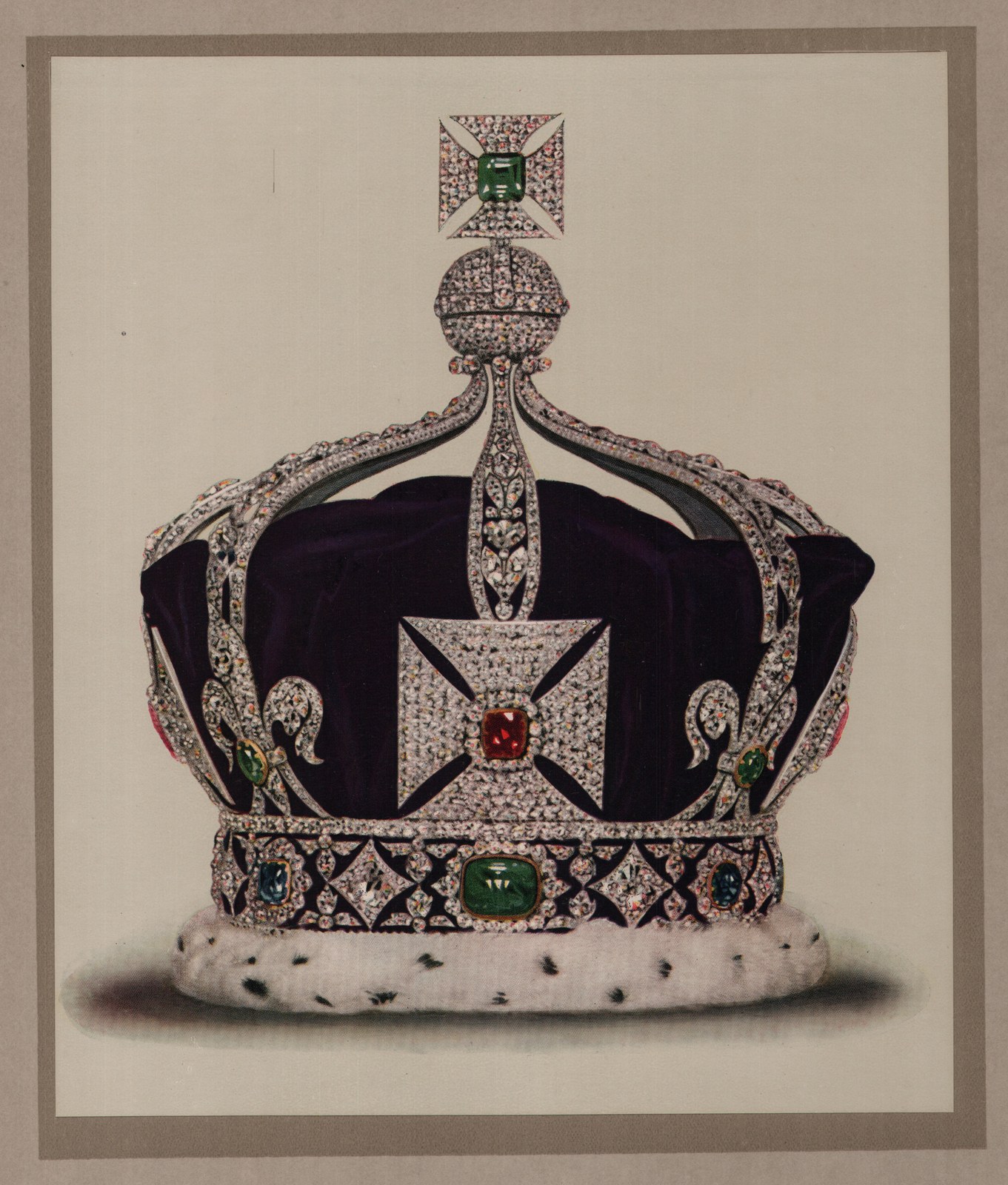
This admirable account of the coronation ceremonies contains two large plates of the regalia. On the first plate are figured the vestments, and there are also detailed figures of the buskins, sandals and spurs, which are only in outline in Sir Edward Walker's account. The ampulla and the spoon are figured for the first time, and appear to be exactly the same as they are now. The coronation chair is also shown with designs upon it that certainly do not exist at the present day. This chair, of course, is the one that all our kings have been crowned on at Westminster since Edward I. except Queen Mary I.; and, when Cromwell was installed Lord Protector, the chair was brought into Westminster Hall for the ceremony. The second plate contains figures of St. Edward's crown and the Queen's crown, a circlet worn by the Queen on her proceeding to her coronation, and two state crowns, to be worn by their Majesty's after their coronation on their return to Westminster Hall-one for the King and one for the Queen. Plate III THE IMPERIAL CROWN OF INDIA XXXXX THE REGALIA St. Edward's crown is shown substantially the same as it is now, but the setting of the gems is not quite so elaborate. The circlet worn by the Queen on her proceeding to her coronation, and her state crown, are now in the Tower, and are there described as having belonged to Queen Mary of Modena. But there are considerable differences between the illustrations of 1687 and the actual crowns now existing; and it seems not improbable that both these crowns have been remade. Some of the gems from the state crown of James II. now find a place in that of George V., notably the Black Prince's ruby which forms the centre of the cross-patée on the front of the crown. At the top of this crown was a cross-patée on a mound, the mound being "one entire stone of a sea-water green known by the name of an agmarine." This stone is cut in facets, and with the cross is still preserved in the Tower. The figure of the orb is nearly the same as it is now, "on the top whereof is a very large amethist of a violet or purple colour encompassed with four silver wires." St. Edward's staff is the same as now. The sceptre with the dove is probably the same as that now in the Tower. Then there are two sceptres with a cross: the first one, with the upper part wreathed, is probably that figured by Sir Edward Walker, and into the head of this was inserted the great Star of Africa by Edward VII. The second sceptre with the cross appears for the first time; it was doubtless made for Queen Mary, and is now in the Tower with slight differences. The Queen's ivory rod, with a dove at the top, was also made for Queen Mary; and one of the larger plates, in the same book, shows King James and his Queen seated side by side, each crowned, and each holding two sceptres, one with a cross and one with a dove, so that with the exception of the holding of the orb, the Queen of James II. appears to have had equal ceremonial honour with his Majesty himself.