Home › The Skippers › The Skippers (Superfamily Hesperioidea)
The Skippers (Superfamily Hesperioidea)
Superfamily Hesperioidea (Hes-per-i-oi'de-a) THE skippers are commonly classed with the butterflies; for this reason they are discussed here, although the writer believes that they consti- Sc R R3 R R2 tute a superfamily distinct R M. from the butterflies.
Ma The skippers are so called C r R-M 3d A C. D.
C.O.
C. D.
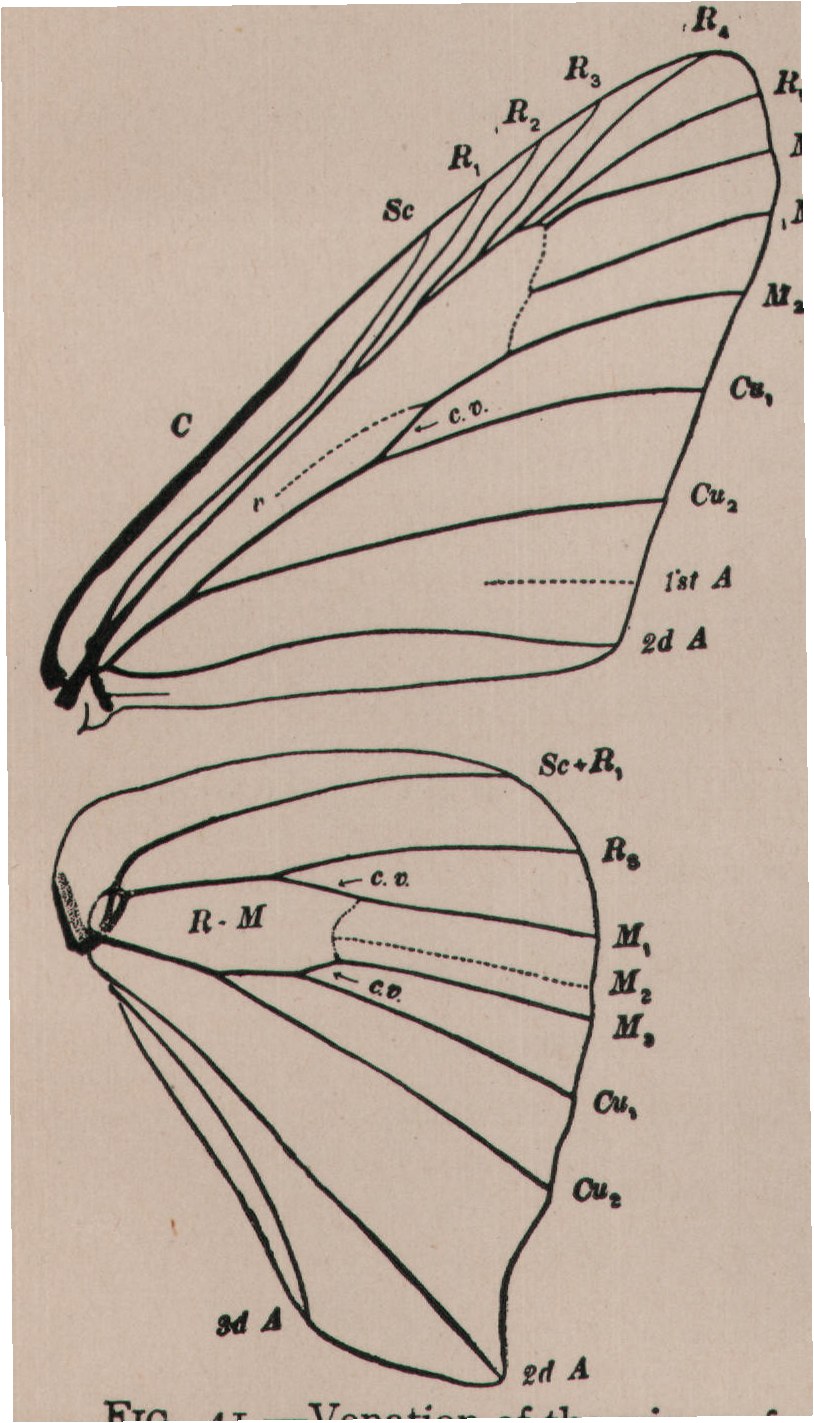
Sc+R, R M M Ma CB, Cu2 1'st A 2d A 2 M, Cu Cu2 2d A FIG. 41. Venation of the wings of Epargyreus tityrus. 3 on account of their peculiar mode of flight. They fly in the daytime and dart suddenly from place to place. When at rest most species hold the wings erect in a vertical position like butterflies; in some the fore wings are thus held while the hind wings are extended horizontally; and a few extend both pairs of wings horizontally. The antennæ are threadlike, and enlarged toward the tip; but in most cases the extreme tip is pointed and recurved, forming a hook. The abdomen is usually stout, resembling that of a moth rather than that of a butterfly. The skippers are most easily distinguished by the peculiar venation of the fore wings, radius being five-branched, and all the branches arising from cell R+M (Fig. 41). In some butterflies all the branches of radius appear to arise from the cell R+M; but this is because two of the branches coalesce to the margin of the wing. In such butterflies radius appears to be only four-branched.
This superfamily includes two families-the Giant Skippers, Megathymida, and the Common Skippers, Hesperiidæ. These can be distinguished as follows :
A. Head of moderate size; club of antenna large, neither drawn out at the tip nor recurved. Large skippers, with wing expanse of two inches or more, p. 258.