Home › The Meadow-Browns › The Monarch
The Monarch
Anosia plexippus (A-no'si-a plex-ip'pus) PLATE XXXII, FIG. 3, male; PLATE XXVIII, FIG. I, female; PLATE I, transformations The upper surface of the wings is light tawny brown, with the borders and veins black, and with two rows of white spots on the costal and outer borders. In the male the veins of the wings are more narrowly margined with black, and there is a black pouch next to vein Cu, of the hind wings, containing scent-scales or androconia.
CATERPILLAR.-Length nearly two inches; head yellow striped with black; body white with narrow black and yellow cross stripes on each segment. On the second thoracic segment there is a pair of black whiplash-like filaments. On the eighth abdominal segment is a similar pair, but shorter. Food-plant. Milkweed. 2 3 Plate XXXII.
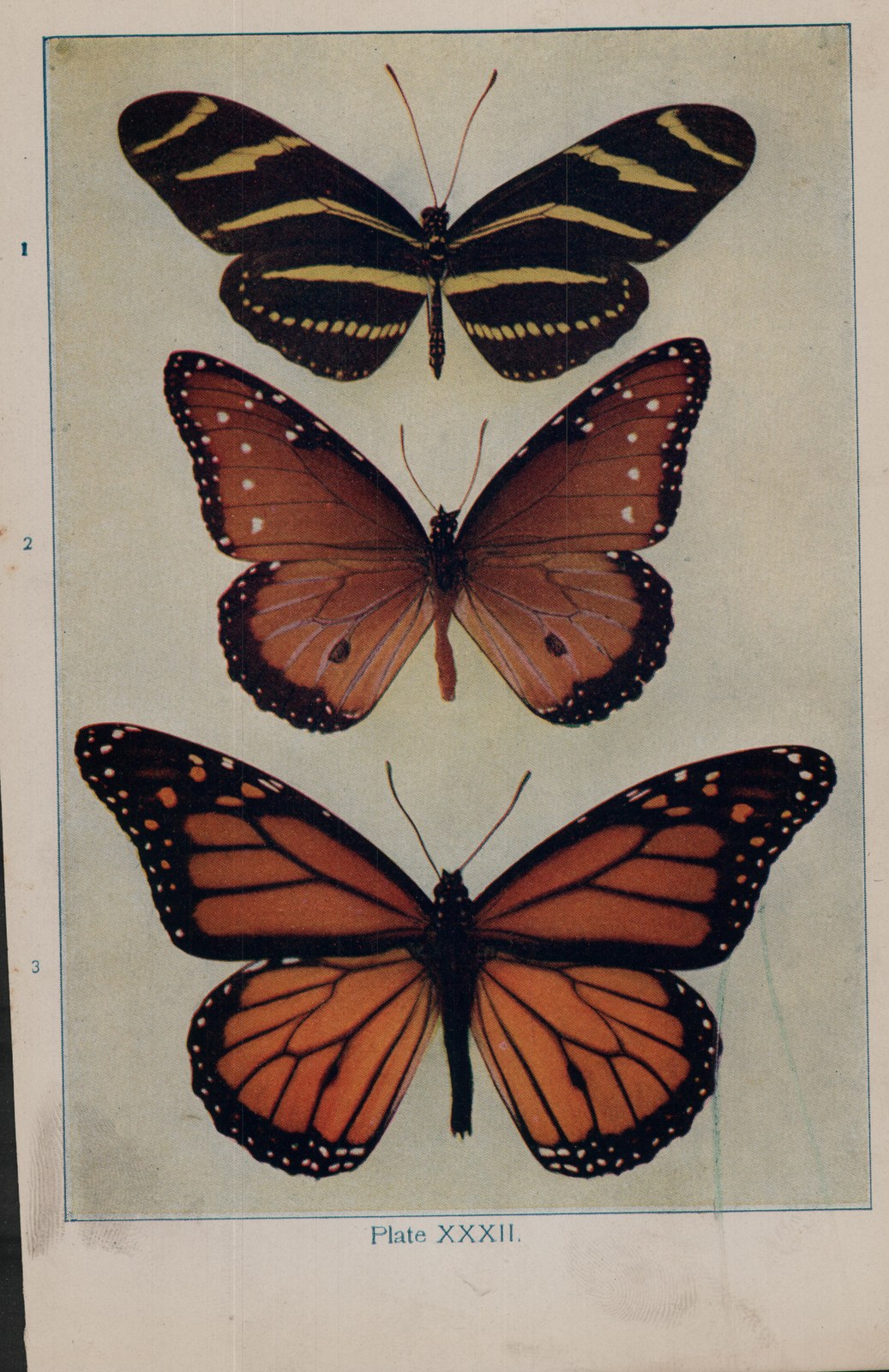
The male monarch is the dandy among butterflies par excellence. He is not only trig in figure and gorgeous in color, but on each hind wing he carries a black sachet bag for the allurement of his lady-love. And she is as brilliant as he, but lacks the perfume pockets. "I am monarch of all I survey" is exemplified in the confident, serene flight of this butterfly; the species is nauseous to birds in both the caterpillar and adult stages, and by their bold actions they show the result of this immunity. But the monarchs have other problems of their own just because the bird problem is eliminated; for undisturbed they spread and flourished in their native tropic America until it became a question of sufficient food-plants to nourish their numerous progeny.
Because of this they began pushing farther north and south during the seasons of plant growth.
As they could not endure the northern winter they came north for the summer and went back in the autumn. This northern migration is accomplished thus: the mother butterfly follows the spring northward as it advances as far as she finds milkweed sprouting; there she deposits her eggs, from which hatch individuals that carry on the journey, and in their turn lay their eggs as far north as possible. Thus generation after generation pushes on until late in the season we hear of them as far north as Hudson Bay. As the cool weather approaches these emigrant butterflies gather in great flocks and move back to the South. It is quite impossible for us to understand how the flocks of butterflies are guided in their migrations. There are among their numbers none that are travel-wise, like the leaders of the bird flocks, but still they follow their direction as steadily as the wind will allow. Nor is the monarch satisfied with these journeys to the north and south; it is the strongest flyer of all the butterflies and does not hesitate to try its fortune over the seas, and has been found flying five hundred miles from shore. Either by flight or as stowaways in vessels it has pressed eastward to Europe and westward to the isles of the Pacific.
Well is it named the monarch, for it is the most daring and indomitable butterfly that we know, pushing back its geographical boundaries to the edge of the arctic zone, exploring leisurely on confident wing the seas of the Occident and Orient.
The caterpillars when disturbed jerk the whiplash-like filaments back and forth, this evidently being a method of keeping off the ichneumons.
They are smug-looking caterpillars and flaunt their gay stripes without any attempt to hide, for they seem to know that the birds will not touch them. In the North there is but one brood during the summer, while in the South there are No hibernating specimen has ever many more. been found.
Birds have their nests; they rear their eager young And flit on errands all the livelong day; Each fieldmouse keeps the homestead where it sprung; But thou art nature's freeman-free to stray Unfettered through the wood, Seeking thine airy food, The sweetness spiced on every blossomed spray.
HIGGINSON.