Home › The Meadow-Browns › The Grayling
The Grayling
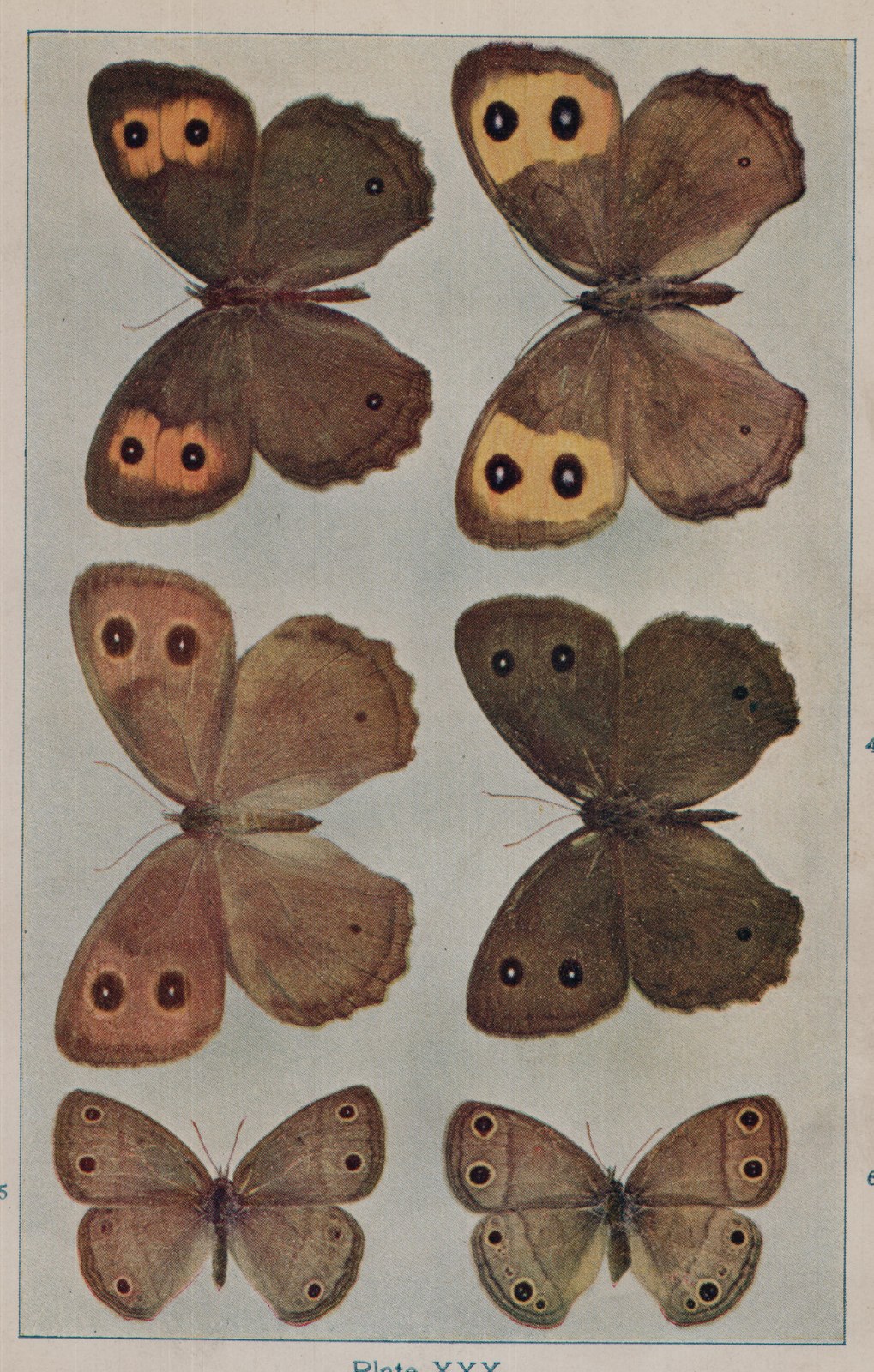
Cercyonis alope (Cer-cy'o-nis al'o-pe) PLATE XXX, FIG. I, 2, 3, 4 This species is found from the Atlantic to the Pacific; it occurs under several forms, some of which have been described as distinct species. The most common forms found east of 3 4 5 Plate XXX. 6 the Rocky Mountains are the first two described below and intergrades between these. Expanse two to two and one-half inches. (1) The Blue-eyed Grayling, Cercyonis alope alope. The upper surface of the wings is dark brown; on the outer half of the fore wings there is a distinct yellow band, wnich extends from vein R, to the anal vein; in this band there are two dark spots with a white or bluish centre. The hind wing usually bears a small spot in cell Cu,, which is narrowly rimmed with yellowish and has a minute white pupil. The lower surface of the hind wings is either with or without eyelike spots, usually with six of them. This is a Southern form, which extends into the southern portions of New England, New York, Michigan, Wisconsin, Iowa, and Nebraska ; and into the northern portions of Illinois, Indiana, and Ohio. (2) The Dull-eyed Grayling, Cercyonis alope nephele.-In this form the yellow band of the fore wings is either absent or represented by a faint pallid cloud. In other respects it closely resembles the blue-eyed grayling.
This is a Northern form; the southern limits of its range overlaps the northern limits of the range of the blue-eyed grayling as given above. (3) Hybrid Graylings. In that narrow belt where the ranges of the two forms of Cercyonis alope described above overlap, all variations between the two types occur. In most of these intergrades the eye-spots of the upper sides of the fore wings are surrounded by yellowish rings, or each is on a yellowish patch. (4) The Sea-coast Graylings (Cercyonis alope maritima). -In a narrow belt along the Atlantic coast there occurs a form which is smaller than those described above, and of a dark color; this form is easily recognized by the color of the band bearing the eye-spots on the fore wings, it being reddish yellow.
CATERPILLAR. - Length one and one-third inches. Green in color with two lighter green or yellowish lengthwise stripes along each side. The body is covered with down but is otherwise naked. The slender tail ends in a shallow fork.
Food-plant. Grass.
The Blue-eyed Grayling. The blue eyes of this grayling are rather disappointing, partly because they are mere dots in the large black eyespots, scarcely noticeable from above, and partly because they are usually lavender instead of blue; however, on the lower sides of the wings the blue eyes are well worth looking at. Above and below the blue iris has a pupil of white at its center. The first thing that attracts the eye to this butterfly is never blue eyes, but rather the large yellow band on the outer half of the front wing against which the round black spots, each a true "bull's-eye" in its appearance, shows off to great advantage.
The blue-eyed grayling is most careless as to the number of its decorations. Usually two eyespots on the front wing are reproduced with large blue centers on the lower side; but one of our specimens shows these ocelli with white to select some tree for its abiding-place. It alights on the trunk head downward, or perhaps suns itself on the upper leaves. From this "home base" it makes sallies into the air to indulge in a wrestling match with one of its fellows for a little time and then returns to its chosen spot.
The caterpillar has on either end of the body red-tipped "horns," and one wonders if this is perchance an advantage, and if so, why. The species winters in the larval stage. The caterpillar attains part of its growth in the fall and completes it in the spring after the grass starts. In the South the pearly eye is double-brooded.
The butterflies-bright, airy things- From off the lilac buds I scared, for having on their wings The shadows of the woods.