Home › The Milkweed Butterflies › The Gossamer-Winged Butterflies (Family Lyc nid Ly-c n'i-d This)
The Gossamer-Winged Butterflies (Family Lyc nid Ly-c n'i-d This)
Family Lycænidæ (Ly-cæn'i-dæ) This family includes butterflies which are of small size and delicate structure. In size they resemble the smaller skippers ; but they can be distinguished at a glance from the skippers, as they present an entirely different appearance. The body is slender, the wings delicate and often brightly colored, and the R R2 3 R4+5 R Sc M M2 M 3 club of the antenna straight. The antennæ are nearly always ringed with white, and a conspicuous rim of white scales encircles the eyes.
In the venation of the wings they agree with the metal-marks, and differ from all other butterflies described in this book in the following combination of characters: radius of the fore wings is only three- or four-branched, and vein M, arises at or near the apex of cell R + M (Fig. 40). In the R+M R+M Sd A 2d A Cu Sc+R Cu2 2d A Rs M M. 2 Cu, Cu, M, FIG. 40. - Venation of the wings of Chrysophanus. other butterflies occurring in our fauna in which radius is only three- or four-branched, vein M, coalesces with radius for a considerable distance beyond the apex of the discal cell. In a single species of this family the wanderer (Feniseca) vein M, coalesces with radius for a considerable distance beyond the apex of cell R + M.
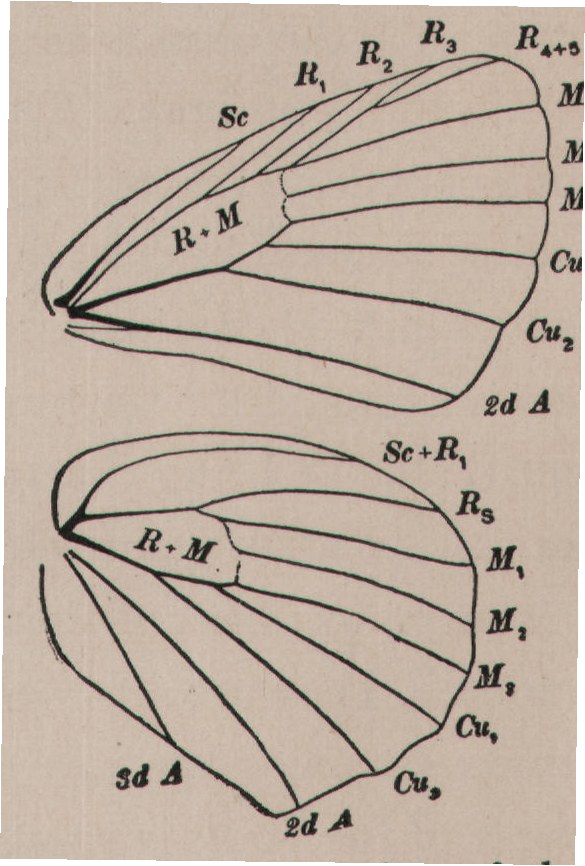
The gossamer-winged butterflies can be distinguished from the metal-marks by the absence of the costal and humeral veins of the hind wings.
In the female the front legs are like the other legs, in the male they are shorter, without tarsal claws, and with the tarsi more or less aborted.
The caterpillars of the Lycænidæ present a very unusual form, being more or less slug-like. The body is short and broad; the legs and prolegs are short and small, allowing the body to be closely pressed to the object upon which the insect is moving-in fact some of the species glide rather than creep; and the head is small, and can be retracted more or less within the prothorax. The body is armed with no conspicuous appendages; but some of the species are remarkable for having honey-tubes which can be pushed out from the seventh and eighth abdominal segments, and through which honeydew is excreted for the use of ants. Certain other species are remarkable in being carnivorous; one American species feeds exclusively upon plant-lice.
The chrysalids are short, broad, ovate, and without angulations. They are attached by the caudal extremity, and by a loop passing over the body near its middle. The ventral aspect of the body is straight and often closely pressed to the object to which the chrysalis is attached.
The family includes three well-marked groups of genera, which have been distinguished as the hair-streaks, the coppers, and the blues. These groups can be separated by the following table : A. Radius of the front wings four-branched.
B. Body comparatively stout; colors of the upper surface of the wings orange red with a coppery luster, or brown with a coppery tinge, in each case spotted with black, p. 236.