Home › Remarkable Rings › Remarkable Rings: Medici
Remarkable Rings: Medici
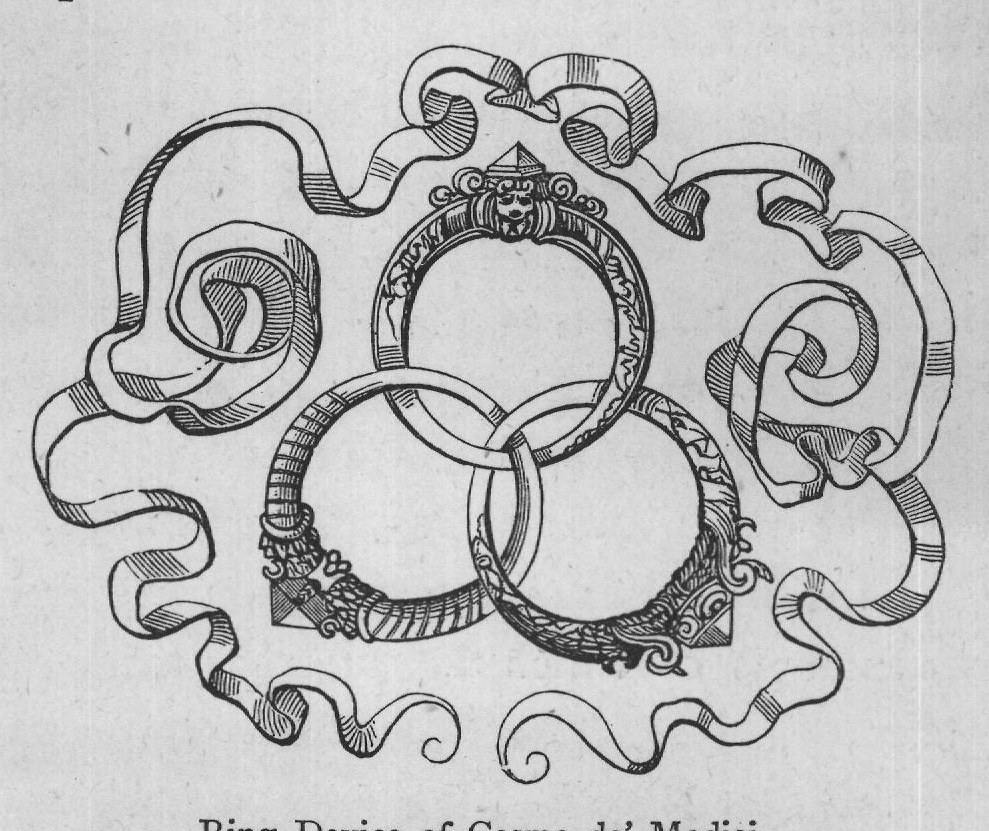
Ring Device of Cosmo de' Medici.
Cosmo de' Medici had for device three diamonds on rings, intertwined emblems of excellency, superiority, and endurance.
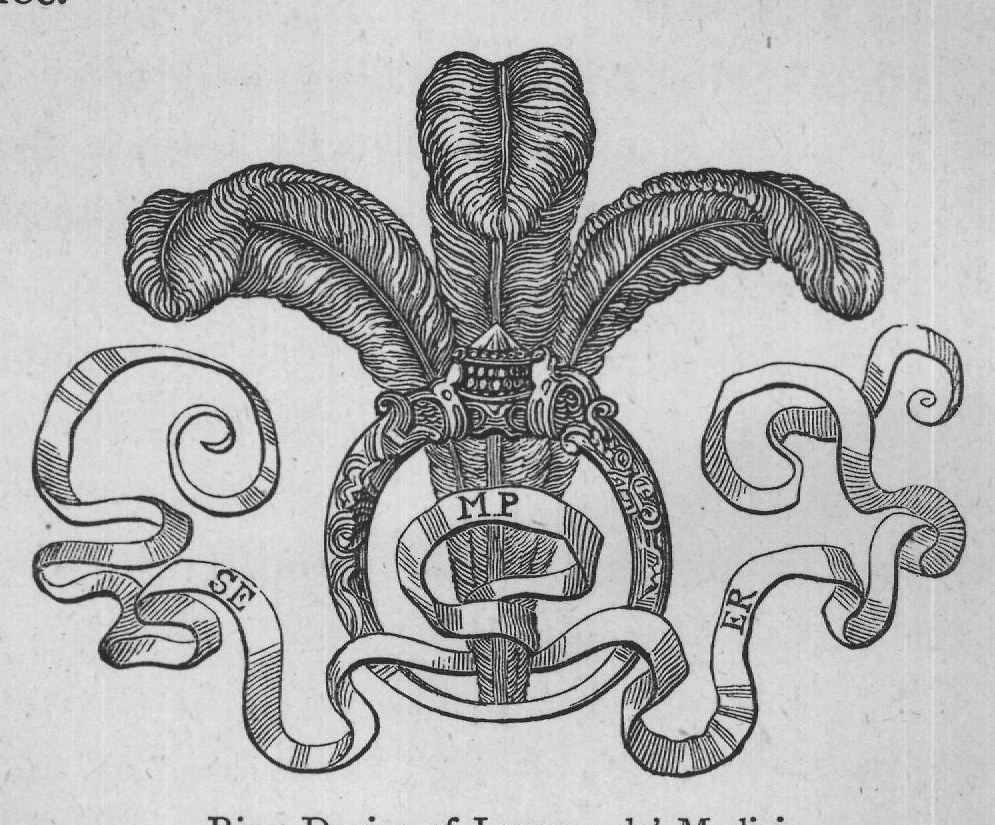
SE M.P Ring Device of Lorenzo de' Medici.
Lorenzo de' Medici had a ring with a diamond; a plume of three colours, green, white, and red, to signify that in loving God he displayed three virtues: the white plume representing faith; the green, hope; the red, charity. Pope Leo X. adopted this device.
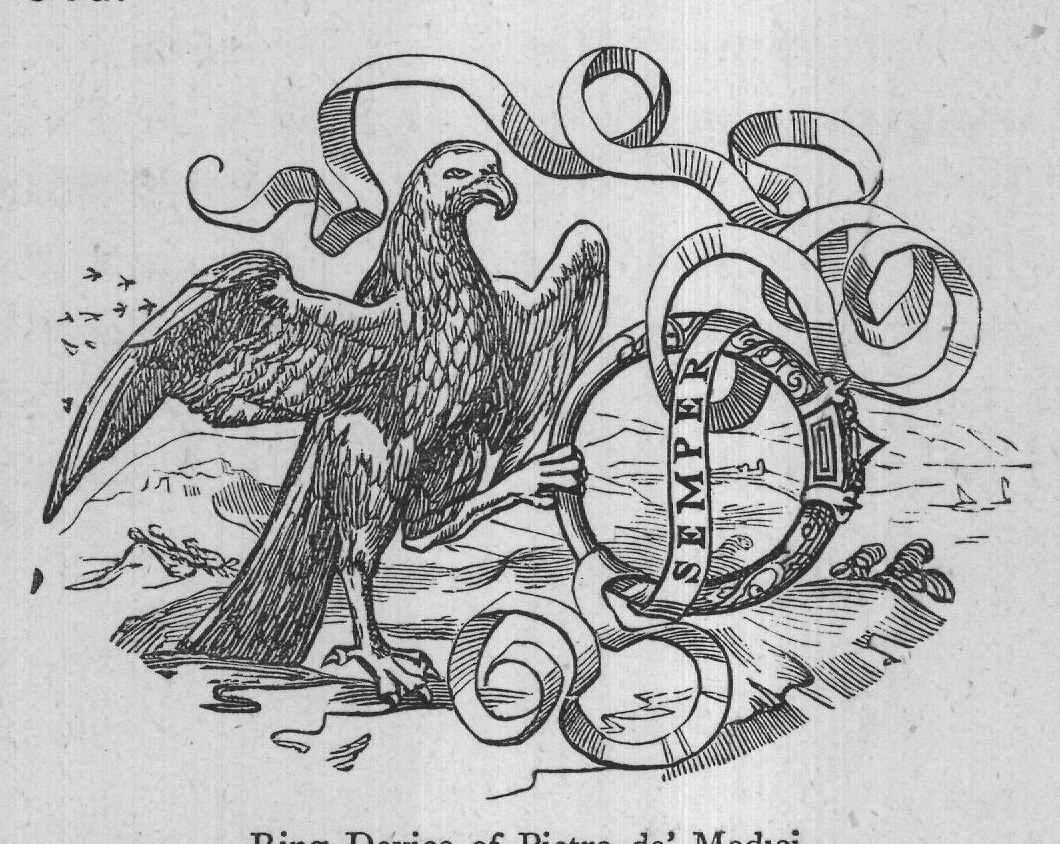
Pietro de' Medici had a falcon holding a diamond-ring in its claws, signifying that everything should be done to please God. " > SEMPER Ring Device of Pietro de' Medici.
In the Staunton collection of antiquities (Longbridge House, near Warwick) is a remarkable ring, which is described (with illustrations) in the 'Archæological Journal' (vol. iv. p. 358). It is a beautiful gold signet-ring, found, about the year 1825, in the ruins of Kenilworth Castle, by a person named Faulkner, who was in the constant habit of searching among the rubbish with the expectation of making some valuable discovery. Its weight is 4 dwts. IO grs. The impress is very singular ; under a crown appear the numerals 87, of the forms usually designated as Arabic, of which no example has been noticed in this country, except in MSS. prior to the fifteenth century. Above the crown are the letters s and bh; lower down on one side is seen the letter a, and on the other m. Various interpretations of this remarkable device have been suggested : it has been supposed that it might have reference to the coronation of Elizabeth, Queen of Henry VII., solemnised at Westminster, A.D. 1487, or have been connected with the enterprise of Lambert Simnel, which occurred during that year at the instigation of Margaret, Duchess of Burgundy. Mr. Hawkins considers its age to have been about the reign of Edward IV., the crown with fleur-de-lys ornaments, and the form of them being of similar character to those on his coins; a similar type of crown may, however, be found in earlier times, as shown by the great seals and other authorities as early even as the reign of Richard II. ٨٨٧.bot 20 Ring found at Kenilworth Castle.
The letters have been supposed to be the initials of a sentence such as 'Sancta virgo adjuva me' (the second letter being read asb) or, supposing the ring to be referred to the times of Henry VII., 'Sigillum,' or 'secretum, Henrici, anno (14) 87. Mh.' The most probable explanation, however, appears to have been proposed by Mr. John Gough Nichols: that the ring, which is of a size suited to a lady's finger, might have been a betrothal or wedding present; the initials s.h. and a.m. being those of the two parties, the Arabic numerals indicating the date 1487, and the crown being merely ornamental, frequently used during the fifteenth century on seals by persons not entitled by rank to use them. 1 The coronet, with an initial letter, adopted as a device on the seals or signet-rings of commoners, appears on numerous rings of the fifteenth century, as well as on seals appended to documents. It appears on another ring of later date in Mr. Staunton's collection, of base metal gilt, found in Coleshill Church, Warwickshire. The device appears to be a crown placed upon a shaft or truncheon, resting on a heart, in base, with the initials of the wearer, I. G., at the sides.
At a meeting of the Society of Antiquaries (May 1875), Mr. Robert Day (Local Secretary for Ireland) exhibited a silver ring of fourteenth-century work, the hoop portion of which is formed of two hands, which grasp an octagonal signet that bears the centre device of a letter R crowned, with the motto 'Bacchal,' and a spray of roses in the border. 'To illustrate this,' remarks Mr. Day, 'I send a small coin of base silver, having a similar crowned R on the obverse. These crowned letters recall the familiar lines of Chaucer, of _ a crowned A, And after, Amor Vincit Omnia.
The ring was dug up in a potato garden at Howth, near Dublin. The motto "Bacchal" I am unable to throw any light upon, except it be a contraction of Baccalaureus. On the rim is a star of six points, to show the position for sealing.' A ring-relic of Fotheringay, belonging to Mrs. Simpson, of Edinburgh, is of gold, set with a diamond cut in facets, with three smaller diamonds over it, representing a crowned heart. It is considered to have belonged to the unfortunate Mary, Queen of Scots.