Home › Customs and Incidents › Customs and Incidents: Vitus
Customs and Incidents: Vitus
Mr. Howitt, in his additions to the 'History of Magic' of Ennemoser, remarks: 'In the St. Vitus's dance patients often experience divinatory visions of a fugitive nature, either referring to themselves or to others, and occasionally in symbolic words. In the "Leaves from Prevorst," such symbolic somnambulism is related, and I myself have observed a very similar case: Miss V. Brand, during a violent paroxysm of St. Vitus's dance, suddenly saw a black evil-boding crow fly into the room, from which, she said, she was unable to protect herself, as it unceasingly flew round her, as if it wished to make some communication. This appearance was of daily occurrence with the paroxysm for eight days afterwards. On the ninth, when the attacks had become less violent, the vision commenced with the appearance of a white dove, which carried a letter containing a betrothal ring in its beak; shortly afterwards the crow flew in with a black-sealed letter. The next morning the post brought a letter with betrothal cards from a cousin, and a few hours after the news was received of the death of her aunt at Lohburg, of whose illness she was ignorant. Of both these letters, which two different posts brought in on the same day, Miss V. Brand could not possibly have known anything. The change of birds and their colours during her recovery, and before the announcement of agreeable or sorrowful news, the symbols of the ring and the black seal exhibit in this vision a particularly pure expression of the soul, as well as a correct view into the future.' A French MS. of the thirteenth century gives the earliest version hitherto discovered of the fable of the three rings, known by the story in Boccaccio's 'Decamerone,' and by Lessing's 'Nathan.' From these, however, it differs essentially. In the present version the true ring is found out after the father's death, while Boccaccio and Lessing tell the contrary. Of course the allegorical meaning of the true ring is the Christian faith, and the two false are the Mohammedan and the Judaic faith. The Mohammedan faith is considered the oldest because it represents the pagan faith in general.
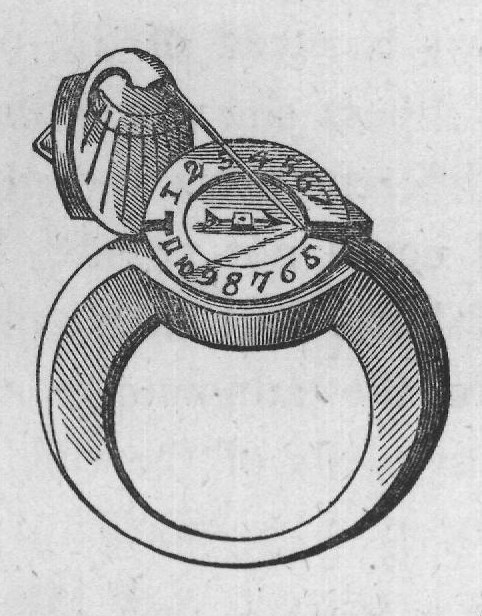
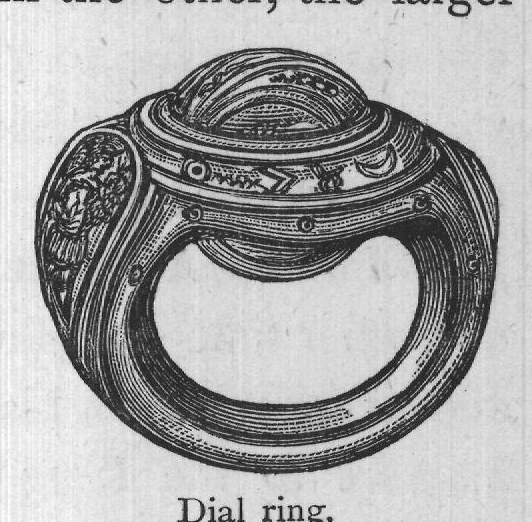
Among the singular uses to which rings have been applied, I may mention what were called 'meridian.' These were various kinds of astronomical rings formerly in use, but now superseded by more exact instruments. In the French 'Encyclopédie' (Diderot and D'Alembert) will be found an account of the 'solar' ring (anneau solaire), which showed the hour by means of a small perforation, GG2 7 'un trou, par lequel on fait passer un rayon de soleil.' Zeller also describes a kind of sun-dial in the form of a H 2 1098765 دو 568 10 23 IASOND AMFI Dial rings. 1 ring. This was called the astronomical ring, 'annulus astronomicus.'1 The Rev. Danson R. Currer has a brass ring-dial, probably of the kind formerly designated as 'journey rings.' 6 1 In Knight's Pictorial Shakspeare' is the following note on the dial which Touchstone drew from his "poke:" "There's no clock in the forest," says Orlando; and it was not very likely that the fool would have a pocket-clock. What then was the dial that he took from his poke? We have lately become possessed of a rude instrument kindly presented to us by a friend, which, as the Maid of Orleans found her sword, he picked "out of a deal of old iron." It is a brass circle of about two inches in diameter. On the outer side are engraved letters, indicating the names of the months, with gradual divisions; and on the inner side, the hours of the day. The brass circle itself is to be held in one position by a ring; but there is an inner slide in which there is a small orifice. This slide being moved, so that the hole stands opposite the division of the month when the day falls of which we desire to know the time, the circle is held up opposite the sun. The inner side is then, of course in shade, but the sunbeam shines through the little orifice and forms a point of light upon the hour marked on the inner side. We have tried this dial and found it give the hour with great exactness.' A correspondent of 'Notes and Queries' (vol. xii. 3rd series, p. 79) mentions that rings to ascertain the time are regularly sold at the Swiss fairs. They are called cadrans. The price of one is twenty centimes. Mr. Edward Jones, of Dolgellau, has a dial-ring consisting of two concentric rings moving within the other, the larger one having a linear groove, and the smaller one a slight hole working into it.
Dial ring.