Home › Giant Sloths and Armadillos › Giant Sloths and Armadillos: History
Giant Sloths and Armadillos: History
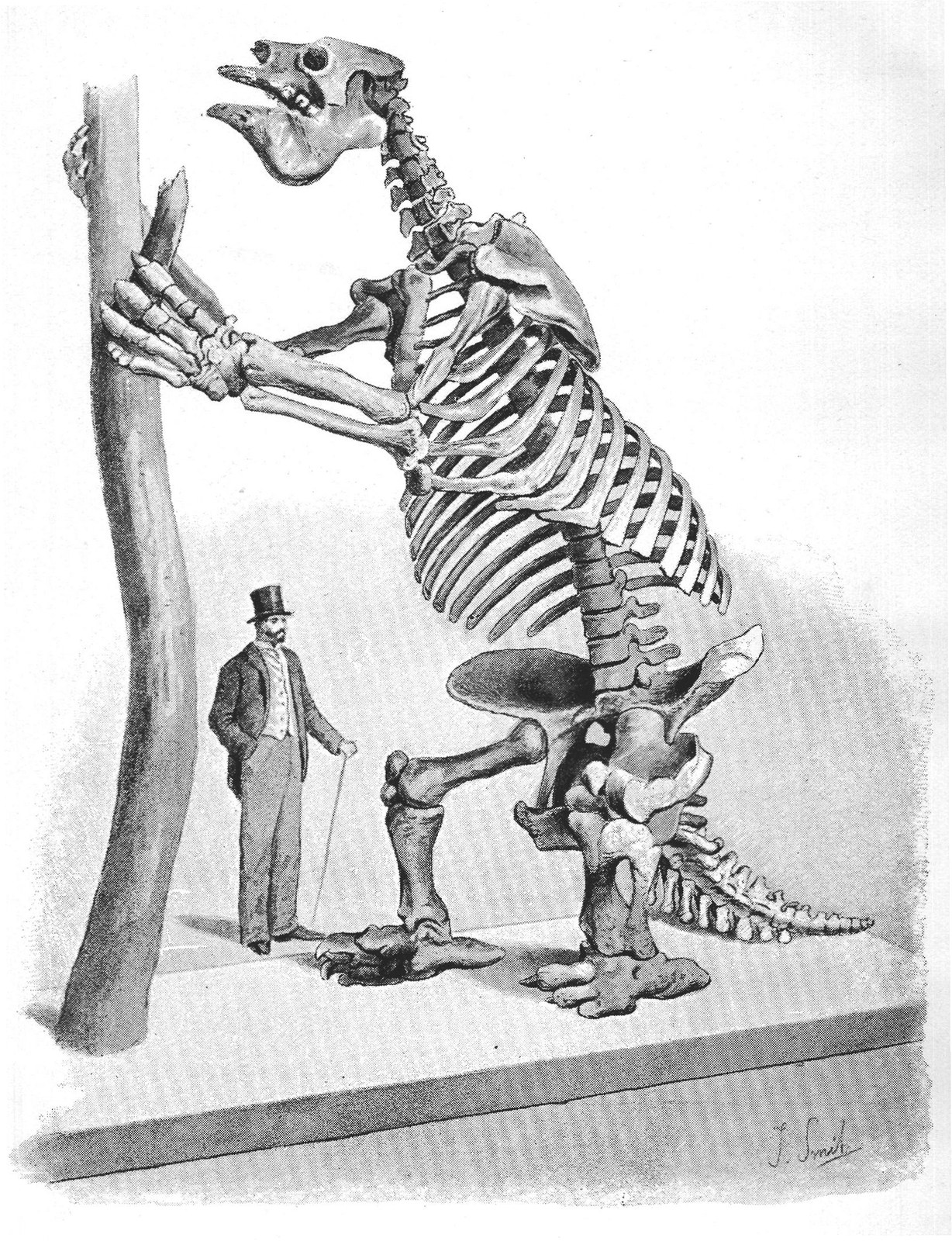
J. Smil CAST OF A SKELETON OF MEGATHERIUM AMERICANUM, Set up in the Natural History Museum, London. distance from the place where the first had been found. It was in the year 1832 that Sir Woodbine Parish sent his valuable collection of bones from Buenos Ayres, and presented them to the Royal College of Surgeons. These specimens formed the subject of Mr. Clift's memoir above quoted. But even then the materials were not complete for a thorough knowledge of the bony framework of the Megatherium, and it was not till 1845, when more remains (discovered near Luxan, 1837) reached this country, that Sir Richard Owen was able to clear up one or two doubtful details. These were purchased by the trustees of the British Museum, and casts of the bones were taken. Among the various writings by learned men on the subject, Owen's masterly description stands pre-eminent; indeed, he was the only one to solve the riddle, to thoroughly explain the structure of this giant sloth, and to show how its food was obtained.1 Neither Cuvier, nor the German doctors, nor Mr. Clift had succeeded in so doing. In the Natural History Museum is a cast representing the animal nearly erect, and grasping a tree. This magnificent cast (see Plate L.) represents an animal eighteen feet in length, and its bones are more massive than those of the elephant. For instance, the thigh-bone is nearly thrice the thickness of the same bone in the largest of existing elephants, the circumference being equal to the entire length. To a comparative anatomist several striking indications of great strength present themselves; thus, not only the very forms of the bones themselves mean strength, but their surfaces, ridges, and crests are everywhere made rough for the firm attachment of powerful muscles and tendons. In the fore part of the body the skeleton is comparatively slender, 1 His views are expounded in his Memoir on the Megatherium, or Giant Ground Sloth of America, 1861, which is beautifully illustrated. The Royal Society gave £100 (part of a Government grant of £1000) to enable Professor Owen to carry out this important work. but the hind quarters show enormous strength and weight combined. The tail, also, is very powerful and massive. The fore limbs are long, and evidently constructed for the exertion of great force. How this force was applied we shall see presently. In both sets of limbs we notice powerful claws, such as might be used for scratching up the ground near the roots of a tree, and it was at one time thought that this was the way in which the creature obtained its leafy food, namely, by digging up trees by the roots and then devouring the leaves. But Owen had another explanation.
As in the living sloths and armadillos (edentata ¹), there are no teeth in the fore part of the jaw. The molar teeth, of which there are five on each side of the upper jaw, and four in the lower, are hollow prismatic cylinders, straight, seven to nine inches long, and implanted in deep sockets.