Home › Contents › Red-Eyed Vireo
Red-Eyed Vireo
Bringing with them the good cheer of the south, Redeyed Vireos return to northern United States about the middle of May. They are the most abundant of the vireos and are also the most persistent songsters that we have. From morn until night, song after song pours from their tireless throats until at times, especially when one is listening to a new or unusual song of some other bird, it becomes very irritating. The vireo song is a rather lazily whistled repetition of the word vireo with varying accents and modulations. It is a song that readily lends itself for the imaginative person to substitute numerous words and sentences; delivered in an intermittent, rambling, recitative manner that has given it the local name of "preacher-bird".
Vireos are among the most useful protectors of the foliage, always busy; most birds stop work and raise the head to deliver their song but with this species, work and song go hand in hand, even though he be hanging head-down looking over the under surface of the leaves.
Some of my pleasantest hours among birds were passed at the home of a pair of Red-eyed Vireos, the one shown in the accompanying illustrations. These birds had chosen for their summer residences one of the prettiest places ever selected by a pair of vireos. It was in a pleasant piece of woods overlooking a beautiful lake. Not only were their natural surroundings pleasant, but they had congenial neighbors on every side, a fact that added greatly to my pleasure.
While sitting within my photographic tent, beside this nest, I could, with my glasses, see all that happened at the home of a pair of Redstarts about three hundred feet away. About forty feet distant, in the vertical face of a gravel pit, was the entrance to a tunnel leading to the home of a pair of kingfishers. And within six feet of the edge of the The Yellow-throat finally concluded that it was useless to threaten, persuade or reason with such a young one and started searching for something with which to quiet it. He finally brought a green worm and, with many misgivings and false starts, hopped out on the branch where the large baby-bird stood flapping his wings and coaxing. Birds can move very quickly but I have never seen one jump as suddenly as Yellow-throat did when the shutter clicked. Before the picture was taken, which happened in one onehundredth part of a second, he had made a complete beat of his wings as is clearly shown in the photograph. As no harm had come to him at the first shot, he was not as wary when he approached the second time, and I secured him on the plate without motion.
For a month afterward, that little Cowbird was still depending upon its small step-father, following him everywhere, always fluttering its wings and begging for more, more, more.
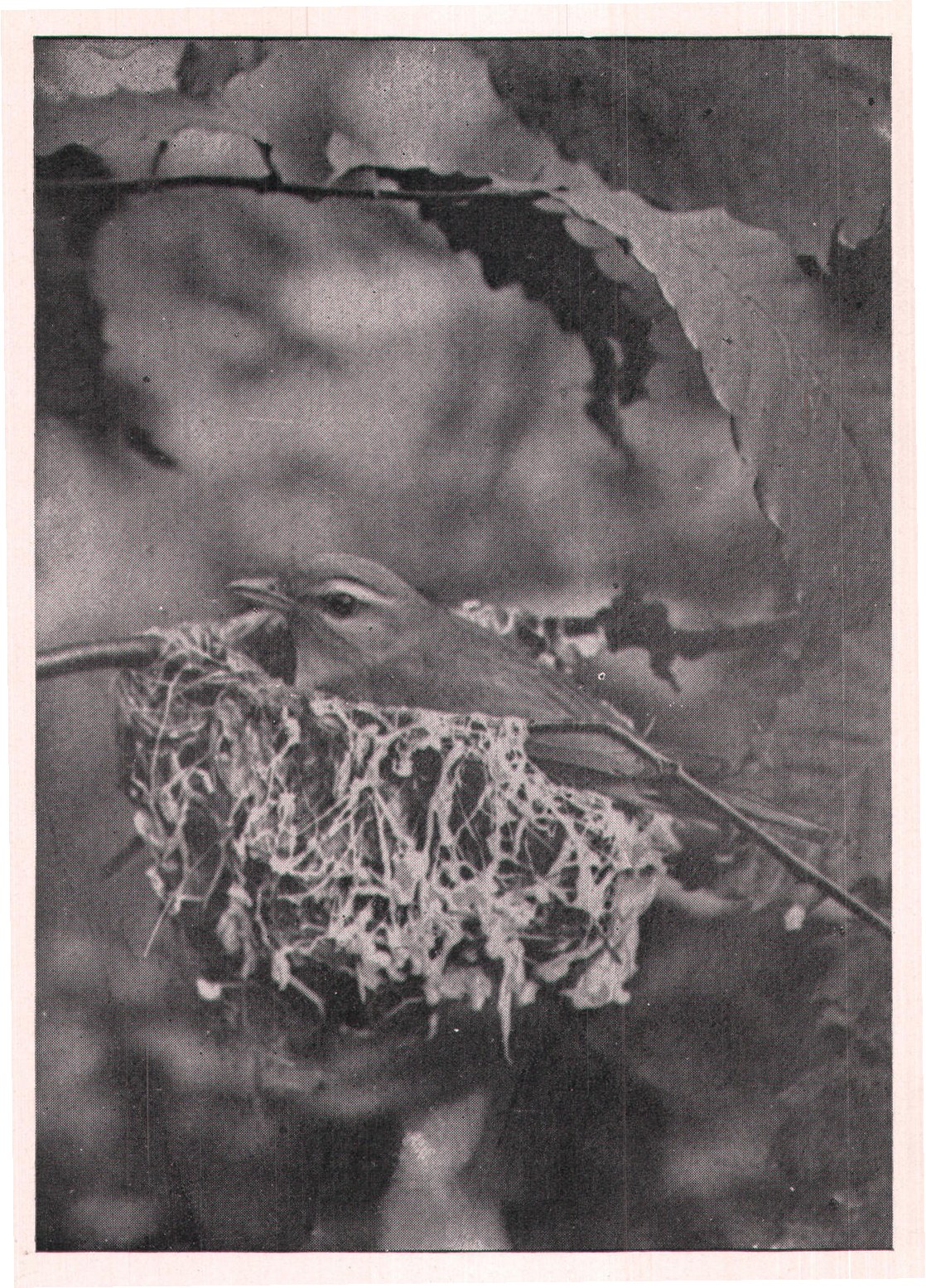
No'e that the rim of the basket is low on the right side so that the bird can sit comfortably. tent was the nest of an Ovenbird, containing four eggs. These last birds did not get used to me for a long time and scolded a great deal. I imagine that some chipmunks living in a stump a short distance away could have thrown some light on the disappearance of the Ovenbird eggs, that took place before I made a second visit.
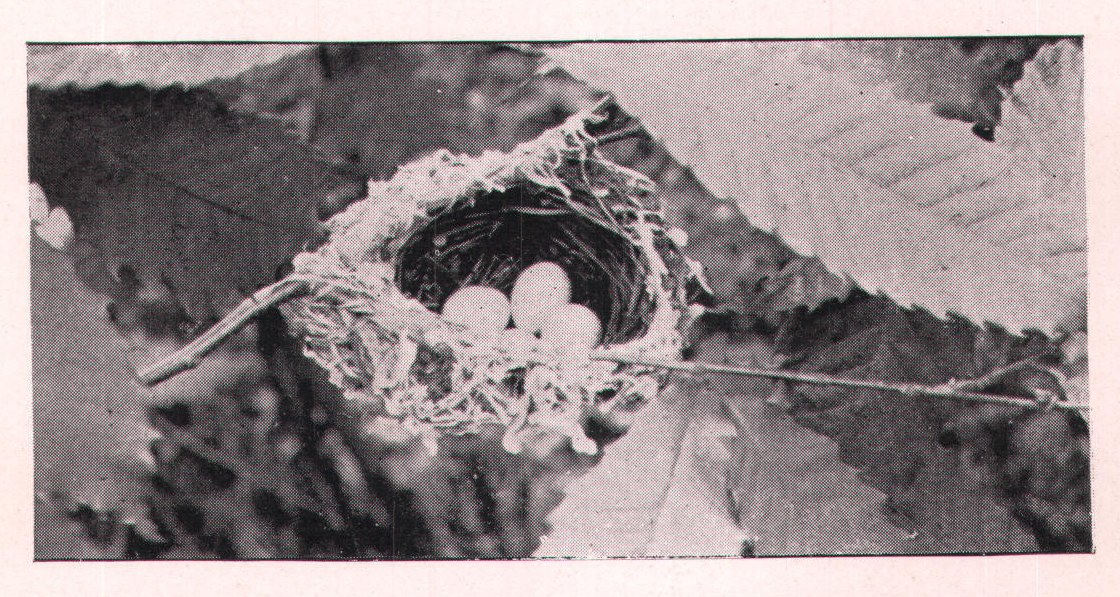
A little farther off, out of sight but still within stone's throw, were nests of Wood Thrush, Catbird, Thrasher, Towhee, Veery, Prairie and Chestnut-sided Warblers and Indigo Bunting. But let us return to the vireo nest. When I found it, the nest contained four eggs that were evidently well incubated, for the vireo was sitting very closely. This nest was very strongly built of strips of bark, plant fibres and grasses woven into a compact basket that swung from a crotch of a young chestnut shoot. The side opposite the crotch was lower than the others, allowing the vireo to sit in a comfortable position instead of doubled up as is the bird on the other nest shown. But one picture was taken on the day the nest was found, the one showing the four eggs. Three days later the eggs had hatched.
On the morning that the little birds were five days old, we again visited the nest carrying camera and tent. As we approached, we saw that the mother bird was brooding her young and that her mate was standing on the edge of the nest beside her. At no time while we had the camera in position did both birds come to the nest at the same time, although frequently one stood just out of range while its mate was busy feeding the babies.
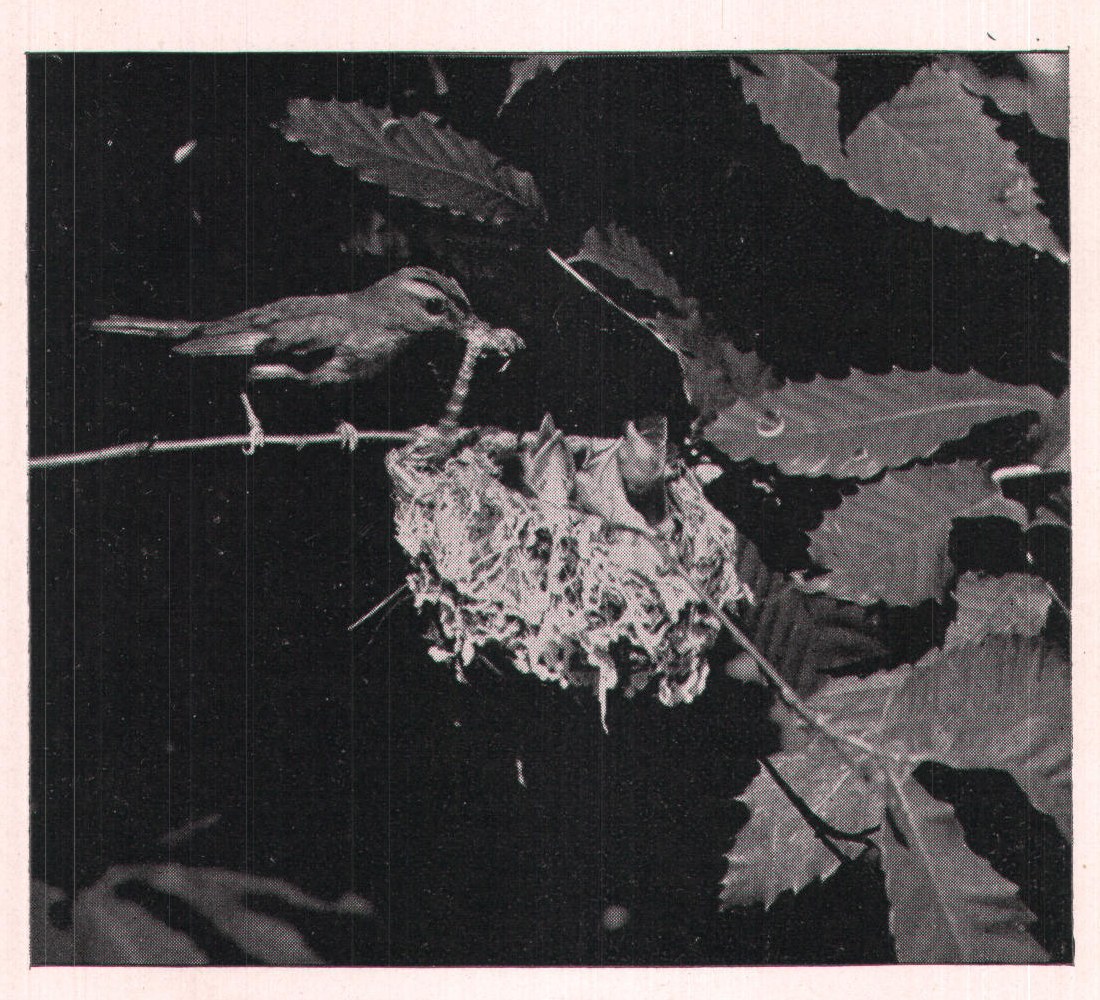
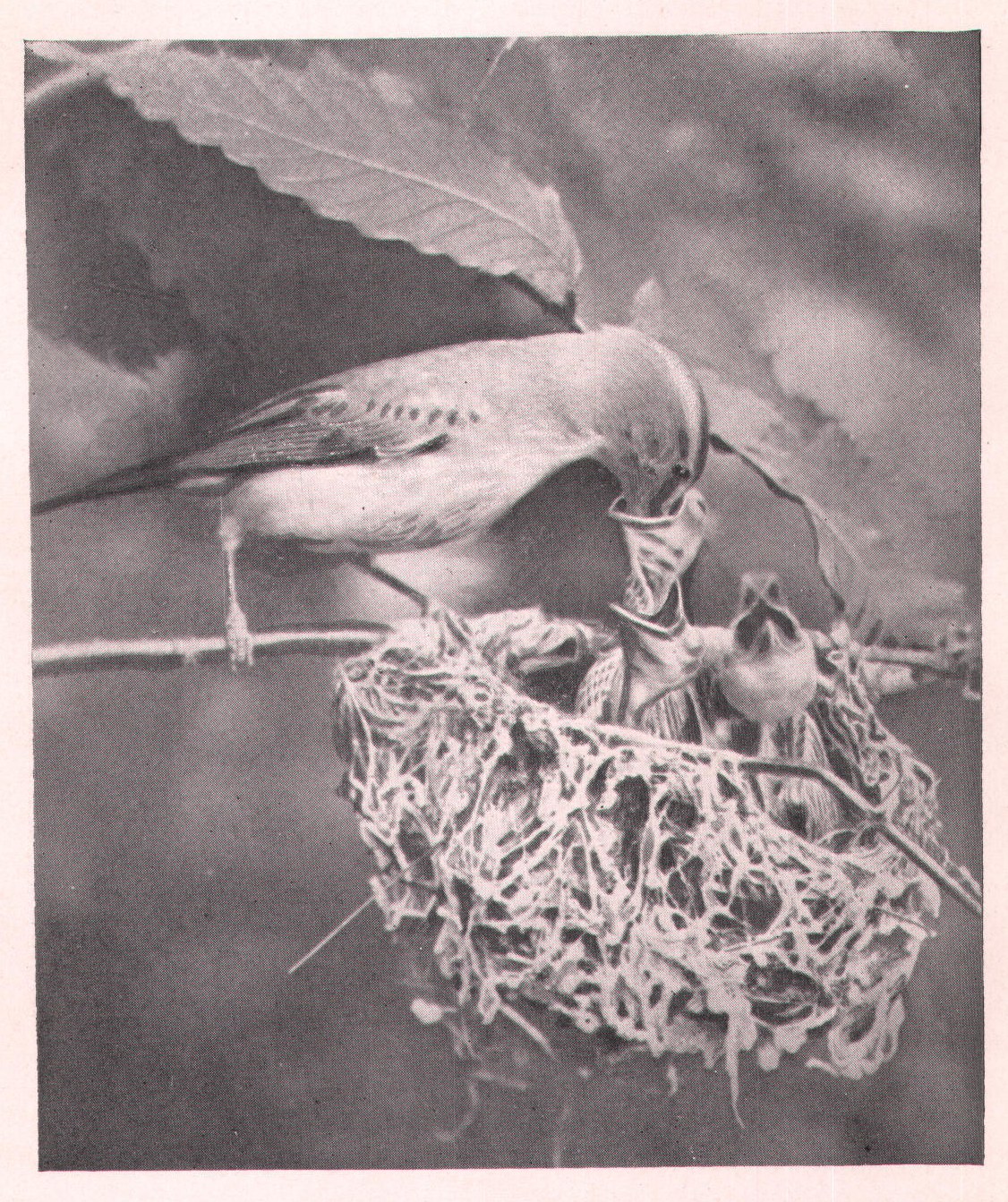
The young were fed with clock-like precision beginning within ten minutes from the time the tent was set up. The longest period of waiting between visits was ten minutes and the shortest, two minutes. They were fed chiefly upon various worms and caterpillars, with an occasional dragonfly or moth. The picture showing the male vireo with his bill thrust down the throat of one little fellow illustrates a number of interesting points. First:- Birds do not simply drop food into the mouths of their little ones but thrust it far down the throat. Second: - Notice that the head of the one being fed is raised higher than the others. The more hungry a little bird is, the higher it will reach, a fact that insures their being fed in rotation. The little fellow Fig. 161.. On one occasion the male brought a large dragonfly, carefully dirested of wings and all but one leg. in front is much smaller and a day or two younger than the other two (the fourth egg did not hatch), but when the next morsel was brought his wide-open, appealing mouth was raised above that of his brothers and sisters. Third:- Notice the motion of the head of the young bird on the Fig. 162. Food is thrust well down the throats of the little ones. right. In this case the whole head, as shown by the lower mandible, was oscillating about the upper mandible as an axis. It is this rapid motion of little birds that spoils many a photograph.
On one occasion, the male vireo brought a large dragon- Fig. 163 He moved too quickly for the camera shutter this time . fly which he carefully prepared for nestling-food by divesting it of wings and all but one leg. He then walked along the branch and thrust it headfirst down the throat of one of his children, leaving fully an inch of the body sticking out of the little fellows mouth. I had supposed that he would surely divide the fly into a portion for each and was greatly astonished to see him feed such a large morsel to such a small bird. The contortions of the little fellow, as he slowly but surely swallowed the dragonfly, were painful to watch; it took about four minutes for it to entirely disappear from view. For fifteen minutes this little bird lay quietly in the bottom of the nest, at the end of which time he again bobbed up, as hungry as ever.
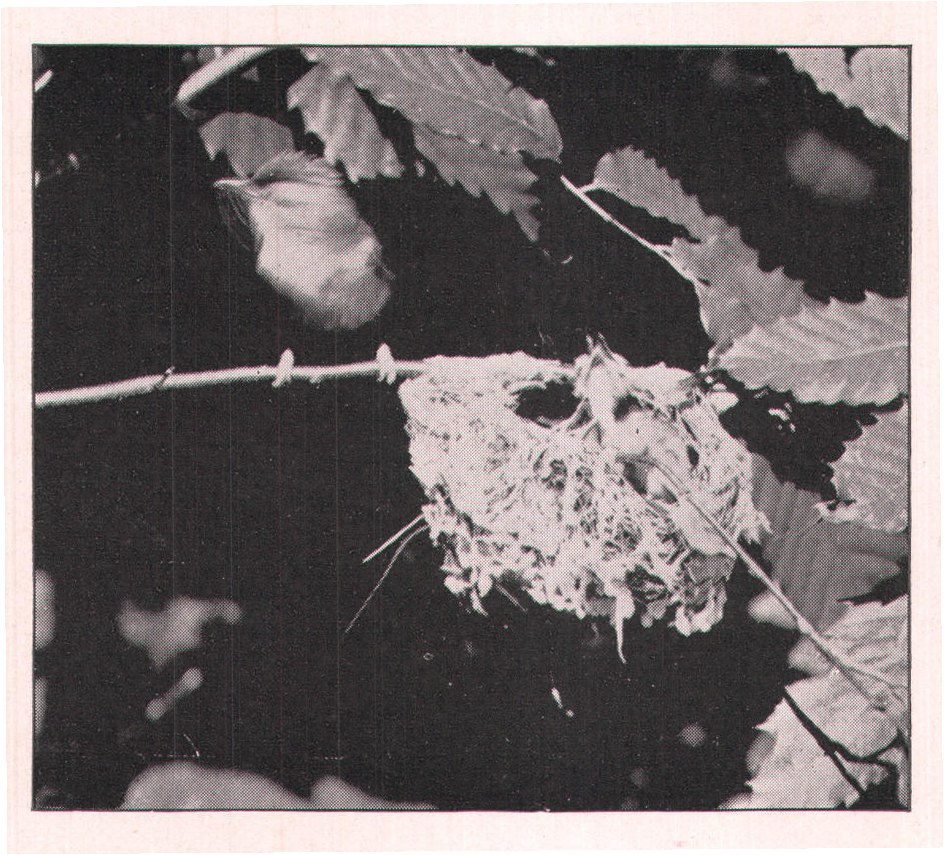
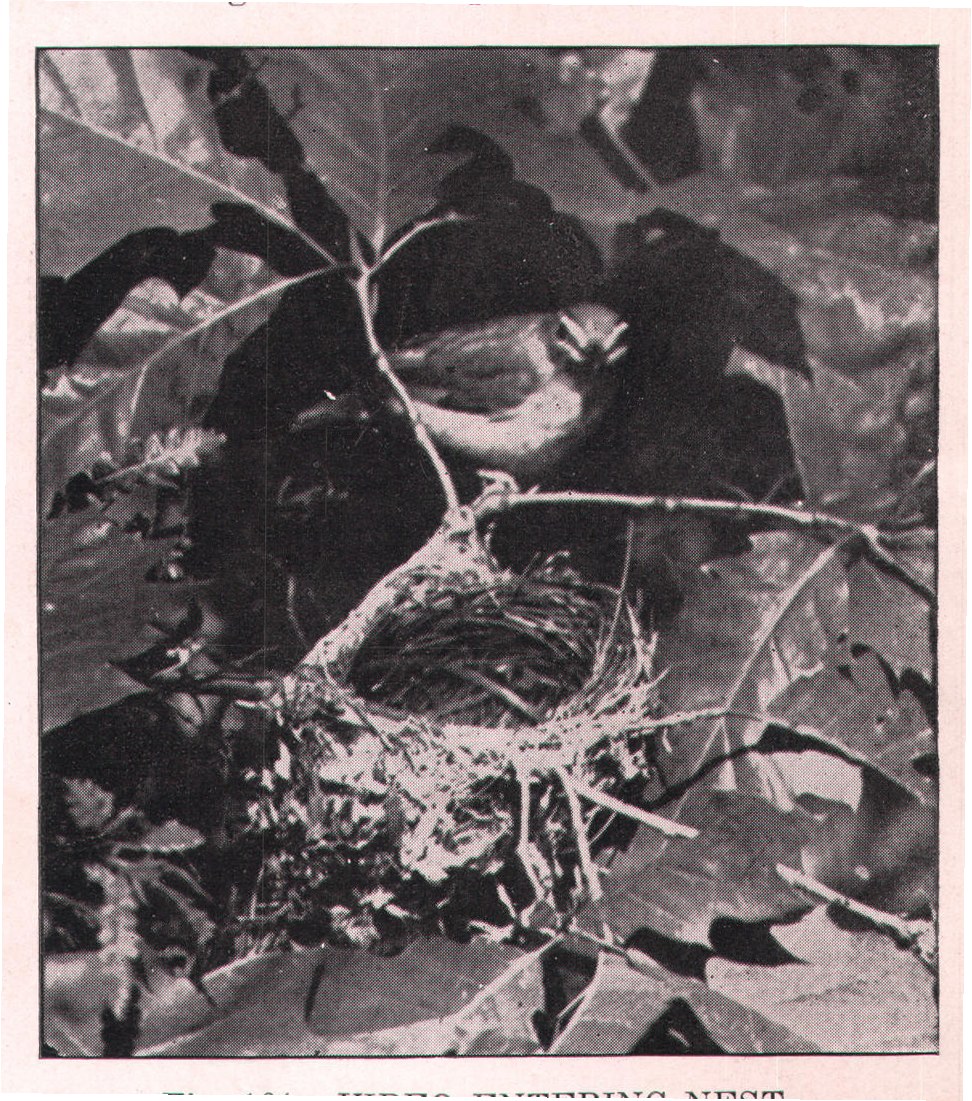
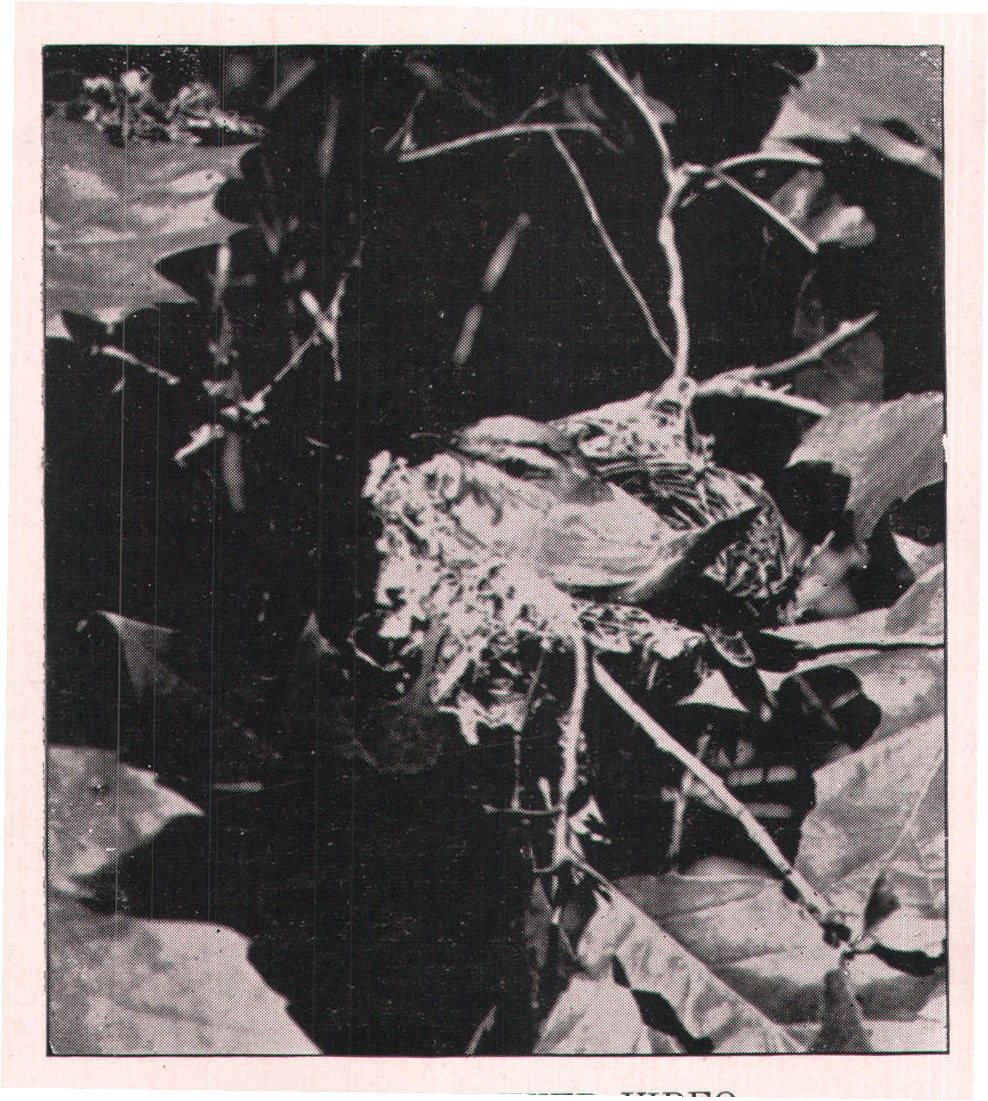
I show two views of another nest located in a little oak. This nest is of the ordinary type, with a high rim all around so that the sitting bird has to have her tail erect. The black-bordered superciliary and maxillary lines on the bird entering the nest from the rear, give its face a very peculiar appearance, almost as though it were equipped with automobile goggles. This last nest was in a very ill-chosen location. When these pictures were made, at which time the nest contained eggs, the bottom of the structure was less than six inches from the ground. By the time the eggs had hatched and the young were a week old, the nest touched the ground. Two days later it was empty; some marauding animal had made away with the little birds and perhaps captured the mother too, for I did not see her again although the male was in the neighborhood for several weeks.