Home › Contents › Belted Kingfisher
Belted Kingfisher
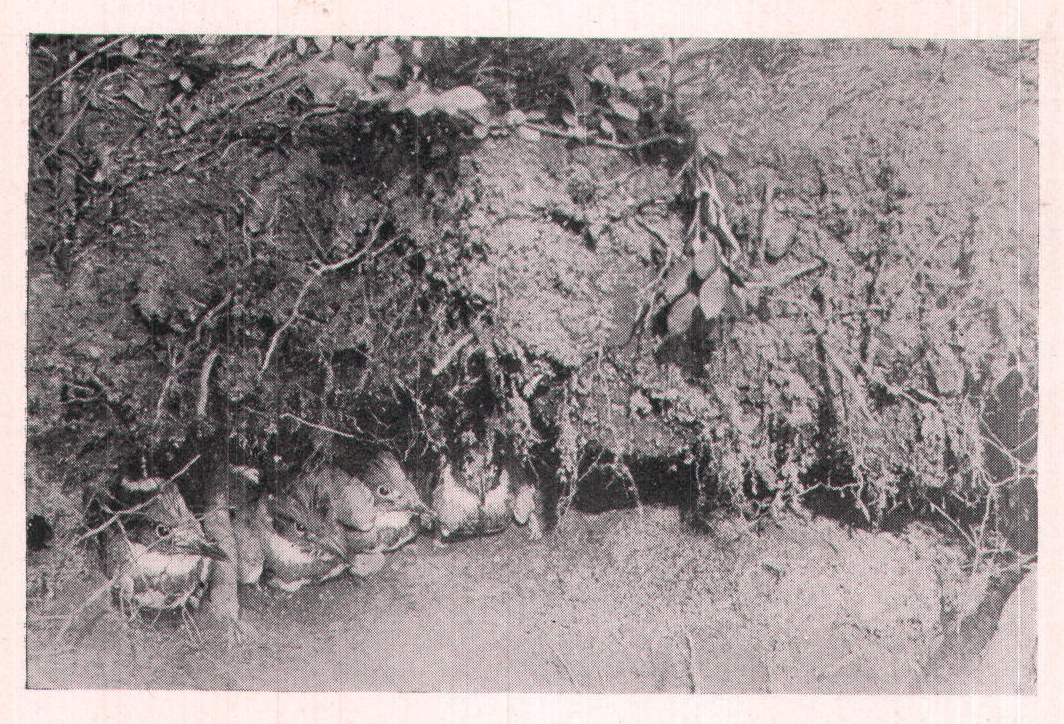
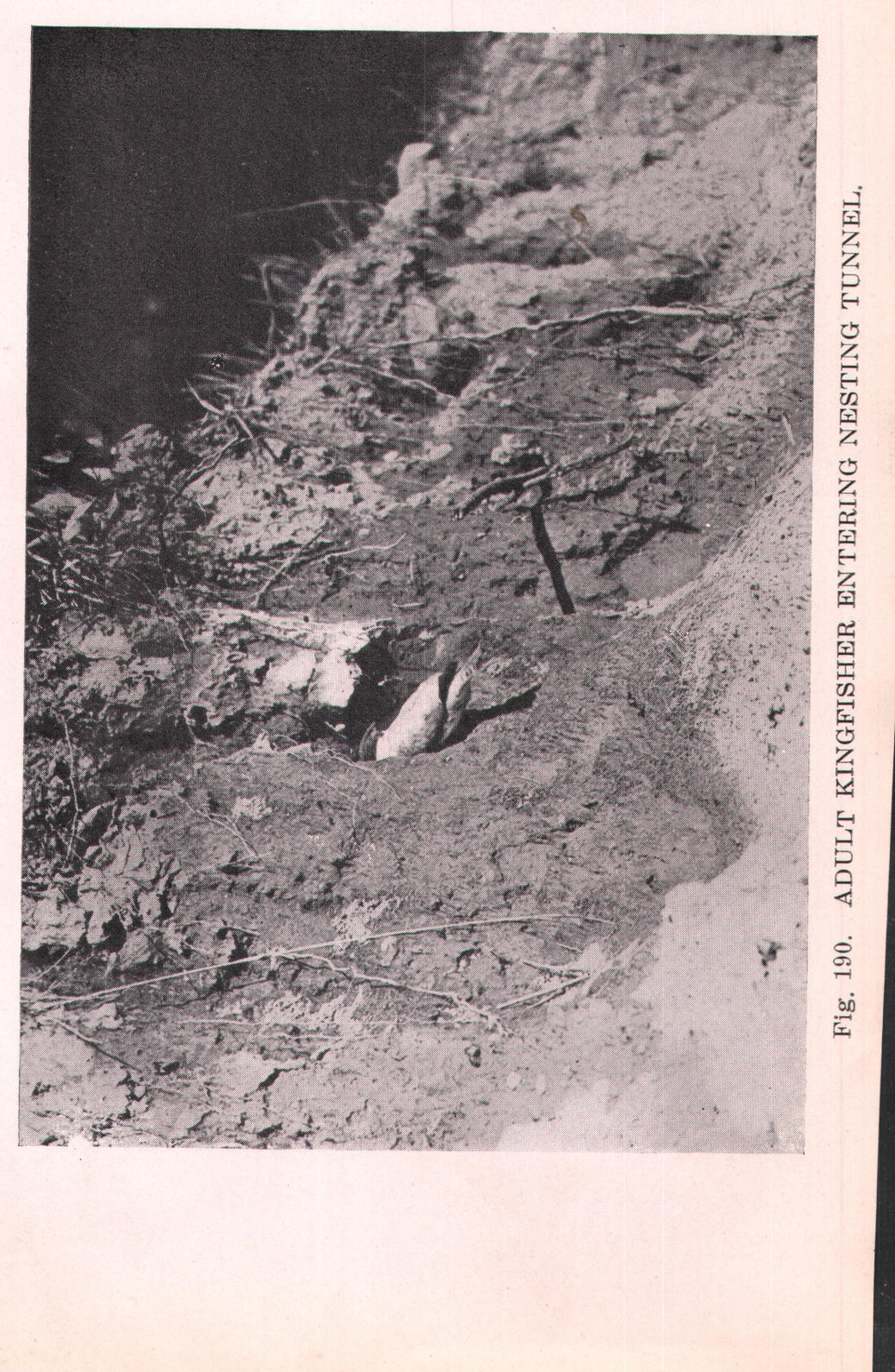
One June day, a friend, while roaming about on the edge of some woods, suddenly felt the earth giving way beneath his feet and sprang to one side just in time, as he soon discovered, to avoid crushing a family of young kingfishers. Probably the old birds had misjudged the thickness of the earth and made the roof of their house too high, for examination showed that less than half an inch of earth separated the chamber from the outer world. My friend was very enthusiastic in his description of how handsome the little fellows were and it took little urging to induce me to accompany him to the scene the next day. I found that he had repaired the break in their home by placing a large flat stone over it, so that the place was much more secure than before it had been broken into. The entrance to the home, that is the proper one, was located in the side of a gravel pit about six feet from the chamber where the little kingfishers lay. We decided, before opening the nest again, to try and get a few views of the adult entering; as there were several roots projecting from the earth within a few inches of the opening, I expected that the birds would alight on one of these before entering. The camera was placed on a rock five feet from the opening, and carefully covered; the shutter was to be operated with a thread running to a clump of bushes about twenty yards distant. A few minutes after we had comfortably seated oureslves in our ambush, a warning rattle was heard from the bed of the brook, to be repeated a moment later from close at hand. Guided by the sound, we soon located the mother kingfisher perched on the lower limb of an oak and, as we had expected, she held a small fish in her beak. She had not seen us come and was apparently very much surprised to find a new, curious, bulky object (the camera) so near her home. Surely this had not been there when she came last. She watched it long and very closely, nervously flirting her tail just as sandpipers are wont to do. At least once she changed the position of the fish she carried by tossing it a few inches in the air and catching it again. Having satisfied herself that the camera was not alive, after a great deal of scolding, she flew directly to the entrance Fig. 191. The bank cut away to show the little "fishers" at the end of the tunnel. to her home; greatly to my surprise, she alighted neither on the roots nor on the edge of the hole, but seemed to dash right in without a pause. Her departure was almost as rapid; she backed out the length of the tunnel and, just as her tail appeared at the opening, whirled about and was off in a flash.
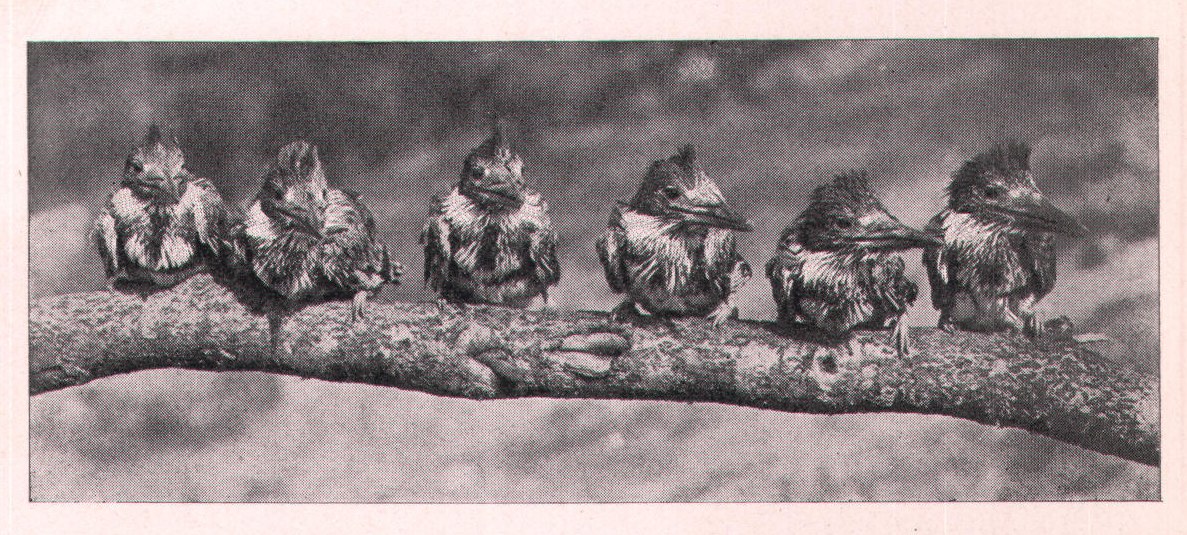
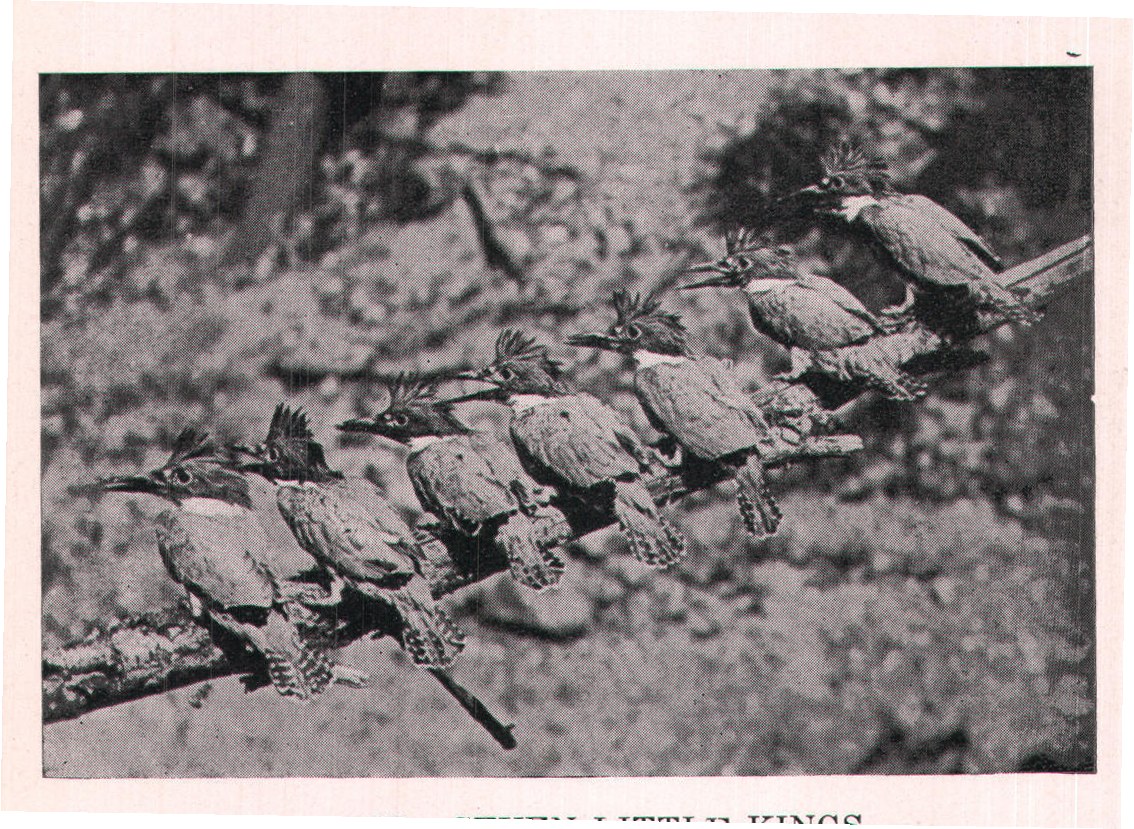
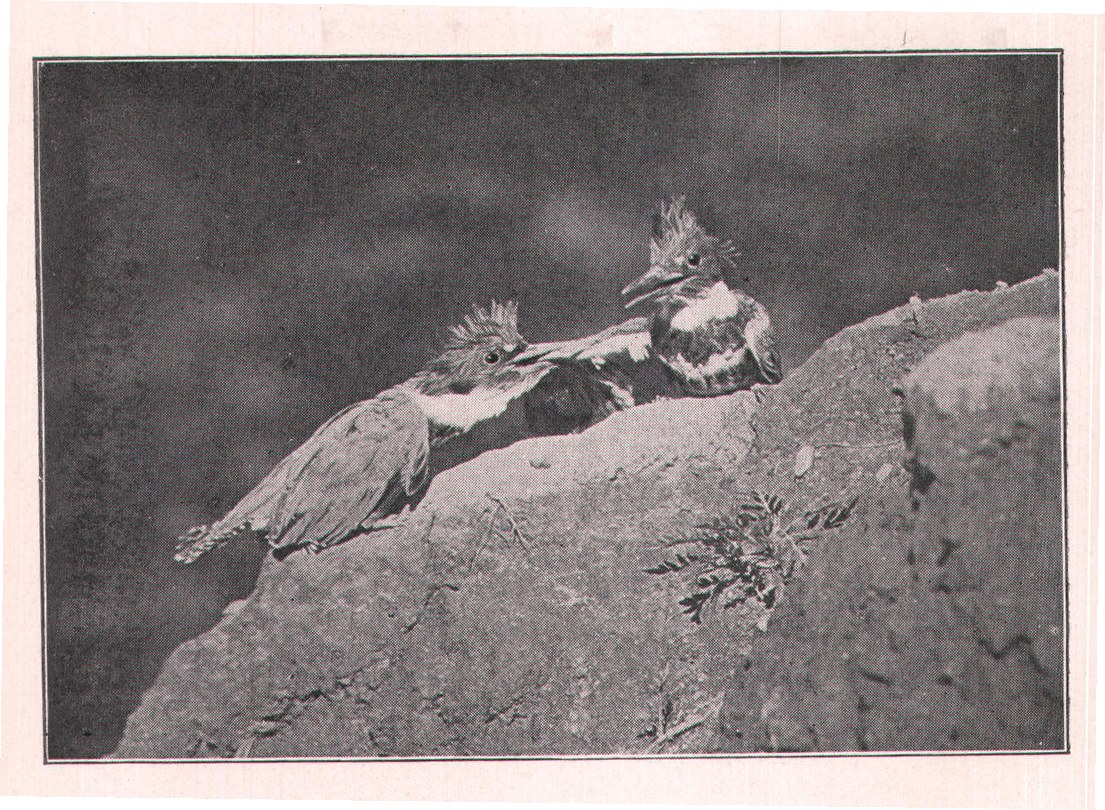
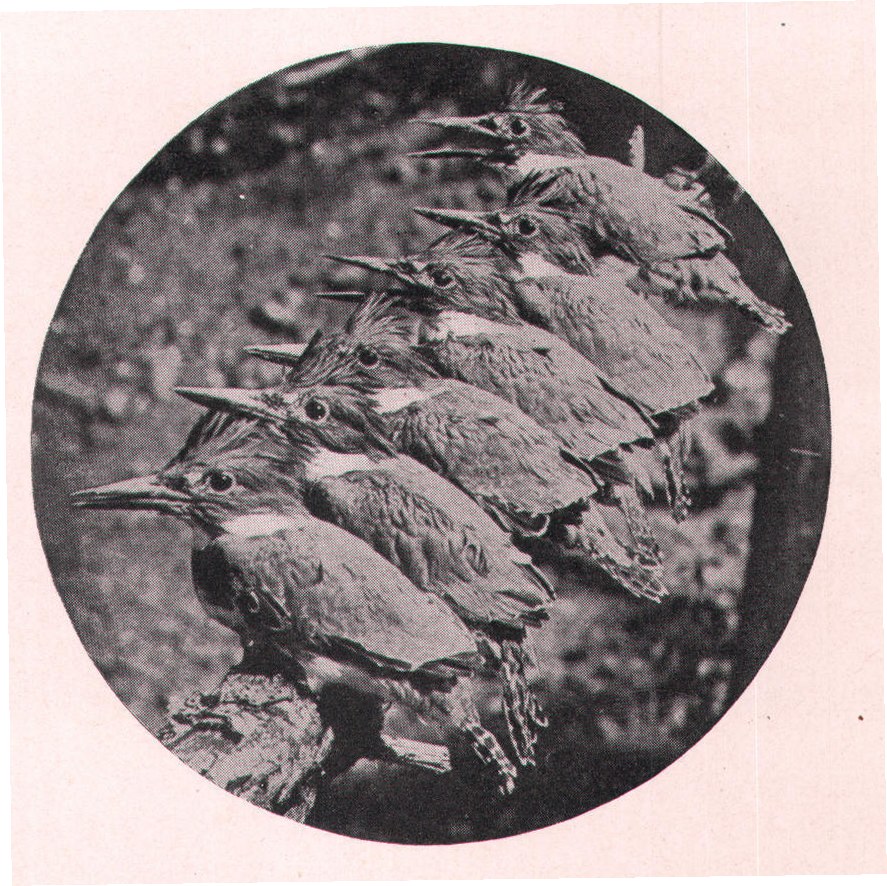
During half a dozen visits that she made, she entered and left in the same manner; as I was not prepared to make moving pictures, the best I could do was to "get her" backing out, just as she started to turn about. The bird shown in one of the illustrations, with a mullet in its bill, was more considerate for she lit on a stick thrust into the bank for that purpose and allowed Mr. R. H. Beebe to take several pictures of her. Young kingfishers are very comical birds both in appearance and in actions. At an early age, they are entirely cov- Fig. 192. Little Kingfishers are very "spiney" or pin-feathery during the early stages of their life. ered with coarse pin-feathers, giving them a bristly appearance like little porcupines. They remain in the nest about three weeks at the end of which time they closely resemble their parents in plumage. Although six or seven of them have to occupy rather cramped quarters in their home, it does not seem to develop brotherly love to any great extent. They always seem to be biting at one another. On one occasion when I had seven of them side by side on a rail, a youngster on one end grabbed the fellow next to him by the wing; this one seized the next and so on along the whole row, the seven of them finally going to the ground in a connected tangle. Undoubtedly, their rough actions hasten their development by bursting the casing of the pin-feathers sooner than they would unaided, and it may be that this is the purpose of their roughness.
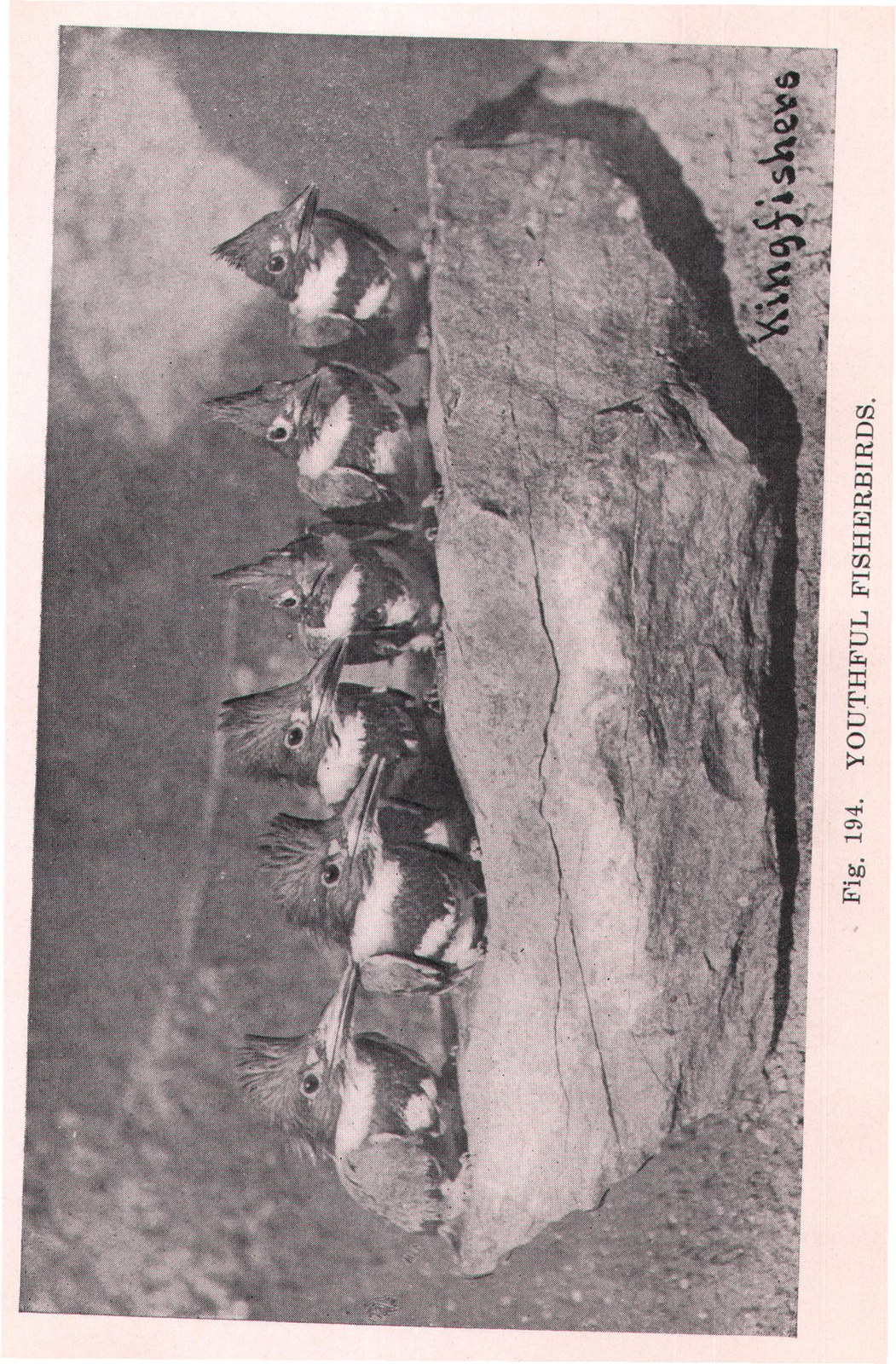
The tunnel that leads to the nest is just large enough for one bird and gives him no room to turn around. When the young get so they can walk, even though clumsily, they often meet their parent at the door way, at least one does, with the others crowding in a line behind. Before feeding even the first one, the parent will usually force them all back into the enlarged chamber. This walking in single file, usually in step, forward and backward often gets them into the habit of moving in unison when they are removed from the nest. It is a most comical sight to see seven, frizzly-headed birds deliberately take three or four steps forward, backward or sidewise, as the case may be, in Kingfishers Fig. 195. They often grabbed and bit at one another. perfect lock step as though controlled by one mind or master.
Little kingfishers do not seem to know fear until after they have made their first flight. Housed in as they are, they have no chance to see what goes on in the outer world and, if a man happens along, takes them out of their nest and groups them on a rock or branch, they take it just as a matter of course, as though it were something that ought to happen. After they have made their maiden flight, however. they object to being handled and will sometimes bite savagely. Their parents feed them for more than a week after they leave the nest, but all the time their wings are getting stronger and stronger so that soon they can hover over the water and pounce on little fish, just as their parents do. The food of kingfishers consists wholly of small fish up to four inches in length. They are very persistent in their fishing, as much so as the man that often sits with his line dangling in the water for several hours without getting a bite. I once watched one of these birds, that happened to be perched where I could see it from my blind as I was taking pictures at a Vireo nest, and for two hours it sat perfectly still, watching the water below it, before it got a chance to plunge and then it missed the fish. However, they make a very fair percentage of successful strikes, always catching their prey between the opened mandibles.