Home › The Eight Specimens › The Eight Specimens
The Eight Specimens
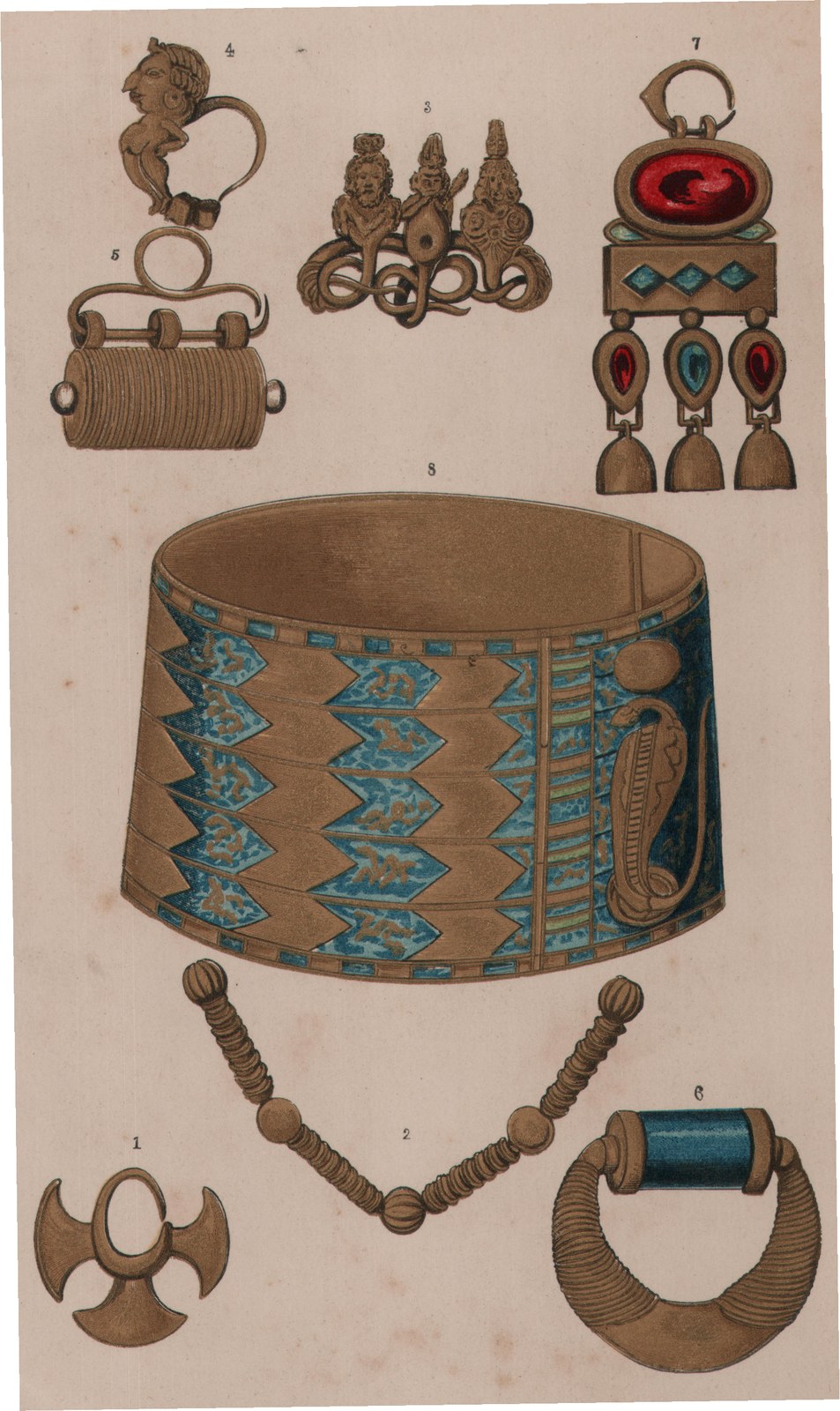
The same antiquity cannot be claimed for the specimens chosen for illustration as for the relics of Queen Aah-hept; but the most recent example is of about the year B.c. 300. The Assyrian earrings, Nos. 1 and 5, are from Kouyunjik (Nineveh), of about 700 years before Christ. The necklace, No. 2, and the earrings, Nos. 4 and 7, are from Babylon, of probably a somewhat later date. The ring, No. 3, representing the figures of Serapis, Isis, and Horus, is of the Ptolemaic period, about B.c. 300 years. The bracelet, No. 8, is inscribed with the name of Namrut (Nimrod), an Egyptian prince of the twenty-second dynasty, from Sais, and therefore dates from about 500 years before Christ. The numbering has been arranged on the principle of taking the most simple forms and workmanship first, having some regard also to age.
The earring, No. 1, although not actually existing as a gold specimen, is found so repeatedly on the colossal bas-reliefs of the Nimrod collection, that it may be taken as a very common type of ornament, and although certainly elegant in form, is of very simple construction. It may have been cast solid, or struck with a punch in two pieces, and soldered together. It is scarcely probable that it was cast solid, as in that case its excessive weight would render it painful and even unsafe to wear. That the Assyrians certainly, and probably the Egyptians also, were in the habit of casting ornaments in metal, we have distinct evidence in the ring moulds discovered by Mr. Layard, and exhibited in the Nineveh collection. Not only have we there a mould for casting rings-not a mould of sand, as used in modern times, but of some chalky or clayey substance, in which the subject is cut in both halves of the mould, with a proper gate wherein to pour the melted metal, and radiating lines to admit of the escape of the air-but also small bells and weights, on which the distinct ridge left by the juncture of the mould is still visible. But even for so rude a piece of jewelry as a cast earring, some mechanical appliances are necessary beyond the mould and the metal. Some sort of furnace must have been erected, with probably wood for fuel, and an inflated pig-skin for a bellows. The workman must also have had crucibles, and some kind of iron pincers to lift his gold out of the fire.
But it is more probable that the earring in question was hollow-struck by means of a punch in two halves, and soldered together. This is undoubtedly the method pursued in the manufacture of the chain, No. 2; and adopting this conclusion, we must pre-suppose the carving or moulding of iron or bronze punches, and the knowledge of the several delicate operations which go to complete a soldered juncture of metals. We have no difficulty in determining the fact of the use of carved punches in the manufacture of jewelry, for there are abundant evidences of it in the necklaces and other ornaments which are exhibited in the British Museum. One necklace of shells and cornucopiæ, placed alternately, is especially remarkable. It is of silver, and each kind of ornament is so exactly similar, that they must necessarily have been struck off the same punch. A bead necklace offers the same evidence; and it is not at all improbable that many of the aphes, cobras, scarabæi, and other symbolical ornaments which we find embedded in opaque glass, were struck from carved punches out of thin gold plate. The question then arises, how were these punches made? Were they also cast in moulds, say in bronze? Or were they forged, and worked up by file and graver into the required form? We have no evidence of the existence of a file at this period; and a file, besides that it must be of steel to be of any service, even upon bronze, is a really artistic production. There is no proof that steel was known at so remote a date, and the probabilities are against such a supposition. Cast iron is a modern invention; and regarding the matter from all sides, one is almost forced to the conclusion that these punches were cast in bronze, and finished for use by such cutting gravers or other tools as sharpened iron would furnish. The suggestion that these exactly similar ornaments might have been struck in dies offers many difficulties, for a die is an implement of manufacture much more difficult of production than a hand-punch.